Lecture | Jeffrey Collins at University of Bern’s ‘Interior’ Series
Jeffrey Collins offers the second in a three-part lectures series at the University of Bern’s 2012-13 lecture series:
Lecture Series: The Interior
University of Bern/Switzerland, 2012-13
This lecture series is part of the SNSF Sinergia project The Interior: Art, Space, and Performance (Early Modern to Postmodern) which is based at the Institute of Art History, University of Bern, and is conducted in cooperation with the Institute of Media Culture and Theatre, University of Cologne. Proceeding from a heterogeneous and dynamic conception of the interior drawn from various media, styles, and contexts, this interdisciplinary project investigates diverse theoretical and interpretative models of interiors in art, theatre, and visual culture from the Early Modern to the Contemporary eras.
12 December 2012
‘Interior Designs: Imagining the Museum in Eighteenth-Century Italy’
Jeffrey L. Collins, (Bard Graduate Center: Decorative Arts, Design History, Material Culture, New York)
More information is available at the project website»
Seminar Series | Gobelins Seminars, 2012-2013
As noted at Le Blog de l’ApAhAu:
Rencontres des Gobelins
Galerie des Gobelins, Paris, 2012-2013
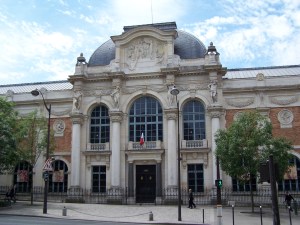
Manufacture des Gobelins, Paris (Wikimedia Commons)
Les Rencontres des Gobelins constituent des rendez-vous hebdomadaires qui invitent un large public à partager les connaissances actuelles de l’histoire et des activités du Mobilier national et des manufactures nationales (tapisseries des Gobelins et de Beauvais, tapis de la Savonnerie et dentelles du Puy et d’Alençon).
Pour cette année, trois axes sont explorés : une pratique de l’art contemporain (l’art textile), une question esthétique (le décoratif) et un métier de la décoration (l’art du tapissier).
◊ ◊ ◊ ◊ ◊
Selected offerings addressing the late seventeenth and eighteenth centuries (please see the full listing at Le Blog de l’ApAhAu)
Mardi, 4 décembre : La mode des intérieurs au XVIIe siècle
• Nicolas Courtin (Commission du Vieux Paris) — L’activité des tapissiers au travers des inventaires des hôtels particuliers parisiens du XVIIe siècle
• Annabel Westman (chercheur indépendant) — Les tapissiers français à la cour du Roi d’Angleterre à la fin du XVIIesiècle
Mardi, 15 janvier : Le marché des étoffes (XVIIIe siècle – 1)
• Natacha Coquery (Université Lumière Lyon 2) — L’art du tapissier à Paris au XVIIIe siècle : de la réparation à l’innovation
• Richard Cartigny (Collège Anceau de Garlande, Roissy-en-Brie) — Les fournisseurs des tapissiers parisiens au XVIIIe siècle : entre proximité spatiale et professionnelle
Mardi, 22 janvier : Le décoratif et les arts du décor : matériaux et esthétique
• Sophie Mouquin (École du Louvre/Université Lille 3) — Marbres et bois : matières du décor au XVIIIe siècle
• Charlotte Guichard (CNRS/Université Lille 3) — Arts et sciences : dispositifs matériels, esthétiques et savants dans les collections du XVIIIe siècle
Un programme de recherche
L’histoire des Garde-Meubles en Europe(XVIe-XIXesiècle)
Mise en place d’un programme de recherche sur plusieurs années visant à écrire l’histoire des Garde-Meubles dans les cours européennes de la Renaissance au XIXe siècle.
Seminar Series | Eighteenth-Century Studies at Queen Mary University
From the QM Centre for Eighteenth-Century Studies:
Eighteenth-Century Studies Seminar Series, 2012-2013
Queen Mary University of London
All are welcome to attend this year’s Eighteenth-Century Studies Seminars at Queen Mary University of London. Sessions meet on Wednesdays from 5:00 to 7:00 pm in the Seminar Room, Lock-Keepers Cottage Graduate Centre, Queen Mary University of London, Mile End, London. For updates and more information, see our website.
◊ ◊ ◊ ◊ ◊
10 October 2012
Charles Saumarez-Smith (Royal Academy) with Mark Hallett (Paul Mellon Centre for Studies in British Art)
‘The Company of Artists’: On the Origins of the Royal Academy of Arts
21 November 2012
Charles Walton (Yale)
The Fall from Eden: The Free-Trade Origins of the French Revolution
30 January 2013
Malcolm Baker (U California Riverside)
Celebrating the Illustrious: Roubiliac, Newton, Handel and Pope
13 February 2013
John Barrell (Queen Mary)
‘I know where that is’: The Place of Edward Pugh
27 February 2013
Naomi Tadmor (Lancaster)
The Nuclear Hardship Hypothesis: An Eighteenth-Century Case Study
13 March 2013
Tony LaVopa (North Carolina)
David Hume in Paris: Reading a Friendship
27 March 2013
Susan Manning (Edinburgh)
Becoming a Character
◊ ◊ ◊ ◊ ◊
Convenors: Markman Ellis, English (m.ellis@qmul.ac.uk); Colin Jones, History (c.d.h.jones@qmul.ac.uk); Miles Ogborn, Geography (m.j.ogborn@qmul.ac.uk); Barbara Taylor (English and History); and Amanda Vickery, History (a.vickery@qmul.ac.uk).
Travel instructions: Central Line or District Line to Mile End. Exit tube station, turn left down Mile End Road, cross Burdett Road, go under the Mile End Green Bridge (a large yellow bridge), over the canal, and the college is on the left. Enter East Gate, and the Lock-Keepers Cottage is the second building on the right.
Showcasing Versaille’s Image Bank
As Hélène Bremer notes, the CRCV Image Bank will be of interest to many Enfilade readers, and perhaps some of you will even make it to Thursday’s event showcasing the collection. From the Centre de recherche du château de Versailles:
Patrimoine écrit et numérique avec Raphaël Masson, Isabelle Pluvieux, et Elisabeth Maisonnier
L’Atelier numérique, Versailles, 11 October 2012

Singe. Aquarelle extraite du Livre des oiseaux de la Ménagerie de Versailles, 1710 (MS F 930, folio 7). © Bib. Municipale de Versailles
Depuis 2005, le Centre de recherche du château de Versailles et la Bibliothèque municipale se sont engagés dans un partenariat visant à numériser les ressources concernant le château et la vie à la cour aux XVII et XVIIIe siècles ; au cours de deux campagnes successives de numérisation, ce sont près de 16 300 pages ou images qui ont été numérisées provenant des collections de la Bibliothèque (manuscrits, estampes et imprimés), complétant ainsi les 26 000 images issues des collections iconographiques ou des archives du château de Versailles.
Cette immense base de données permet de découvrir des images différentes et singulières du château de Versailles, de ses jardins, des fêtes, des personnages qui s’y côtoyaient… Quelques thèmes y sont plus particulièrement développés : la vie à la cour, les fêtes, le costume… On y trouve aussi bien des estampes, des dessins, des manuscrits que des plans, des documents d’archives ou des périodiques. On peut ainsi y découvrir les plus belles images du Carrousel de Louis XIV, l’un des plus magnifiques livres de fêtes jamais réalisé, que feuilleter l’un des Almanachs de Versailles, ces petits vade-mecum annuels où l’éditeur Blaizot résumait tout ce qu’il fallait savoir de la vie à Versailles, à la cour ou à la ville, à la fin de l’Ancien Régime. La banque d’images mise en œuvre par le CRCV est ainsi un outil précieux pour l’historien, l’éditeur, l’amateur ou le simple curieux.
◊ ◊ ◊ ◊ ◊
Soirée — Patrimoine écrit et numérique
Présentation des fonds numérisés de la Bibliothèque municipale de Versailles présents dans la banque d’images du Centre de recherche du château de Versailles avec :
• Raphaël MASSON, conservateur du patrimoine et adjoint au directeur du Centre de recherche du château de Versailles,
• Élisabeth MAISONNIER, conservateur en charge du pôle patrimoine de la Bibliothèque municipale de Versailles,
• Isabelle PLUVIEUX, responsable des sites web et des bases de données du Centre de recherche du château de Versailles.
Jeudi 11 octobre 2012 à 19 heures
Atelier numérique, 8, rue Saint Simon – 78 000 Versailles
Tél. : 01 39 24 19 85 – clotilde.despres@versailles.fr
Entrée libre dans la limite des places disponibles
Exhibition | Napoléon and the Art of Propaganda
From the UIMA:
Napoléon and the Art of Propaganda: Art from the Collection of Pierre-Jean Chalençon
University of Iowa Museum of Art, Iowa City, 13 September 2012 — 29 January 2013
Curated by Heidi Kraus and Sean O’Harrow, with Dorothy Johnson
The masses… must be guided without their knowing it.
— Napoléon I to Joseph Fouché, his minister of police
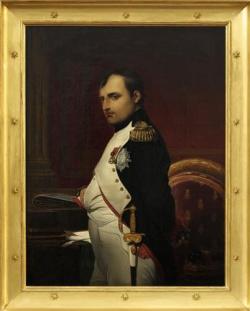
Hippolyte (Paul) Delaroche, Portrait of Emperor Napoleon the First in his Office,
(Collection of Pierre-Jean Chalençon)
From approximately 1800-1815, Napoléon Bonaparte used official propaganda to control artistic autonomy and manipulate public perceptions of his regime both in France and throughout Europe. As a result, government-sponsored art created during the Consulate and Empire is frequently dismissed by art historians as lacking in experimentation, complexity, and beauty. In this extraordinary traveling exhibition, Napoléon and the Art of Propaganda, the aesthetic value and social history of so-called ‘propagandistic art’ created during the First Empire is critically re-examined through the use of visual display, close analysis, and scholarly research. Despite strict censorship laws and a dictatorial arts administration, this exhibition demonstrates that many artists working in the service of Napoléon were deeply inspired by and passionately engaged with their prescribed ‘official’ subjects. Less of a literal presentation, this aesthetic cornucopia shows off the stunning visual aspects of this luxurious Age of Empire.
Napoléon and the Art of Propaganda is a visual chronology of more than 120 drawings, prints, paintings, works of sculpture, manuscripts, medals, and objets d’art from the remarkable private Parisian collection of Pierre-Jean Chalençon. This exhibition considers the full range of official art created under Napoléon I and emphasizes the aesthetic qualities of the period. Some of the most important artists, architects, and sculptors are included, such as Jacques-Louis David, Andrea Appiani, Anne-Louis Girodet, François Gérard, Charles Percier, and Pierre-François-Léonard Fontaine. The selected works display the visual power of the Napoléonic propaganda ‘machine’ and its scope of influence both politically and artistically; illustrate how Napoléon, his ministers, and artists fabricated and produced an imperial iconography; and provide the viewer with an understanding through the use of images of the legend or myth of Napoléon that persisted after his death in exile.
◊ ◊ ◊ ◊ ◊
An exciting array of city-wide programs has been planned to complement the exhibition: lectures (by Bernard Chevallier, Christopher Johns, and Susan Taylor Leduc), concerts, films (Sokurov’s Hubert Robert: A Fortunate Life and Patrice Jean’s Napoléon, David Le sacre de I’image), and readings. The full schedule is available here»
Things: Material Culture at Cambridge, Michaelmas Term 2012
Programming from CRASSH at the University of Cambridge:
Things: Material Cultures of the Long Eighteen Century
Centre for Research in the Arts, Social Sciences and Humanities (CRASSH), Cambridge, ongoing series
The seminar meets alternate Tuesdays 12.30-2.30pm in the Seminar Room, Alison Richard Building, West Road. A light lunch will be provided.
 The early-modern period was the age of ‘stuff.’ Public production, collection, display and consumption of objects grew in influence, popularity, and scale. The form, function, and use of objects, ranging from scientific and musical instruments to weaponry and furnishings were influenced by distinct and changing features of the period. Early-modern knowledge was not divided into strict disciplines, in fact practice across what we now see as academic boundaries was essential to material creation. This seminar series uses an approach based on objects to encourage us to consider the unity of ideas of this period, to emphasise the lived human experience of technology and art, and the global dimension of material culture. We will build on our success discussing the long eighteenth century in 2012-13 to look at the interdisciplinary thinking through which early modern material culture was conceived, adding an attention to the question of what a ‘thing’ is, to gain new perspectives on the period through its artefacts.
Each seminar will feature two talks each considering the same type of object from different perspectives
Tuesday, 9 October 2012 – Thinking Things
Jonathan Lamb (Vanderbilt University) and Elizabeth Eger (King’s College London)
Tuesday, 23 October 2012 – Worshipping Things
Mary Laven (University of Cambridge) and Maia Jessop (University of Cambridge)
Tuesday, 6 November 2012 – Stilling Things
Hanneke Grootenboer (Oxford) and Joserra Marcaida Lopez (Cambridge)
Tuesday, 20 November 2012 – Curing Things
Simon Chaplin (Wellcome Library) and Christelle Rabier (London School of Economics)
Visit the external blog or subscribe to the group mailing list.
Exhibition | The Princely Furniture of the Roentgens
Press release (15 August 2012) for the upcoming exhibition at The Met:
Extravagant Inventions: The Princely Furniture of the Roentgens
The Metropolitan Museum of Art, New York, 30 October 2012 — 27 January 2013
Curated by Wolfram Koeppe
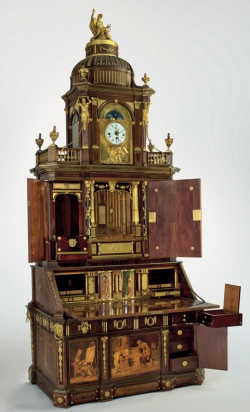
David Roentgen, Berlin Secretary Cabinet, ca. 1778–79. 11 ft. 9 in. (Kunstgewerbemuseum, Staatliche Museen zu Berlin)
Extravagant Inventions: The Princely Furniture of the Roentgens will be the first comprehensive survey of the Roentgen family’s cabinetmaking firm from 1742 to its closing in the early 1800s. Some 60 pieces of furniture, many of which have never before been lent outside Europe, and several clocks will be complemented by paintings, including portraits of the Roentgen family, and prints that depict the masterpieces of furniture in contemporary interiors. The exhibition and catalogue are made possible by the Anna-Maria and Stephen Kellen Foundation.
The meteoric rise of the workshop of Abraham Roentgen (1711-93) and his son David (1743-1807) is the most spectacular chapter in the history of innovative 18th–century Continental furniture-making. Their original designs, combined with their use of intriguing mechanical devices, revolutionized traditional French and English furniture types. From its base in Germany, the workshop served an international clientele. The Roentgens utilized a sophisticated business model, combined with intensive research on potential patrons’ personal taste and forward-looking marketing and production techniques.
In 1742 Abraham Roentgen opened a cabinetmaker’s workshop in the tiny village of Herrnhaag, in the Wetterau region near Frankfurt am Main. With only one journeyman on staff, the shop was concerned principally with the production of furniture for daily use. Abraham distinguished himself by adhering to the highest standards of quality, and soon he was producing veneered show-off pieces in the English Queen Anne style, which he had learned during his years as a journeyman in the Netherlands and England. The local nobility recognized the furnishings’ unusual appearance and quality. Abraham’s progressive designs and types, such as his fashionable tea chest and multi-functional table, were novelties in Germany and were an immediate success. Following his move to Neuwied-at-the-Rhine in 1750, Abraham took his innovative designs even further by adapting elegant French-inspired outlines that, combined with superb marquetry, fine carving, intricate gilded bronze mounts, and multiple mechanical devices, came to be recognized by contemporaries as hallmarks of the Roentgen brand. Roentgen’s playful and perfectly executed inventions became a favored status symbol in princely interiors throughout Europe.
Abraham’s son, David Roentgen, graduated quickly from his apprenticeship in his father’s workshop and eventually took over the enterprise between 1765 and 1768. He perfected the sophisticated structure and intricate marquetry designs of the furniture, and was appointed Ebéniste-Méchanicien du Roi et de la Reine at the court of Queen Marie Antoinette and King Louis XVI at Versailles in 1779. Having conquered the Western market, David revised his designs and reinvented his product line’s appearance as he looked eastward. Focusing on his new target, the Imperial residences of Catherine the Great in St. Petersburg, David Roentgen developed specific models catering to Russian taste. He caught the fancy of the Empress herself with his Apollo Desk (1783-84), which depicted her favorite dog as a gilded mount, and which David produced on pure speculation. After Catherine the Great paid a huge sum for the piece, Russian nobility hurried to catch up with its sovereign, ordering examples of ‘Neuwied Furniture’ by the dozens.
Abraham and David Roentgen’s story is a tale of international success, fame, luxury, and high honor but, in the case of David, it is also the tragedy of a deeply pious man who struggled to balance his ambitions and his glorious achievements with the regulations of his religious community, the Moravian brotherhood. At the pinnacle of David’s career, the workshop employed more than 130 specialists and the annual production amounted to that of the famous Meissen porcelain factory. His fortune shifted dramatically with the progress of the French Revolution, as Europe’s nobility struggled to stay afloat, and the market for luxurious furnishings collapsed.
Many of the works in Extravagant Inventions will be lent from distinguished international museums and royal collections. Six pieces from the Metropolitan Museum’s own collection of Roentgen furniture will be featured, in addition to two that are on long-term loan to the Museum. The exhibition will showcase many outstanding pieces, including a Writing Desk (ca. 1758-62) designed by Abraham Roentgen and considered to be one of the finest creations of his workshop; a spectacular Automaton of Queen Marie Antoinette (1784), a likeness of the queen at a clavichord that still functions and will be played at select times during the exhibition; and six intriguing objects from the Berlin Kunstgewerbe Museum that have never before traveled, most notably a mechanical Secretary Cabinet (1779) made for King Friedrich Wilhelm II of Prussia that is one of the most complex pieces of royal furniture ever produced.
The most complicated mechanical devices in the exhibition will be illustrated through virtual video animations. Additionally, working drawings and portraits of the cabinetmakers, their family, and important patrons—as well as a series of documents owned by the Metropolitan Museum that originated from the Roentgen estate—will underline the long-overlooked significance and legacy of the Roentgens as Europe’s principal cabinetmakers of the ancien régime.
◊ ◊ ◊ ◊ ◊
From Yale UP:
Wolfram Koeppe, ed., Extravagant Inventions: The Princely Furniture of the Roentgens (New Haven: Yale University Press, 2012), 304 pages, ISBN: 9780300185027, $75.
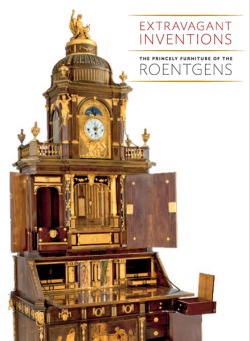 During the second half of the 18th century, the German workshop of Abraham and David Roentgen was among Europe’s most successful cabinetmaking enterprises. The Roentgens’ pieces combined innovative designs with intriguing mechanical devices that revolutionized traditional types of European furniture. An important key to their success was the pairing of the skilled craftsman Abraham with his brashly entrepreneurial son David, whose clients included Louis XVI and Marie Antoinette of France as well as Catherine the Great of Russia. This landmark publication is the first comprehensive survey, in nearly four decades, of the firm from its founding in about 1742 to its closing in the late 1790s.
The Roentgen workshop perfected the practice of adapting prefabricated elements according to the specifications of the customers. Detailed discussions of these extraordinary pieces are complemented by illustrations showing them in their contemporary interiors, design drawings, portraits, and previously unpublished historical documents from the Roentgen estate. This fascinating book provides an essential contribution to the study of European furniture.
Wolfram Koeppe is the Marina Kellen French Curator in the Department of European Sculpture and Decorative Arts at The Metropolitan Museum of Art.
◊ ◊ ◊ ◊ ◊
Lecture | The Legacy of David Roentgen
The Metropolitan Museum of Art, New York, 15 November 2012
David Linley (Chairman, Christie’s, UK), and Charles Cator (Deputy Chairman, Christie’s International)
David Roentgen (1743–1807) was known throughout Europe for his inventive and ingenious mechanical furniture, which found favor in the courts of France and Russia through the patronage of Marie Antoinette and Catherine the Great respectively. He was also famed for pioneering a new method of marquetry, created to give the impression of pietra dura. To mark the occasion of an extensive exhibition of Roentgen’s work, David Linley will share personal insights into Roentgen’s influence on his own furniture designs and his enduring influence on furniture makers today. Charles Cator will examine the collectors’ market for Roentgen from his rediscovery in the nineteenth century to today.
Lecture | Dining in 18th-Century France
This fall at The Getty:
Charissa Bremer-David — Of Cauliflower and Crayfish:
The High Art of Dining in 18th-Century France
Getty Center, Los Angeles, 25 October 2012

Lidded Tureen (detail), Thomas Germain, 1744–50 (Los Angeles: The J. Paul Getty Museum)
In mid-18th-century France, decorative sculptural elements on many luxurious serving vessels and tablewares actually portrayed, quite naturalistically, ingredients of the food contained within. Identifiable representations of vegetables, fish, and game can be compared to the recipes from period cookbooks.
Charissa Bremer-David, curator of Sculpture and Decorative Arts at the Getty Museum, discusses the naturalism of these miniature sculptures and how they reflected the broader interests of the Enlightenment as well as the latest culinary developments. Discover how these visualizations were meant to awaken and enhance the palate. This talk, part of the Tracey Albainy Lecture Series, commemorates the life and career of Tracey Albainy, a specialist of European silver and ceramics.
◊ ◊ ◊ ◊ ◊
Tracey Albainy, a senior curator at Boston’s Museum of Fine Arts, died in 2007 at the age of 45. More information is available here»
Bard Graduate Center’s 2012-2013 Seminar Series
The following list offers a sample of events at the Bard Graduate Center during the 2012-13 academic year that might be of interest to Enfilade readers. A flyer listing all events is available as a PDF file here.
◊ ◊ ◊ ◊ ◊
Bard Graduate Center’s Seminar Series
Bard Graduate Center, New York City, 2012-2013
 All events take place in the Lecture Hall at 38 West 86th Street, between Columbus Avenue and Central Park West, in New York City. Seminars begin at 6pm. RSVP is required. For general information or to reserve your place, please visit the BGC website.
September 27-29
Symposium — Beyond Representation: an Interdisciplinary Approach to the Nature of Things
October 15
Symposium — Circus and the City: New York, 1793–2010
November 14
Steven Pincus (History, Yale University) — Spanish American Trade, Patriot Politics and the Shaping of the British Empire
November 27
Laura Auricchio (Art History/Humanities, The New School) — Hero and Villain: Lafayette’s Legacies
February 12
Tobias Locker (Art History, Saint Louis University-Madrid) — Paris / Potsdam / Paris: Gilt Bronzes ‘à la française’ in Prussia and the Circulation of Knowledge
February 13
Christopher Brown (Director, Ashmolean Museum of Art and Archaeology, University of Oxford) — The New Ashmolean
February 20
Béla Kapossy (History, University of Lausanne, Switzerland) — Rousseau’s, and Other Relics: Material Memories in Later Eighteenth-Century Switzerland
Roundtable Discussion for New Book on Court Funerals
As noted at L’ApAhAu, in Paris on Thursday, 20 September 2012, at 6pm, the Fondation Maison des Sciences de l’Homme, in conjunction with the Centre de Recherche du Château de Versailles, will host a roundtable discussion with the authors of this new book on the role of court funerals in early modern Europe. The invitation (as a PDF) is available here»
◊ ◊ ◊ ◊ ◊
Juliusz A. Chrościcki, Mark Hengerer, Gérard Sabatier, Les funérailles princières en Europe, XVIe-XVIIIe siècle — Volume I : Le grand théâtre de la mort (Paris: Éditions de la Maison des sciences de l’homme, 2012), ISBN: 9782735114269, 47€. [Publication issue du colloque international des 14-16 octobre 2007 à Cracovie]
 Depuis une trentaine d’années, les historiens ont exploré la problématique de la « genèse de l’État moderne » en Europe entre le XVIe et le XVIIIe siècle, et son corollaire, la place centrale tenue par les cours princières dans le processus. L’objectif de ce livre est de s’interroger sur la part qu’ont pu y prendre les stratégies funéraires des familles souveraines. Ce livre propose une approche différente des travaux consacrés jusqu’à présent aux rituels funéraires princiers où l’histoire de l’art y est prépondérante. Les funérailles princières sont étudiées en terme de stratégies de la part des monarchies, comme rituel interne de transmission du pouvoir, mais aussi dans le cadre de leurs relations entre dynasties, et de leurs rapports tant avec leurs opinions publiques propres qu’avec une opinion européenne en formation.
Premier des trois volumes consacrés aux funérailles princières, l’ouvrage s’intéresse au déroulement des cérémonies en relation avec les institutions propres, la conjoncture, les traditions particulières, les rapports de force internes, l’insertion dans le jeu politique européen.










2 comments