Art Fair | Masterpiece London 2012
From the fair’s website:
Masterpiece London 2012
Royal Hospital Chelsea, London, 28 June — 4 July 2012
 Now in its third year Masterpiece London confirms its position as the capital’s leading art and antiques fair. This is no ordinary event, but a forum for distinctive design and aesthetic excellence where every exhibit offered is scrutinized by a team of experts to ensure every confidence in each purchase. The variety on offer at the fair is second to none: cars, wine, contemporary design and exquisite jewellery sit alongside the best of the fine and decorative arts. Presenting a snapshot of the history of art and design from antiquity to the present day, visitors will relish the chance to acquire rare collectors’ items or simply enjoy temptation on a grand scale. There is nowhere better than Masterpiece London 2012 to discover a rich and varied treasure trove. . .
If your interest is piqued by what you see, Masterpiece London offers you the chance to develop your knowledge and appreciation. During each day of the fair, select exhibitors will present insights into their given area of expertise so if your interest is portraits or pocket watches, mirrors or miniatures, Degas or diamonds, Masterpiece London gives you the opportunity to get up close and personal with some of the finest examples shown at the fair and to learn from the world’s leading luminaries.
Building on the success of 2010 and 2011 Masterpiece London promises you an impressive choice of art and design enlivened with its own special twist to ensure you have a memorable and enjoyable visit. All is displayed in a fresh and lavish setting, so that whether you are a seasoned collector, or a new buyer or just an admirer of exquisite beauty, you will experience countless opportunities to buy, enjoy and learn from.
◊ ◊ ◊ ◊ ◊
Of all the events associated with the fair, Saturday’s Wallace Collection Symposium might be most interesting to Enfilade readers:
Wallace Collection Symposium at Masterpiece London
Royal Hospital Chelsea, London, 30 June 2012
The Wallace Collection will be hosting a symposium on Saturday 30 June, led by Director, Dr Christoph Vogtherr. There will be four talks by Collection curators, from 11.30 – 16.00 on great collectors and their collections to include the French court of Louis XVI and British collecting in the nineteenth century.
11.30 A Golden Age: Collecting Medieval and Renaissance Sculpture and Decorative Arts in the Nineteenth Century
Jeremy Warren, Collections and Academic Director
12.00 Nineteenth-Century British Collectors of Contemporary French Paintings
Stephen Duffy, Curator of Pictures
13.00 Lunch
14.30 Royal Collectors at the Court of Louis XVI
Helen Jacobsen, Curator French Eighteenth-Century Decorative Arts
15.15 How Paintings Were Displayed in the Eighteenth Century
Christoph Vogtherr, Director
The day and each talk is free to Masterpiece London ticket holders. To reserve a place at the symposium, please email contact@masterpiecefair.com with your full name and address, with the subject: The Wallace Collection Symposium, indicating how many spaces you wish to reserve and a confirmation letter will be sent to you. Places are subject to availability.
◊ ◊ ◊ ◊ ◊
Note (added 9 July 2012) — A press release highlighting the successes of Masterpiece London 2012 is available at Art Daily.
Exhibition Programming | The ‘Westmorland’
A posting here at Enfilade noted the exhibition last November. Here we include details on the programming at The Ashmolean.
◊ ◊ ◊ ◊ ◊
The English Prize: The Capture of the Westmorland, an Episode of the Grand Tour
The Ashmolean Museum, Oxford, 17 May — 27 August 2012
The Yale Center for British Art, New Haven, 20 September 2012 — 6 January 2013
Curated by Scott Wilcox, Elisabeth Fairman, and María Dolores Sánchez-Jáuregui Alpañés
 The story of the Westmorland, an armed merchant ship sailing from Livorno to London in January 1779, is one of colourful 18th-century personalities and modern detective work. Consigned to the ship, by a cast of characters that included artists, aristocrats and dealers, was a precious cargo of art and antiquities, books, and luxury goods such as 32 wheels of Parmesan cheese. Captured by two French warships on 7 January 1779 and declared a ‘prize of war’, the Westmorland and the goods on board were acquired by King Carlos III of Spain who presented many of the works of art to the Real Academia de Bellas Artes de San Fernando, Madrid. Other items were eventually scattered across Spanish museums; one painting ended up as far away as St Petersburg. Reconstructed with archival discoveries and research in Spanish collections, The English Prize presents 120 objects including paintings, drawings, sculptures, books and maps from the fateful voyage, in a vivid recreation of the Grand Tour and the high seas.
The exhibition is the result of an extraordinary research project begun in the late 1990s, with gaps in the story filled by discoveries made in recent years. It was found, for instance, that the mysterious marking ‘P. Y’ on books and drawings in the Academia indicated ‘Presa Ynglesa’ (‘The English Prize’). The original inventories of the ship’s crates which survive in the archives in Madrid are remarkably thorough and have allowed the identification of many items which were on the Westmorland when it was captured. Using these records and studying the notes and marginalia scribbled on books and maps by their owners, it is now possible to link the objects and works of art to the individuals who were sending them home to Britain.
Amongst the highlights of the exhibition are portraits of Grand Tourists Francis Bassett and George Legge (Viscount Lewisham), by Pompeo Batoni; a group of amazingly fresh watercolours by John Robert Cozens made on his first trip to Italy; and portrait busts by Irish sculptor Christopher Hewetson who was working in Rome. Of the tourists, collectors and dealers who had consigned works of art and souvenirs to the Westmorland, we find the Scottish painter Allan Ramsay; the diplomat and dealer John Udny; a Scottish landowner and lawyer, Sir John Henderson of Fordell; and such a high ranking aristocrat as the Duke of Gloucester, brother of George III.
The exhibition website is available here»
◊ ◊ ◊ ◊ ◊
From The Ashmolean:
P U B L I C S T U D Y D A Y
The Experience of Italy: Travel, Collecting and the Grand Tour
Headly Lecture Theatre, Friday, 8 June 2012, 10am–5pm
This special one-day event looks at the cultural context of the Westmorland and its story. As a rare time-capsule, the ship can help us uncover the concerns and interests of British tourists, collectors and artists, from their musical education to their fascination with volcanoes and excavations. Over the day, six distinguished speakers deliver lectures with the opportunity to ask questions and discuss the varied topics.
The Westmorland and the Mechanics of the Grand Tour in the 1770s
Jonathan Yarker, University of Cambridge
Vases and Volcanoes: Sir William Hamilton and Collecting for Posterity
Kim Sloan, British Museum
Enjoying the Souvenirs of Travel: Art and Antiquities at Home
Clare Hornsby, author of Digging and Dealing in 18th-Century Rome
Music and the Musical Outcomes of the Grand Tour
Roderick Swanston, former Professor, Royal College of Music
Women at Grips with the Grand Tour: Adventure, Authority and Anomaly
Chloe Chard, independent scholar
British Artists in Rome
Martin Postle, Paul Mellon Center for Studies in British Art
Free, spaces limited, to book contact: education.service@ashmus.ox.ac.uk T 01865 278 015
◊ ◊ ◊ ◊ ◊
L E C T U R E S
Uncovering the Westmorland, Step by Step
José María Luzón Nogué, Real Academia de Bellas Artes, Madrid
Thursday, 31 May, 2–3pm
We can reconstruct the extraordinary story of the Westmorland and its cargo thanks to fascinating detective work that began in the 1990s. In this lecture, Prof Luzón, who led the original research project, will take you on the journey which led to the rediscovery of the ship. Free, spaces limited, to book contact E education.service@ashmus.ox.ac.uk T 01865 278015
Marble Mania: Why Was Antique Sculpture So Desirable?
Ruth Guilding, art historian and curator
Wednesday, 20 June, 2–3pm
The Westmorland’s cargo included 23 crates of marble statues, and the ship was one of many which brought the souvenirs of British travellers back to London in the 1770s. Dr Guilding explores the way that antique sculpture was imagined, understood and used by collectors in England at the time. Free, spaces limited, to book contact E education.service@ashmus.ox.ac.uk T 01865 278015
The First English Prize: The Story of the Arundel Marbles
Susan Walker, Keeper of Antiquities, Ashmolean Museum
Wednesday, 27th June, 2–3pm
Dr Susan Walker, Keeper of Antiquities, explores the history of the earliest collection of classical sculptures and inscriptions in Britain, a treasure of the Ashmolean Museum. Free, spaces limited, to book contact E education.service@ashmus.ox.ac.uk T 01865 278015
‘Magick Land’: British Landscape Painters in Italy in the 1770s
Scott Wilcox, Chief Curator of Art Collections and Senior Curator of Prints and Drawings, Yale Center for British Art
Wednesday, 4th July, 2–3pm
Oil paintings and watercolors on the Westmorland by John Robert Cozens, Jacob More, and Solomon Delane point to a community of British landscape painters active in Italy. This lecture examines that community and the impact of Italy, particularly the Roman Campagna, on the development of British landscape art. Free, spaces limited, to book contact E education.service@ashmus.ox.ac.uk T 01865 278015
Carrying off the Colosseum: The Westmorland and Architecture
Frank Salmon, Head of the Department of History of Art, University of Cambridge
Wednesday, 18 July, 2–3pm
The personal treasures that were being shipped by Grand Tourists on the Westmorland included both real and fictitious drawings of Roman antiquities, as well as design drawings intended for building work back in Britain. This lecture will examine those drawings in the light of the wider culture of Neoclassical architecture and interior design in the second half of the eighteenth century. Free, spaces limited, to book contact E education.service@ashmus.ox.ac.uk T 01865 278015
In Conversation — New Discoveries: The Secret Cargo of Relics
Catherine Whistler, curator of the exhibition, and Barry Williamson
Thursday, 19 July, 11.30am –12.30pm
Just before the exhibition catalogue went to press, the Ashmolean was contacted by Barry Williamson who is an authority on the Arundell family of Wardour Castle. The Westmorland had a secret cargo, a box of saint’s relics carefully concealed in a plinth of coloured marbles. This was a gift from the Pope to Henry Arundell, eighth Baron Arundell of Wardour. The international research project had tracked these relics in Madrid in early 1789, but the trail had gone cold. Barry Williamson will talk about his discoveries in the family archives and his quest to find the relics. Free, spaces limited, to book contact E education.service@ashmus.ox.ac.uk T 01865 278015
Things: Material Culture at Cambridge, Easter Term 2012
Programming from CRASSH at the University of Cambridge:
Things: Material Cultures of the Long Eighteen Century
Centre for Research in the Arts, Social Sciences and Humanities (CRASSH), Cambridge, ongoing series
Please note the change to the time and location of the seminar:
We meet alternate Tuesdays 12.30-2.30pm in the CRASSH Seminar Room at 7 West Road on the Sidgwick Site. A light lunch will be provided.
◊ ◊ ◊ ◊ ◊
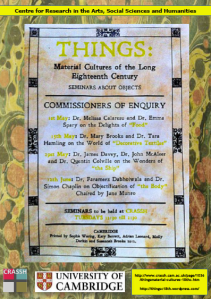 The eighteenth century was the century of ‘stuff.’ Public production, collection, display and consumption of objects grew in influence, popularity, and scale. The form, function, and use of objects, ranging from scientific and musical instruments to weaponry and furnishings were influenced by distinct features of the time. Eighteenth-century knowledge was not divided into strict disciplines, in fact practice across what we now see as academic boundaries was essential to material creation. This seminar series will use an approach based on objects to encourage us to consider the unity of ideas of the long-eighteenth century, to emphasise the lived human experience of technology and art, and the global dimension of material culture. We will re-discover the interdisciplinary thinking through which eighteenth-century material culture was conceived, gaining new perspectives on the period through its artefacts.
Each seminar features two talks considering the same type of object from
different perspectives.
1 May 2012 – Food
Dr Melissa Calaresu and Dr Emma Spary (University of Cambridge)
15 May 2012 – Decorative Textiles
Dr Mary Brooks (York Museums Trust) and Dr Tara Hamling (University of Birmingham)
29 May 2012 – The Ship
Dr James Davey, Dr John McAleer and Dr Quintin Colville (National Maritime Museum)
12 Jun 2012 – The Body
Dr Faramerz Dabhoiwala (University of Oxford) and Dr Simon Chaplin (Wellcome Library), Guest Respondent: Jane Munro (Fitzwilliam Museum)
We will be rounding off the year with a one-day colloquium on Friday, 28 September 2012, We Need to Talk about ‘Things’: Concluding Colloquium. Details can be found at http://www.crassh.cam.ac.uk/events/1980/
◊ ◊ ◊ ◊ ◊
You’re invited to visit the external blog and welcome to subscribe to the group mailing list at https://lists.cam.ac.uk/mailman/listinfo/crassh-things
Catherine Molineux on Visual Ethnography
Catherine Molineux | Visual Ethnography: The Travelogue Illustration as a Site of Encounter
The Newberry Library, Chicago, 28 April 2012
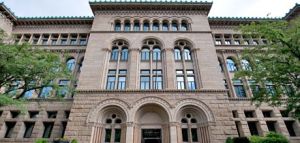
Please join us Saturday, April 28, 2012, 2-4 pm for our Newberry Library Eighteenth-Century Seminar works-in-progress session with Catherine Molineux of Vanderbilt University.
 Between the 1730s and 1780s, a French traveler’s tale about the coronation of a West African king circulated through France, England, and the Netherlands. Embedded in this description of Hueda rituals surrounding kingship was a story about European rivalry for the favor of a key African player in the Atlantic slave trade. As this commercial drama played out in Europe through multiple retellings of the story, engravers transformed the single image that accompanied it, reworking the original sketch into a full-color engraving. The illustration’s evolution tells a modern story about the role of the visual in securing imperial hierarchies threatened by the encounter with African sovereignty.
The Newberry Library Eighteenth-Century seminar is designed to foster research and inquiry across the scholarly disciplines in eighteenth-century studies. It aims to provide a methodologically diverse forum for work that engages our ongoing discussions and debates along this historical and critical terrain.
Attendance at all events is free and open to the public but in order to receive the precirculated paper, participants are asked to register in advance by contacting the Center for Renaissance Studies at: renaissance@newberry.org. A reception follows each presentation. It is also the custom of the seminar to gather at a restaurant in the Newberry neighborhood to continue our conversation. If you would like to join us for dinner after any session, please email Lisa Freeman at lfreeman@uic.edu. For more information about the seminar, please visit our website. We welcome your attendance and participation at the seminar and look forward to continuing our lively discussions.
Yours,
Timothy Campbell, University of Chicago
Lisa A. Freeman, University of Illinois at Chicago
John Shanahan, DePaul University
Helen Thompson, Northwestern University
Lecture | Chrisman-Campbell, When Fashion Set Sail
From the BGC:
 Kimberly Chrisman-Campbell | When Fashion Set Sail:
Maritime Modes in Pre-Revolutionary France
Bard Graduate Center, New York, 3 April 2012
Kimberly Chrisman-Campbell will deliver a Françoise and Georges Selz Lecture on 18th- and 19th-Century French Decorative Arts and Culture on Tuesday, April 3, 2012. Her talk is entitled When Fashion Set Sail: Maritime Modes in Pre-Revolutionary France. Dr. Chrisman-Campbell is an independent scholar and a consultant for The Huntington Library, Art Collections, and Botanical Gardens. She received her B.A. from Stanford University, her M.A. from the Courtauld Institute of Art, and her Ph.D. from the University of Aberdeen. Chrisman-Campbell has published numerous journal and magazine articles on 18th– and early 19th-century French fashion. She has also contributed to several books and museum catalogues, including Fashioning Fashion: European Dress in Detail, 1700-1915 (Los Angeles: Prestel and Los Angeles County Museum of Art, 2010); Paris: Life & Luxury in the Eighteenth Century (Los Angeles: Getty Publishing, 2011); The Saint-Aubin ‘Livre de Caricature’ (Oxford: Studies in Voltaire and the Eighteenth Century, forthcoming); and Seeing Satire (Oxford: Studies in Voltaire and the Eighteenth Century, forthcoming).
One of the most iconic and enduring images of 18th-century extravagance is a French fashion plate depicting a woman wearing a miniature ship in her powdered and pomaded hair. This hairstyle—the coiffure à la Belle Poule—was not just an eye-catching novelty. It was one of many ship-shaped headdresses that celebrated specific French naval victories and, more importantly, advertised their wearers’ patriotism and political acumen. In addition to hairstyles, French women of the era wore hats à la maritime and garments adorned with nautical motifs, and the looms of Lyon produced textiles woven with scenes from naval battles. Sailing ships were also rendered in Sèvres porcelain, depicted on snuffboxes, and included in portraits of ladies of fashion. The vogue for nautical fashions and textiles during the reign of Louis XVI was a powerful testimony to the practical and symbolic role the sea played in the everyday lives of women at the most elite levels of French society, whether as a battlefield or a frontier. It also reflected the increasingly tempestuous nature of fashion itself in the pre-Revolutionary period.
Light refreshments will be served at 5:45 pm. The presentation will begin at 6:00 pm.
RSVP is required. Please click on the registration link at the bottom of this page or contact academicevents@bgc.bard.edu.
Please note that our Lecture Hall can only accommodate a limited number of people, so please come early if you would like to have a seat in the main room. We also have overflow seating available; all registrants who arrive late will be seated in the overflow area.
Elena Boeck at The Newberry, Cartography & Peter the Great
From The Newberry:
Elena Boeck, An Icon for Peter the Great: Linking Imperial Cartography and Sacred Topography
The Newberry Library, Chicago, 9 March 2012
Seminar in Art History, Early Modern European Maps as Art
This paper investigates intersections between piety, imperial expansion, and military cartography in an icon presented to Peter I in 1698. It explores a rare convergence of Christian and imperial narratives. The icon was produced in Ukraine, which long served as a bridge between the west and the world of the Russian court, and offered to Peter I by a Ukrainian monastery as a diplomatic gift to commemorate his first triumph, the capture of the Ottoman town of Azov. The iconography of this nearly two-meter-tall image includes an unusual birds-eye view of the siege of Azov.
This innovative image actively participated in the invention of a new, Europeanized, imperial visual tradition in Russia. Furthermore, its seamless and insistent interweaving of imperial symbols, territorial expansion, and religious legitimization came from a contested territory that was in the process of being integrated into empire. Exploring a Ukrainian donor’s motivations for creating such an object, and taking seriously his aspirations for imperial patronage, enables us to understand aspects of empire often obscured in modern national narratives.
Elena N. Boeck is Assistant Professor at DePaul University.
Friday, 9 March 2012, 2:00 pm. A reception will follow the seminar.
Cosponsored by the Hermon Dunlap Smith Center for the History of Cartography.
This program is free and open to the public, but registration in advance is required. Register online here. The paper will be electronically precirculated to registrants.
Art, Agency, Empire: India in Global Contexts
From the YCBA:
Art, Agency, Empire: India in Global Contexts — Graduate Student Symposium
Yale Center for British Art, New Haven, 11 February 2012

Edward Lear, "Kangchenjunga from Darjeeling," detail, 1879 (New Haven: Yale Center for British Art)
This one-day graduate student symposium is informed by the recent proliferation of projects on India’s visual and material culture, including two exhibitions that opened at the Center in the fall of 2011: Johan Zoffany RA: Society Observed (October 27, 2011– February 12, 2012), which includes a substantial section devoted to the works the artist produced during his residence in India, between 1783 and 1789; and Adapting the Eye: An Archive of the British in India, 1770–1830 (October 11–December 31, 2011), which concentrated on the complex networks of British and Indian artists, patrons, and scholars in the late eighteenth and early nineteenth centuries.
Art, Agency, Empire: India in Global Contexts explores how, in a postcolonial period, it has become increasingly pressing to reevaluate India as a site of multifarious cultural (indeed intercultural) production, which has provoked global responses across media. The symposium is free and open to the public; registration is required. Online registration is available from January 16 to February 9, 2012. Onsite registration is available on February 11 from 8:30 am.
The program will include papers by graduate students (listed here) as well as breakout sessions in the Johan Zoffany exhibition and Center’s collections.
◊ ◊ ◊ ◊ ◊
Keynote Lecture, 5:30 pm
Gillian Forrester (Curator of Prints and Drawings Yale Center for British Art)
In the Cock-Pit: Zoffany and the Performance of Empire in India
Things: Material Culture at Cambridge
Programming from CRASSH at the University of Cambridge:
Things: Material Cultures of the Long Eighteen Century
Centre for Research in the Arts, Social Sciences and Humanities (CRASSH), Cambridge, ongoing series
Please note the change to the time and location of the seminar:
We meet alternate Tuesdays 12.30-2.30pm in the CRASSH Seminar Room at 7 West Road on the Sidgwick Site.
◊ ◊ ◊ ◊ ◊
 The eighteenth century was the century of ‘stuff.’ Public production, collection, display and consumption of objects grew in influence, popularity, and scale. The form, function, and use of objects, ranging from scientific and musical instruments to weaponry and furnishings were influenced by distinct features of the time. Eighteenth-century knowledge was not divided into strict disciplines, in fact practice across what we now see as academic boundaries was essential to material creation. This seminar series will use an approach based on objects to encourage us to consider the unity of ideas of the long-eighteenth century, to emphasise the lived human experience of technology and art, and the global dimension of material culture. We will re-discover the interdisciplinary thinking through which eighteenth-century material culture was conceived, gaining new perspectives on the period through its artefacts.
Each seminar features two talks considering the same type of object from
different perspectives.
24 January 2012 — Fashion
Professor John Styles (University of Hertfordshire) and Amy Miller (National Maritime Museum)
7 February 2012 — Advertising
Dr Philippa Hubbard (Adam Matthew Digital) and Jenny Basford (University of York)
21 February 2012 — Porcelain
Dame Rosalind Savill (Wallace Collection) and Dr Anne Gerritsen (University of Warwick)
6 March 2012 — Artist’s Things
Dr Katie Scott (Courtauld Institute of Art) and Dr Hannah Williams (University of Oxford)
◊ ◊ ◊ ◊ ◊
Subscribe to the group mailing list at https://lists.cam.ac.uk/mailman/listinfo/crassh-things
Visit the external blog at http://thingsc18th.wordpress.com/
Panel Discussion of ‘The Image of the Black in Western Art’
From the National Gallery:
Image of the Black in Western Art, Part II
National Gallery of Art, Washington DC, 11 December 2011
Panel discussion includes David Bindman, emeritus professor of the history of art, University College London; Henry Louis Gates Jr., Alphonse Fletcher University Professor and director of the W. E. B. Du Bois Institute for African and African American Research, Harvard University; and Sharmila Sen, general editor for the humanities, Harvard University Press. Moderated by Faya Causey, head of academic programs, National Gallery of Art. Book signing of The Image of the Black in Western Art (volumes 1-3) follows. Sunday, 11 December 2011, 2:00pm, East Building Concourse, Auditorium.
◊ ◊ ◊ ◊ ◊
David Bindman and Henry Louis Gates, Jr., eds., associate editor Karen C. C. Dalton, The Image of the Black in Western Art Volume III: From the ‘Age of Discovery’ to the Age of Abolition, Part 3: The Eighteenth Century (Cambridge: Harvard University Press, 2011), 400 pages, ISBN 9780674052635, $95.
 In the 1960s, art patron Dominique de Menil founded an image archive showing the ways that people of African descent have been represented in Western art. Highlights from her collection appeared in three large-format volumes that quickly became collector’s items. A half-century later, Harvard University Press and the Du Bois Institute are proud to publish a complete set of ten sumptuous books, including new editions of the original volumes and two additional ones.
The Eighteenth Century features a particularly rich collection of images of Africans representing slavery’s apogee and the beginnings of abolition. Old visual tropes of a master with adoring black slave gave way to depictions of Africans as victims and individuals, while at the same time the intellectual foundations of scientific racism were established.
Seminar Series: Tableaux Vivants
Le tableau vivant ou l’image performée: sources, méthodes, enjeux
Institut national d’histoire de l’art, Paris, 2011-2012
For the 2011-2012 academic year, INHA in Paris is addressing tableaux vivants with six sessions on the topic. The second in the series takes place on Tuesday, 29 November, from 5-7pm. More information on the series as a whole is available here»
◊ ◊ ◊ ◊ ◊
From Le Blog de l’ApAhAu
Aux frontières du tableau vivant : la pantomime ou l’éloquence du corps, XVIIIe-XIXe siècles
Institut national d’histoire de l’art, Paris, 29 November 2011
Organized by Julie Ramos and Léonard Pouy
 Communément définie comme un arrangement de personnes vivantes reproduisant une composition artistique, que ce soit une peinture, une sculpture, une estampe ou une scène littéraire, la pratique du « tableau vivant » aurait, selon les récits admis, connu son apogée dans les salons privés du début du XIXesiècle avant de déchoir en simple divertissement populaire. Cette vision du tableau vivant a contribué à concentrer son étude autour de 1800, à occulter ses origines plus anciennes, ainsi qu’à négliger ses évolutions ultérieures et son apport à l’histoire de l’art. Partant de ce constat, ce séminaire vise à examiner le tableau vivant et ses genres connexes dans la durée, ainsi qu’à saisir la manière dont ils franchissent les frontières esthétiques et sociales et questionnent les définitions traditionnelles de l’art.
Pratique variée et sans cesse réactivée, des anciennes entrées royales au cinéma et à l’art contemporain, elle interroge la relation entre mimesis et représentation, la capacité de l’art à véhiculer des affects et des idéaux, ainsi que les statuts d’auteur et de spectateur. L’étude des tableaux vivants permet de réfléchir sur le caractère reproductible et la diffusion des œuvres d’art, sur l’apparition du terme dans la critique, sur les effets de réel et de présence, ou encore sur les relations entre image et performativité.
◊ ◊ ◊ ◊ ◊
Chiara Savettieri Wurmser (Université de Pise)
L’art du geste comme modèle de la peinture ? le cas de Jacques Nicolas Paillot de Montabert
Enseignant-chercheur en Histoire de l’Art à l’Université de Pise, Chiara Savettieri travaille sur les interactions entre peinture et littérature de même qu’entre arts visuels et musique. Parmi ses travaux les plus significatifs: Ingannare la morte. Anne-Louis Girodet Trioson e l’illusione dell’arte (Palermo 2005), tiré d’une partie de sa thèse de doctorat consacrée à la pensée esthétique de Anne-Louis Girodet ; Dal Neoclassicismo al Romanticismo. Fonti per la Storia dell’arte (Carocci, 2006, Rome, 766 p.) ; “Il faut que le peintre adopte, comme le musicien, un mode: peinture et musique dans la pensée esthétique de Paillot de Montabert”, Jacques-Nicolas Paillot de Montabert, 1771 – 1849: idées, pratiques, contextes, dir. par F.Desbuissons, Langres, Guéniot, 2009, p. 171-187 ; “L’essence du cinéma consiste dans le rythme : peinture, cinéma et musique dans l’Univers de Luigi Veronesi”, dans Ligeia, 97/100.2010, p. 83-95 . Avec Marie-Pauline Martin elle a organisé le colloque «La musique face aux Beaux-arts ou les vicissitudes de l’imitation» (Centre Allemand d’Histoire de l’art, INHA, février 2010) dont la publication des actes est en préparation.
Arnaud Rykner (Université Paris 3-Sorbonne Nouvelle)
Le paradigme pantomimique
Romancier, essayiste et dramaturge, Arnaud Rykner est également Professeur à l’Institut d’Etudes Théâtrales de l’Université Paris 3-Sorbonne Nouvelle et membre associé du Laboratoire « Lettres, Langages et Arts » de l’Université Toulouse II – Le Mirail. Il a notamment dirigé l’ouvrage Pantomime et théâtre du corps. Le jeu du hors-texte (Presses Universitaires de Rennes, 2009, 245 p.) ; « Tableau vivant, scène érotique. L’entrelacs des images et des corps », Journée d’études Théâtralité de la scène érotique aux XIXe et XXe siècles, 21 mai 2010, Maison de la Recherche de l’Université Toulouse II – Le Mirail. Les actes du colloque Entre code et corps. Tableau vivant et photographie mise en scène, organisé en collaboration avec Christine Buignet à Toulouse du 18 au 20 mars 2010, paraîtront en mars 2012 dans le 22e numéro de la revue Figures de l’art.
Bernard Vouilloux (Université de Paris-Sorbonne)
Gestes, attitudes, mouvements : le tableau vivant des arts de la scène à la photographie
Professeur de littérature française du XXe siècle (littérature et arts visuels) à l’Université de Paris-Sorbonne, Bernard Vouilloux a centré ses recherches sur les rapports entre le verbal et le visuel, littérature et peinture, poétique et esthétique. Outre de très nombreux articles (notamment dans les revues Poétique, Littérature et Critique), il a publié dix-sept ouvrages, parmi lesquels La Peinture dans le texte. XVIIIe-XXe siècles (CNRS Éditions, 1994), Langages de l’art et relations transesthétiques (Éd. de l’Éclat, 1997), Le Geste, suivi de Le geste ressassant (La Lettre volée, 2001), Le Tableau vivant. Phryné, l’orateur et le peintre (Flammarion, 2002), L’œuvre en souffrance. Entre poétique et esthétique (Belin, 2004), Tableaux d’auteurs. Après l’Ut pictura poesis (Presses universitaires de Vincennes, 2004), Écriture de fantaisie. Grotesques, arabesques, zigzags et serpentins (Hermann, 2008), Un art sans art. Champfleury et les arts mineurs (Fage Éditions, 2009), Le Silence et la nuit des images. Penser l’image avec Pascal Quignard (Hermann, 2010), Le Tournant « artiste » de la littérature française. Écrire avec la peinture au XIXe siècle (Hermann, 2011).
Pauline Beaucé (Université de Nantes, Centre Marc Bloch, Berlin)
Répondante
Auteur d’une thèse de doctorat consacrée à la Poétique de la parodie dramatique d’opéra au XVIIIe siècle en France (dir. F. Rubellin), Pauline Beaucé est membre du Centre d’études des théâtres de la Foire et de la Comédie-Italienne (Univ. de Nantes). Rattachée au Centre Marc Bloch, elle a édité plusieurs parodies d’opéra (et notamment une parodie pantomime) aux Editions Espaces 34 et a publié différents articles sur le théâtre au XVIIIe siècle tels « La parodie-pantomime d’opéra au XVIIIe siècle ou l’adaptation sous contraintes », actes du colloque L’Adaptation comique, de la référence à l’irrévérence, 2009 ; « Musique et théâtre : pour de nouvelles perspectives théoriques et méthodologiques à partir de l’exemple de la parodie dramatique d’opéra en France au XVIIIe siècle », colloque junior franco-allemand Musique-Contexte, CIERA, Berlin, 4-6 février 2010, actes à paraître, chez Lang ; « L’envers parodique du magicien d’opéra au XVIIIe siècle », Les Scènes de l’enchantement, Desjonquères, 2011.










2 comments