Seminar at The Frick: A 1767 Longcase Clock
From The Frick:
Seminar with Joseph Godla and Charlotte Vignon: “It’s About Time”
The Frick Collection, New York, 17 November 2011

Balthazar Lieutaud, Longcase Regulator with Mounts Emblematic of Apollo, 1767. Bronze Mounts by Philippe Caffiéri; movement by Ferdinand Berthoud (Frick Collection)
Clocks are among the most interesting and elaborate works of art in The Frick Collection. In this seminar, a curator and a conservator will discuss the design, history, and function of a magnificent French longcase regulator clock from the permanent collection. This exceptional example was made in 1767 by Ferdinand Berthoud, one of the leading Parisian clock and watchmakers of his day, together with case maker Balthazar Lieutaud and sculptor and bronze caster Philippe Caffiéri.
Click here to register at the regular rate of $100 per person. Members of The Frick Collection may click here to register at the discounted membership rate of $90 per person. Discounts will be applied upon verification of membership. To register over the phone, please call 212.547.0704.
Questions: seminars@frick.org
Lecture: Mark Hallett at the Scottish National Gallery
As reported at the blog for British Art Research:
Mark Hallett, Faces in a Library: Sir Joshua Reynolds’s Streatham Worthies
Scottish National Gallery, Edinburgh, 3 November 2011
 Mark Hallett, Professor of History of Art at the University of York, will be giving this year’s Watson Gordon Lecture at the Scottish National Gallery (Hawthornden Lecture Theatre – Gardens Entrance), which will analyse the remarkable set of thirteen portraits that the celebrated Georgian artist Sir Joshua Reynolds painted for a private library at Streatham Park, just outside London, between the early 1770s and 1781. Professor Hallett’s lecture is entitled Faces in a Library: Sir Joshua Reynolds’s Streatham Worthies, and will take place at 6pm on November 3rd. The lecture, which will be published as a short book in 2012, focuses on Reynolds’s pictures for Streatham, which include portraits of such cultural luminaries as Edmund Burke, Oliver Goldsmith and Samuel Johnson, which will be explored as expressions of friendship, learning and fame, and as works that responded to the social rituals and intellectual ideals of the eighteenth-century library.
Lecture: Sisterhood as Alternative to Fraternité
From Sciences Po (as noted at Le Blog de L’ApAhAu). . .
Anne Lafont — Sororités, ou l’alternative au motto de 1789: liberté, égalité, fraternité
Sciences Po, salle de conférences, 56 rue Jacob, Paris, 2 November 2011

Henriette-Lorimier, "Self-Portrait," 1801
Il est au moins deux registres où la question de la sororité peut faire sens dans un séminaire consacré à la passion égalitaire de la société post-révolutionnaire et de ses implications dans la vie culturelle. La sororité des arts, de la peinture et de la poésie, fut le leitmotiv de la théorie artistique à l’époque moderne. De même, le sort public des femmes engagées dans la création fut autant considéré, pendant la Révolution française, par les femmes artistes que par les femmes de lettres, à l’instar de Germaine de Staël, qui n’est pas étrangère, d’ailleurs, à la constitution de la pensée tocquevillienne. Par ailleurs, la sororité désigne le processus de communautarisation des artistes femmes en 1800, face au tout masculin initié par la société révolutionnaire des clubs et des assemblées, comme l’ont bien montré les nombreux travaux sur le genre depuis le livre pionnier de Geneviève Fraisse, Muse de la Raison Démocratie et exclusion des femmes en France (1989). Néanmoins, nombreuses furent celles qui saisirent l’opportunité de l’abolition de la censure à l’exposition publique annuelle du Louvre : le Salon, en 1791, pour investir l’espace public de la création et risquer la professionnalisation à une époque de redéfinition radicale du marché de l’art, de la commande privée et de la commande publique. En un mot, ces femmes artistes s’employèrent à suivre des stratégies de subsistance à un moment d’instabilité, où les rivalités entre artistes, en général, s’étaient accrues. Quelles furent alors les solutions imaginatives de ces sœurs de plumes et de pinceaux? En quoi leurs expériences inaugurales forment un paradigme propice à comprendre l’avènement de l’artiste moderne?
Lecture: Susan Siegfried on Boilly
At the Dallas Museum of Art:
The Eighth Annual Michael L. Rosenberg Lecture
Louis Léopold Boilly: Between Genre and Portraiture
Dallas Museum of Art, 3 November 2011

Louis-Léopold Boilly, "A Family Admiring a Portrait of a Lady in an Interior," ca. 1790, oil on canvas, 17 1/2 x 21 in. (44.45 x 53.34 cm), The Michael L. Rosenberg Foundation
Focusing on Louis-Léopold Boilly’s Woman Showing her Portrait, this lecture explores the richly imaginative interchange between genre painting and portraiture in the eighteenth century. Join distinguished scholar Dr. Susan L. Siegfried, Denise Riley Professor of the History of Art and Women’s Studies at the University of Michigan, as she describes how the easy exchanges between the real and the fantasy elements of these two categories of subject matter evidently facilitated the imaginative participation of patrons and viewers in ascribing meanings to them.
Thursday, November 3
7:30 p.m., C3 Theater
Included in general admission to the Museum
The Irish Country House
From the Irish Georgian Society:
The Irish Country House: Its Past, Present and Future
Lettsom House, London, 20 October 2011
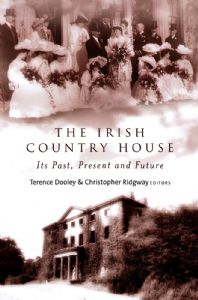
ISBN: 9781846822346
Since the founding of the IGS over fifty years ago, considerable change has taken place in the fortunes of and attitudes to the Irish country house and these changes have been discussed each year at the Annual Historic Houses of Ireland Conference and now published in a book of essays titled The Irish Country House: Its Past, Present and Future, edited by Dr Terence Dooley and Dr Christopher Ridgway and published by Four Courts Press.
Launched earlier this year at the 9th Historic Houses of Ireland Conference, this marvelous collection of essays looks at dozens of houses across a range of time periods, covering a diversity of topics relating to the architecture of these buildings, the people who lived in them, and the position and perception of the Big House in Ireland. Essays include, Terence Dooley – “Social life at Castle Hyde, 1931–88”, Christopher Ridgway – “Making and meaning in the Historic House: new perspectives in England, Ireland and Scotland” and Allen Warren – “The Twilight of the Ascendancy and the Big House.” The London Chapter is delighted to welcome Drs Dooley and Ridgway to discuss these and other aspects of the Irish country house.
Dr Dooley, MA, Ph.D. (NUI), H. Dip. Ed. is senior lecturer at National University of Ireland at Maynooth and Director of the Centre for the Study of Historic Irish Houses and Estates, of which one of its key functions is the organisation of the Annual Historic Houses of Ireland Conference with the aim of promoting focus and recognition for new scholarship and other developments in the field of built heritage studies. Dr Dooley is responsible for the MA in Historic House Studies at Maynooth and author of The Decline of the Big House in Ireland: A Study of Irish Landed Families, 1860-1960 (2001) and A Future For Irish Historic Houses: A Study of 50 Houses (2003) among others. Dr Ridgway, FSA, has been curator at Castle Howard since 1985 and has written and lectured widely on its architecture, gardens and collections. Dr Ridgway is a member of the Board of the National Trust for Scotland and Adjunct Professor in the History Department at the NUI.
The lecture is at Lettsom House, 11 Chandos Street, London W1G 9EB. The nearest tube station is Oxford Circus. Wine will be served from 6.30pm with the lecture commencing at 7pm and costs £12 per person. If you would like to attend, please send your completed application form and cheque to Colm Owens, Apartment 50, Kilner House, Clayton Street, London SE11 5SE. Please note that tickets will not be issued.
Lecture: Amanda Vickery on Georgian Family Life
From The Lewis Walpole Library:
The Eighteenth Lewis Walpole Library Lecture by Amanda Vickery
Yale Center for British Art, New Haven, 21 October 2011
“Family Life Makes Tories of Us All”: Love and Power at Home in Georgian England
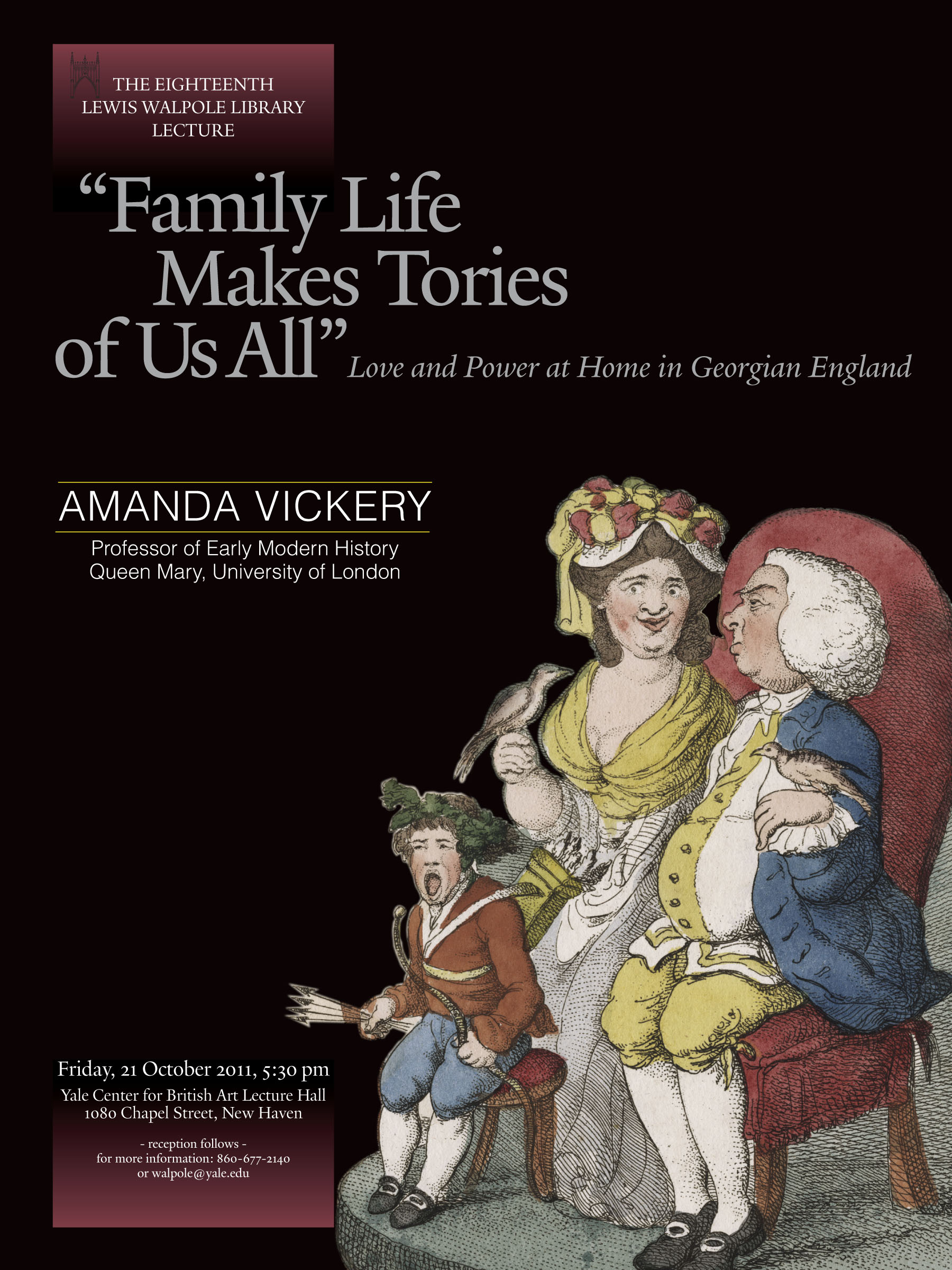 To see the state in miniature one need only go home. Husbands were to govern wives, masters and mistresses to rule servants, and parents to discipline children. The years after 1688 saw the acceptance of new ideas about political authority and social manners, but the household hierarchy endured regardless. Notoriously Hobbes, Locke and Rousseau did not include every adult individual in their democracy of consent, but rather every male head of household, who was seen to represent the interests of his patriarchal entourage. The British considered themselves enemies to tyranny, disparaging and caricaturing ‘oriental despotism’ in foreign families as confirmation of barbarity, but local servitude passed almost unnoticed by political ideas. I have yet to encounter a single gentleman musing on whether it might be possible to reconsider his domestic rule in the light of the new political ideas. ‘Family life’, it was observed in 1779, ‘makes Tories of us all… see if any Whig wishes to see the beautiful Utopian expansion of power within
his own walls’.
 The new political ideas which advocated government by consent did nothing to revolutionize the structures of domestic authority, but the content and meaning of domestic life was transformed over the eighteenth century. New ideals of politeness revolutionized domestic manners and interactions amongst the modestly propertied, while the vogue for sensibility in novels and paintings inflated expectations about affection and happiness at home. What then was the balance of love and power in eighteenth-century marriage and family life? And how did dependents live with the contradictions? ‘Do you not admire these lovers of liberty!’ snapped Elizabeth Montagu in 1765 ‘I am not sure that Cato did not kick his wife.’
◊ ◊ ◊ ◊ ◊
Amanda Vickery is Professor of Early Modern History at Queen Mary, University of London. She is the author of Behind Closed Doors: At Home in Georgian England (Yale, 2009) and The Gentleman’s Daughter: Women’s Lives in Georgian England (Yale, 1998) which won the Wolfson, the Whitfield and the Longman/History Today prize. She is the editor of Women, Privilege and Power: British Politics 1750 to the Present (Stanford, 1991) and Gender, Taste and Material Culture in Britain and North America (Yale, 2006). She writes and presents documentaries for BBC2 and BBC radio 4. In 2011, she judged the Samuel Johnson prize.
For the lecture’s calendar listing at the YCBA click here
Exhibition: ‘Claude Lorrain: The Enchanted Landscape’
From the Ashmolean:
Claude Lorrain: The Enchanted Landscape
Ashmolean Museum of Art and Archaeology, Oxford, 6 October 2011 — 8 January 2012
Städel Museum, Frankfurt, 3 February — 6 May 2012
Curated by Jon Whiteley
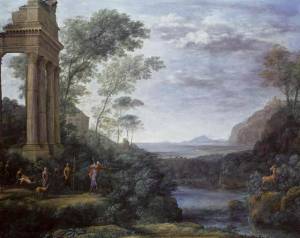
Claude Lorrain, "Landscape with Ascanius Shooting the Stag of Sylvia," 1682 (Oxford: Ashmolean Museum)
The Ashmolean’s major exhibition this autumn will be Claude Lorrain: The Enchanted Landscape, rediscovering the father of European landscape painting, Claude Gellée (ca. 1600–1682), or Claude Lorrain as he is best known.
In partnership with the Städel Museum, Frankfurt, the exhibition will bring together 140 works from international collections, created at different points in the artist’s career. By uniting ‘pairs’ of Claude’s paintings and making a comprehensive survey of his work in different media, the exhibition brings new research to bear on his working methods, to reveal an unconventional side to Claude which has previously been little known.
Born in France, Claude travelled first to Italy at the age of 13 or 14, settling in Rome for the rest of his life in 1627. The scenery of his great compositions was based on his studies of the ancient ruins and the rolling country of the Tiber Valley and the Roman Campagna. Claude’s ability to translate his vision of the countryside and the majesty of natural light with the aid of his brush won him the admiration of his contemporaries, above all else, as a ‘natural painter’. It has been his signature treatment of classical landscape and literature which has impressed itself on generations of artists and collectors, and which has made his name synonymous with great landscape painting.
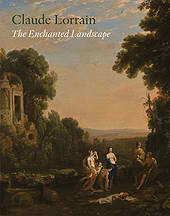
ISBN: 9781848220928, $80
The cult of Claude which grew up in the 18th and 19th centuries, begun by British ‘Grand Tourists’, has left a profound mark on our history and landscape. English country houses are well stocked with both originals by Claude and with copies. Responding to aristocratic taste and fashion, designers such as Capability Brown, Henry Hoare and William Kent reproduced his ideal views in the parklands of great houses from Blenheim Palace, Rousham House and Stowe, to Stourhead and Chatsworth. Claude’s drawings were collected with no less enthusiasm by English connoisseurs, as a result, over 40% of his drawings are now in the British Museum. Claude’s influence on later artists is apparent in the work of Gainsborough, Turner and Constable, who described him as ‘the most perfect landscape painter the world ever saw’.
A lesser-known side to Claude is the eccentricity of his graphic art. Claude Lorrain: The Enchanted Landscape will exhibit 13 paintings alongside related drawings and etchings from international and private collections, and from the Ashmolean’s own extensive holdings. Claude was a dedicated graphic artist. He drew for the sake of mastering the world of nature but also because drawing was a pleasure in itself. Many of his drawings were made as works of art in their own right. During his own lifetime Claude’s fame grew rapidly. As a guard against forgeries, he made copies of his paintings in a book, the Liber Veritatis (Book of Truth), which, by the time of his death, contained 200 drawings. The book also gave him a collection of ideas which he could reuse when necessary. Although he made only 40 prints in total, all of which are on display, he took a serious interest in printmaking. Similar to his drawings, his principle focus was to explore the potential of the medium. His exceptional technique – a painterly brush-and-ink style replicating natural effects – was a novelty in contemporary printmaking. The spectacular ‘Fireworks’ series, ten etchings made during a week of firework displays in Rome, illustrate his experimental style and will be on show together in the Ashmolean’s exhibition.
Unlike contemporaries who had an academic training, Claude’s style and artistic process were unique to him. He worked frequently with existing materials progressing from one painting to another through a process of variation and combination. His sketching excursions provided him with a stock of motifs, including trees, hills, rivers and antique ruins, which became constant accessories in his paintings. Figure groups were shifted from one composition to another. Landscapes, like stage scenery, were taken out for reuse with a different set of characters. Elsewhere he would cut compositions in two or enlarge them with separate sheets. Occasionally, he would pick up a discarded study and add detail to make it a finished work of art, often with peculiar results.
Claude was also the first artist to specialise in painting ‘pairs’. Approximately half his compositions were made as companion pieces, the earliest of which, on display here, are Landscape with the Judgement of Paris and Coast View (both 1633). The idea of pairs is also found among his prints. While many of his pairs show a compositional correspondence, contrast played as great a role as similarity. Often an Arcadian landscape is combined with a maritime view, or a morning scene with an evening setting. The pairs were not always executed concurrently: his very last painting, the Ashmolean’s great Ascanius and the Stag of Sylvia (1682), was made 5 years after its companion, Aeneas’s Farewell to Dido in Carthage (1676) now in Hamburg.
Claude Lorrain: The Enchanted Landscape will display some of Claude’s greatest masterpieces, works which have made his art familiar and well-loved. In placing these beside his graphic art and exploring his singular methods of working, the exhibition aims to expose an unexplored dimension to one of the western canon’s most famous names.
“Claude’s art is recognisable to almost all of us, even if we are less familiar with his name, and this important exhibition will reintroduce us to one of the greatest painters of all time.” Dr Jon Whiteley, Exhibition Curator and Senior Assistant Keeper of Western Art, Ashmolean Museum.
Catalogue: Martin Sonnabend, Jon Whiteley, and Christian Rumelin, Claude Lorrain: The Enchanted Landscape (London: Lund Humphries, 2011), 200 pages, ISBN: 9781848220928, $80.
◊ ◊ ◊ ◊ ◊
S E L E C T E D P R O G R A M M I N G
Colin Harrison (Senior Assistant Keeper of Western Art, Ashmolean Museum), Claude, Wilson, Turner
Saturday, 12 November, 11:00
Claude’s landscape paintings had a profound influence on British artists in the 18th and 19th century. This lecture focuses on his long-lasting inspiration, most apparent in the work of Richard Wilson (1714–1782) and J.M.W Turner (1775-1851).
Michael Clarke (Director of the Scottish National Gallery), Arcadia Revisited – Claude’s Enduring Legacy
Wednesday, 16 November, 2:00
Generally acknowledged as the founder of the European landscape tradition, Claude Lorrain was admired by many of the great European painters, especially Constable and Turner. His work exerted an enormous influence on later generations even eliciting praise from the Impressionist Camille Pissarro. This lecture charts the perennial attraction of an artist who ‘conducts us to the tranquility of Arcadian scenes and fairy land’ (Sir Joshua Reynolds).
Christopher Woodward (Director of the Garden Museum), Claude Lorrain and the Making of the English Landscape Garden
Wednesday, 7 December, 5:00
How did a French artist working in Rome in the 17th-century inspire the creation of 18th-century gardens such as Blenheim, Rousham and Stourhead? Christopher Woodward, Director of The Garden Museum and author of “In Ruins”, explores how Claude’s idyllic Italian scenes inspired the transformation of English gardens into visions of Arcadia.
Hannah Williams, Art History in the Pub
The Association of Art Historians (the British equivalent of CAA), has launched a series of free events intended for a general audience and held in a pub. The next talk, at The Monarch, is to be given by Hannah Williams on September 26th. -CH.
◊ ◊ ◊ ◊ ◊
Hannah Williams, The Violent Suicide of François Lemoyne: An 18th-Century Art History Mystery
The Monarch Pub, London, 26 September 2011

18th-Century French Sword (Photo Source: V&A Collections)
As part of the AAH’s commitment to bringing the best in cutting-edge art-historical research to a wider community, we are pleased to be able to announce a hopefully-regular Art History in the Pub series of talks, lectures and events. Our talks present a selection of the wide variety of topics, periods, methods and approaches common in art historical study, and are aimed at a generalist audience.
Paris, 4 June 1737: the celebrated artist François Lemoyne commits suicide. It started as an ordinary day. Lemoyne had been to his studio to give a lesson to his students and taken a meal with his cousin. But then events took a macabre turn. Lemoyne retired to his bedroom, carefully locked the door, took up his sword, and proceeded to inflict upon his body multiple fatal stab wounds, before dropping to the floor and dying in a pool of blood.
Lemoyne’s death shocked and horrified his family and colleagues, and it has since presented something of a mystery for art historians. Why should this incredibly successful artist – first painter to Louis XV – have wanted to kill himself only months after completing what is now considered his magnum opus: the ceiling of the Apotheosis of Hercules at the Château de Versailles? Was it over money? Professional jealousy? A madness induced by lack of recognition? Could it have been murder? Or if it really was suicide, then how did Lemoyne complete his gruesome task?
With most of the clues now lost deep in the past, some art-historical sleuthing is necessary in order to retrieve the traces. In this paper, I attempt to solve these perplexing mysteries through a forensic and art-historical analysis of the object responsible: Lemoyne’s sword. Using police reports, autopsies, and witness statements, I piece together the final hours of Lemoyne’s life and offer a material reconstruction of the now lost fatal weapon, exploring what Lemoyne’s sword looked like, what he did with it, and what it meant to him. Drawn from a larger study investigating what artists’ personal possessions reveal about their everyday lives, this case explores the limits and possibilities of object-biography, and presents an exercise in recovering the material history of an object when that object no longer materially exists.
Can art history solve the crime? Come along and find out!
Hannah Williams is a Junior Research Fellow in Art History at St John’s College, Oxford. A specialist in 17th- and 18th-century French art, Hannah completed her PhD at the Courtauld Institute of Art in 2010 and previously held a doctoral fellowship at the Centre Allemand d’Histoire de l’Art in Paris. She is currently writing a book on artists’ portraits and self-portraits entitled Face-to-Face with the Académie Royale: An Ethnography in Portraiture, which combines art-historical and anthropological approaches to investigate the culture of an early modern community of artists. Hannah is also researching a post-doctoral project – Painters and Parish Life – which traces the local social networks of artists in 18th-century Paris through a study of parish churches and religious art. With Katie Scott, she is writing a book on Artists’ Things, which offers an alternative guide to the material culture of 18th-century French artists through close studies of their personal possessions.
More information about the Art History in the Pub series is available here»
This Year’s Seminar Series at the BGC
The Bard Graduate Center’s 2011-2012 Seminar Series looks especially promising. The following is a selection of eighteenth-century topics, while the full program is available here
◊ ◊ ◊ ◊ ◊
Bard Graduate Center Seminar Series
New York, 2011-2012

Bard Graduate Center, West 86 Street, New York, NY. Photo: Wikimedia Commons
October 11
Florian Knothe (Curator of European Glass, Corning Museum of Glass)
Beyond the Old Silk Road: International Influences in Glassmaking in the 18th and 19th Centuries
October 25
Sylvain Cordier (Independent Scholar)
Bellangé, Ebénistes à Paris: A History of Taste in Early Nineteenth-Century France
February 22
Robert Stein (Museum Information Systems, Indianapolis Museum of Art)
Conversation and Collaboration: Strategies to Cultivate Meaningful Engagement with Cultural Audiences
February 28
Kristel Smentek (Architecture, MIT)
Encountering Asia in Eighteenth-Century France
March 13
Sussan Babaie (Art History, Ludwig-Maximilians University, Munich)
Nadir Shah’s Delhi Loot and the Eighteenth-Century Exotics of Empire
April 3
Kimberly Chrisman-Campbell (Independent Curator)
When Fashion Set Sail: Maritime Modes in Pre-Revolutionary France
Shoemaking Workshop in New York
Even if you’re not up for the whole week-long workshop, Monday’s public seminar on eighteenth-century shoes sounds like lots of fun. I stumbled upon the event through the 18th-Century Blog: Fashion and Culture from the 1700s, which in turn links to A Fashionable Frolick. As for getting straight to the source, we have Nicole at The Mantua Maker to thank. The following description comes from her website:
◊ ◊ ◊ ◊ ◊
Workshop on Making Eighteenth-Century Shoes
New York, 20-27 August 2011
Led by Brett Walker, an apprentice shoemaker at Colonial Williamsburg
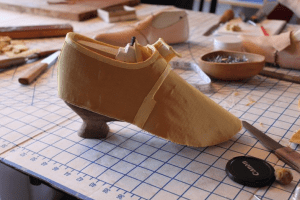 . . . There will be an eight-hour stitching workshop on the Saturday prior to the full class (20 August) that will be open to the publick. This part is a prerequisite, of course, to the full shoemaking workshop, and the fee is included in the total class fees for students of the entire class. However, this day will also be open to the general public as well for a stand-alone $60-per-person fee. We will cover measuring and making up of threads, attaching bristles, shoemaker’s stitch, round-closing, split-and-lift stitches, “subcutaneous” whip-stitches, stabbing stitches, & perhaps some miscellaney like how to make black wax, &c.
Sunday the 21st will be a short recess, and then the shoemaking class will begin in earnest at 8:00 a.m. on Monday morning, 22 August. The first hour-and-an-half or two hours will be a brief seminar on men’s and women’s shoe fashions, ca. 1700-1800, in which we’ll be attempting to “raise the bar” of the attendee’s awareness of stylistic and construction details in the various decades of the 18th-Century. This will most likely be open to the public for a $35 stand-alone fee, but that has not been confirmed.
At ten o’clock, we will take a brief break, after which those folks who are taking the full six-day class will dive right in to making instruction, wrapping up by five o’clock on Saturday, 27 August. When the workshop is completed, the students should have at least one shoe finished and perhaps a second one started.










leave a comment