Exhibition | Italian Tradition of the Quadreria
Now on view at Sperone Westwater:
A Picture Gallery in the Italian Tradition of the Quadreria, 1750-1850
Sperone Westwater, New York, 10 January — 23 February 2013

Francesco Celebrano, Luncheon in the Countryside, 102 x 69 in (260 x 175 cm), ca 1770-80 (New York: Sperone Westwater)
In collaboration with Galleria Carlo Virgilio, Rome, Sperone Westwater is pleased to present A Picture Gallery in the Italian Tradition of the Quadreria, 1750-1850. The exhibition showcases 29 paintings and drawings, all in the Italian figurative tradition, by various European masters created between the mid-18th and mid-19th century.
The exhibition aims to evoke the manner in which collections – known as quadrerie – were formed in Italy in the 18th and 19th centuries, as well as the way in which they were displayed, covering entire walls of the palazzo that housed them. This criterion predates the modern picture gallery, which follows a more scientific idea of classification derived from Illuminism. In addition to satisfying decorative motivations, the arrangement of works within a Quadreria followed the collector’s personal taste, with pictures hung according to related subjects or artistic genres.
Most of the works on view have never been exhibited or published, although many of them are widely documented in literary sources of the time. Firmly grounded in research, the exhibition presents significant works – masterpieces in some cases – by artists who are not widely known beyond specialist academic circles, but who nonetheless have played a key role in art history, with a view to illustrating the progress that research in Italy has made over the past thirty years.
The catalogue accompanying the exhibition groups the works according to artistic or iconographic genre, first with a series of portraits that offer insight into society of the time, followed by history and figure painting – considered the noblest artistic genre in the neoclassical academy tradition – and lastly, landscapes, to illustrate the phenomenon of the Grand Tour with Classical ruins and popular views.
Among the works in the exhibition is a painting by Francesco Celebrano shows members of the aristocracy having a luncheon on a country estate. This painting exemplifies the ancien régime and was likely intended as a model for a tapestry destined for the Neapolitan court. A portrait by Matilde Malechini portrays a French baroness in Rome during the Napoleonic occupation, while Giuseppe Tominz offers an austere, full-length portrait of a member of the new bourgeoisie in Trieste, the founder of the Assicurazioni Generali. The academy nude studies of Francesco Monti and Placido Fabris are followed by two demanding depictions of episodes from Classical history by Gaspare Landi and Pelagio Palagi – influential figures in the artistic circles of Rome and Milan.
The visionary reconstructions of Antiquity in the colored drawings by Giovan Battista Dell’Era counterbalance the series of sentimental mythological evocations by Friedrich Rehberg, Natale Carta and Henry Tresham, who presented his large painting, Sleeping Nymph and Cupid, to the Royal Academy of London in 1797. This section culminates in the romantic Renaissance literary subject by Francesco Podesti. A significant counter-revolutionary allegory by August Nicodemo shows the Dauphin at the tomb of his father, Louis XVI, while another large-format allegory by Francesco Caucig depicts the sentiment/malaise of melancholy with its remedies from Classical medicine.
After the sublime Biblical subject by François Gérard, the monochrome by Bernardino Nocchi of a sculpture by Canova, there follows a series of views of famous buildings of the time such as Hubert Robert’s interior of Palazzo Farnese at Caprarola, and of Classical ruins like the Temple of Diana at Baia in the capriccio by Carlo Bonavia. Two aristocratic travelers admire ruins in the paintings by Andrea Appiani, while an aqueduct is featured in the Roman campagna by Beniamino de Francesco. Volcanoes are the subject of two large-scale paintings by Pierre-Jacques Volaire and Carlo de Paris – the 1771 eruption of the Vesuvius in the Volaire, a virtuoso study of the effects of light caused by the glow of the lava, with lightning and the glare of the moon illuminating the panorama towards Naples and Ischia in the distance. The second volcano is the Pico de Orizaba in Mexico, in a work by a Roman school artist who attempted to document the native customs of Mexico and the grandiose and unspoiled landscapes of that country prior to the imminent transformations that would be brought by civilization. In contrast to this work, there is Antonio Basoli, who produced numerous imaginary views without almost ever leaving his native Bologna.
Curated by Stefano Grandesso, Gian Enzo Sperone and Carlo Virgilio, the exhibition has been produced in collaboration with Galleria Carlo Virgilio in Rome, a gallery that specializes in international art in Italy over the 18th and 19th centuries.
A fully illustrated catalogue will be published on occasion of this exhibition. The book includes an introduction by Joseph J. Rishel, the Gisela and Dennis Alter Senior Curator of European Painting before 1900 and Senior Curator of the John G Johnson Collection and the Rodin Museum, and scholarly entries by Emilie Beck Saiello, J. Patrice Marandel, Fernando Mazzocca, Ksenija Rozman and Nicola Spinosa.
New Book | Modern Antiques: The Material Past in England
From Bucknell UP:
Barrett Kalter, Modern Antiques: The Material Past in England, 1660-1780 (Lewisburg, PA: Bucknell University Press, 2012), 249 pages, ISBN 978-1611483789, $80.
 The recovery and reinvention of the past were fundamental to the conception of the modern in England during the long eighteenth century. Scholars then forged connections between linear time and empirical evidence that transformed historical consciousness. Chronologers, textual critics, and antiquaries constructed the notion of a material past, which spread through the cultures of print and consumption to a broader public, offering powerful–and for that reason, contested–ways of perceiving temporality and change, the historicity of objects, and the relation between fact and the imagination. But even as these innovative ideas won acceptance, they also generated rival forms of historical meaning. The regular procession of chronological time accentuated the deviance of anachronism and ephemerality, while the opposition of unique artifacts to ubiquitous commodities exoticized things that straddled this divide.
Inspired by the authentic products as well as the anomalous by-products of contemporary scholarship, writers, craftsmen, and shoppers appropriated the past to create nostalgic and ironic alternatives to their own moment. Barrett Kalter explores the history of these “modern antiques,” including Dryden’s translation of Virgil, modernizations of The Canterbury Tales, Gray’s Gothic wallpaper, and Walpole’s Strawberry Hill. Though grounded in the ancient and medieval eras, these works uncannily addressed the controversies about monarchy, nationhood, commerce, and specialized knowledge that defined the present for the English eighteenth century. Bringing together literary criticism, historiography, material culture studies, and book history, Kalter argues that the proliferation of modern antiques in this period reveals modernity’s paradoxical emergence out of encounters with the past.
Introduction: The Time Bound and the Modern Antique
Chapter 1 The “Cobweb-Law” and the Fundamental Law: History, Chronology, and Poetic License
Chapter 2 Chaucer Ancient and Modern: Standardization, Modernization, and the Eighteenth-Century Reception of The Canterbury Tales
Chapter 3 DIY Gothic: Thomas Gray and the Medieval Revival
Chapter 4 Horace Walpole’s Fugitive Pieces: Collecting and Ephemerality
Conclusion
Barrett Kalter is Associate Professor of English at University of Wisconsin-Milwaukee.
Things: Material Culture at Cambridge, Lent 2013
Programming from CRASSH at the University of Cambridge:
Things: Material Cultures of the Long Eighteen Century
Centre for Research in the Arts, Social Sciences and Humanities (CRASSH), Cambridge, ongoing series
The seminar meets alternate Tuesdays 12.30-2.30pm in the Seminar Room, Alison Richard Building, West Road. A light lunch will be provided.
 The early-modern period was the age of ‘stuff.’ Public production, collection, display and consumption of objects grew in influence, popularity, and scale. The form, function, and use of objects, ranging from scientific and musical instruments to weaponry and furnishings were influenced by distinct and changing features of the period. Early-modern knowledge was not divided into strict disciplines, in fact practice across what we now see as academic boundaries was essential to material creation. This seminar series uses an approach based on objects to encourage us to consider the unity of ideas of this period, to emphasise the lived human experience of technology and art, and the global dimension of material culture. We will build on our success discussing the long eighteenth century in 2012-13 to look at the interdisciplinary thinking through which early modern material culture was conceived, adding an attention to the question of what a ‘thing’ is, to gain new perspectives on the period through its artefacts.
Each seminar will feature two talks each considering a way of
thinking about objects.
22 January 2013 — Altered Things
Luisa Calè (Birkbeck) and Adam Smyth (Birkbeck)
5 February 2013 — Model Things
Simon Schaffer (Cambridge) and Anna Maerker (Kings College London)
19 February 2013 — Re-materialising Things
Jane Wildgoose (Kingston University and Keeper of The Wildgoose Memorial Library) and Mary Brooks (Durham)
5 March 2013 — Royal Things
Cordula Van Wyhe (York) and Desmond Shawe-Taylor (Surveyor of the Queen’s Pictures)
Visit the external blog or subscribe to the group mailing list.
BSECS 2013 Digital Prize | The History of Parliament

◊ ◊ ◊ ◊ ◊
As noted at The History of Parliament:
As announced at the recent BSECS conference in Oxford, the winner of the BSECS Digital Prize 2013 is The History of Parliament. In the words of the judges:
“The History of Parliament Online is an immensely valuable new resource for scholars of the long eighteenth century. It makes their comprehensive survey of British political history freely available, and presented in a form that is easily navigable and visually attractive.”
The site can be found via the BSECS Links page or directly here»
The prize is funded by Adam Matthew Digital, and GALE Cengage Learning. It is judged and awarded by BSECS. Nominations close on 13 December in any year.
◊ ◊ ◊ ◊ ◊
From The History of Parliament:
This site contains all of the biographical, constituency and introductory survey articles published in The History of Parliament series. Work is still underway on checking and cleaning the data that has been transferred into the website from a number of sources, and the current version of the site is still provisional. In order to find out more about the articles produced by the History, click on the links in the ‘Research’ section above. Additional material – explanatory articles, and images of Members, Parliaments and elections – have been produced specially for the website, and can be found through the ‘Explore’ and ‘Gallery’ sections above. For more information on the History, see the About us section, follow us on Facebook and Twitter or read the HistoryOfParliament, Director and VictorianCommons blogs.
New Book | Marlborough: Soldier and Diplomat
In the book’s final chapter, Richard Johns, curator of prints and drawings at the National Maritime Museum in Greenwich, addresses, “‘The British Caesar’: John Churchill, 1st Duke of Marlborough, and the Visual Arts.” From the publisher:
John Hattendorf, Augustus Veenendaal, and Rolof van Hövell tot Westerflier, eds., Marlborough: Soldier and Diplomat (Zutphen: Karwansaray Publishers, 2012), 408 pages, ISBN: 978-9490258047, € 75.
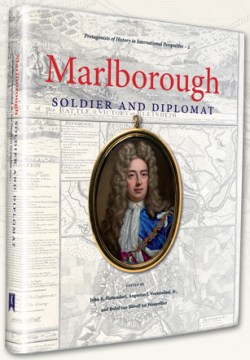
The subject of numerous books in English, Marlborough has typically been seen only in terms of British political and military history. In this book, twelve leading specialists of the period broaden the perspective by assessing Marlborough in the wider and more diverse contexts of the European situation, the common soldier in the British army, the complementary activities of navies, the differing perspectives of the Austrians, Dutch, French, and Germans as well as in the context of the British popular press and the visual arts.
John Churchill, the 1st Duke of Marlborough, is perhaps now best known for his role in the War of the Spanish Succesion. His victories at battles such as Blenheim, Ramillies, Oudenaarde, and Malplaquet have firmly established him as one of Britian’s greatest military heroes. His success also brought his family unprecedented wealth, power and influence. Physically handsome, he rose to power not only thanks to his military genius, but also his personal service as a very successful courtier. It was his interrelated personal, political, and family connections, combined with those his wife developed, that were the key elements in reaching and sustaining his positions of power. While the 1st Duke of Marlborough is firmly established in the British historical canon, far less has been said about him in a broader European context. Marlborough: Soldier and Diplomat attempts to address this disparity through a series of articles writen by noted international historians and experts. In this new book, the Duke is not only examined from the perspective of his enemies and allies, but also for his influence on social, military, and art history as a whole.
Edited by John B. Hattendorf, Augustus J. Veenendaal and Rolof van Hövell tot Westerflier, Marlborough: Soldier and Diplomat is lavishly illustrated with contemporary artwork and photographs of important places in Marlborough’s world. Each of its twelve chapters are dedicated to forming a complete but multi-faceted view of this important figure in European
Exhibition | Nicolas Colombel: L’Idéal et la grâce
Now on at the Musée des Beaux-Arts in Rouen:
Nicolas Colombel: L’Idéal et la grâce
Musée des Beaux-Arts, Rouen, 9 November 2012 — 24 February 2013
 This is the first monographic exhibition to be devoted to this figure long forgotten French painter of the Grand Siècle, Nicolas Colombel (ca. 1644-1717). The exhibition at the Museum of Fine Arts in Rouen brings us an important rediscovery. This artist born in Sotteville-lès-Rouen in approximately 1644 worked in Rome and Paris, developing a unique style which combines sensuality and idealism in the grand tradition of Poussin.
Bringing together over half of the artist’s known works today, dating from the 1680s until 1712, the exhibition offers a unique opportunity to discover Colombel’s unusual career. He was the only French painter of his generation to be successful in Rome before continuing a career in Paris at the Royal Academy of Painting and Sculpture during the reign of Louis XIV. The exhibition brings together exceptional loans from the most important collections in Europe and the United States.
◊ ◊ ◊ ◊ ◊
From the press materials:
Première exposition monographique consacrée à cette figure longtemps méconnue de la peinture française du Grand Siècle, l’exposition du musée des Beaux-Arts de Rouen consacre une redécouverte importante : celle d’un artiste né à Sotteville-lès-Rouen vers 1644, qui a fait carrière à Rome puis à Paris, concevant un style très singulier qui conjugue idéalisme et sensualité, dans la grande tradition de Poussin. Rassemblant plus de la moitié des oeuvres aujourd’hui connues, depuis les années 1680 jusqu’à 1712, l’exposition offre une occasion unique de découvrir le parcours atypique du seul peintre français de sa génération à rencontrer le succès à Rome, avant de faire carrière à Paris au sein de l’Académie royale de Peinture et de Sculpture, à la fin du règne de Louis XIV.
Nombre des tableaux de l’artiste n’ont été redécouverts que récemment : très recherchés des collectionneurs de peinture ancienne, ils sont aujourd’hui dispersés à travers le monde et la plupart sont conservés hors de France. L’exposition réunit des prêts exceptionnels venus des plus grandes collections d’Europe et des États-Unis. Elle marque également l’occasion de publier le catalogue raisonné de l’oeuvre de Nicolas Colombel.
Le parcours de l’exposition présente les principaux aspects de la carrière de Nicolas Colombel, articulés autour de deux axes : ses débuts à Rome, où il acquiert une notoriété auprès du public italien mais également français, puis sa carrière académique à Paris, lorsqu’il intègre l’Académie royale de Peinture et de Sculpture et développe, parallèlement à ses productions religieuses et à la peinture tirée de l’histoire ancienne, une peinture mythologique, aux tons éclaircis et accents de fable galante. Les débuts romains sont illustrés par la peinture religieuse marquée
par l’art de Nicolas Poussin ; Colombel est alors attaché à un classicisme rigoureux.
Les commandes réalisées à Rome pour les ordres religieux français démontrent qu’au-delà de l’exemple de Poussin, Colombel usa de références variées et retint les leçons de peintres tels que Philippe de Champaigne ou le Dominiquin. Les portraits de personnalités françaises peints à Rome révèlent que son activité de portraitiste
se développe suivant une ligne toute personnelle et qu’il développe en Italie un véritable réseau social français. L’italianisme dans la production de Colombel à Rome touche l’ensemble de sa production, les épisodes mythologiques, les scènes tirées de la littérature ou de l’histoire ancienne, comme celles issues de l’Ancien et du Nouveau Testament. Colombel tire ses modèles de Giacinto Gimignani, des Carrache, de Guido Reni.
Le retour à Paris est marqué par la réalisation de son morceau de réception à l’Académie royale qui dénote l’influence de Pierre Mignard, directeur de l’Académie royale, sur l’art de Colombel une fois qu’il intègre l’Académie. Les premières années de sa carrière parisienne doivent en effet beaucoup au modèle de Pierre Mignard, directeur de l’Académie royale, en particulier dans le genre du portrait mythologique dont Colombel fi t l’une de ses spécialités tout en continuant à offrir des compositions religieuses ou historiques. Sa compréhension de l’art bolonais, celui des élèves des Carrache, qu’il adapte aux attentes du public français dans des compositions mythologiques aux coloris clairs, à la ligne épurée et à la délicate sensualité font alors de lui l’un des artistes à la manière la plus séduisante au tournant du siècle.
◊ ◊ ◊ ◊ ◊
Catalogue: Karen Chastagnol, et al, Nicolas Colombel (vers 1644 – 1717): L’Idéal et la grâce (Paris: Éditions Nicolas Chaudun, 2012), 232 pages, ISBN: 978-2350391472, 39€ / $75. [available from ArtBooks.com]
 L’exposition réunit plus de la moitié des peintures de Colombel aujourd’hui conservées, ainsi que la plupart de ses dessins. Elle est l’occasion de publier un catalogue raisonné accompagné d’une biographie détaillée, rédigés par Karen Chastagnol, et complétés par plusieurs essais qui éclairent aussi bien les sources du peintre que le contexte romain des années 1680-1690.
Auteurs: Catalogue établi sous la direction de Karen Chastagnol avec des contributions de Pierre Rosenberg, Liliana Barroero et Diederik Bakhuÿs.
Exhibition | Johann Georg Pinsel: An 18th-Century Sculptor in Ukraine
From the Louvre:
Johann Georg Pinsel: Un Sculpteur Baroque en Ukraine au XVIIIe Siècle
Musée du Louvre, Paris, 22 November 2012 — 25 February 2013
Curated by Guilhem Scherf
 En étroite collaboration avec les institutions ukrainiennes, le musée du Louvre organise une exposition consacrée à Johann Georg Pinsel, un important sculpteur de l’époque baroque actif au milieu du XVIIIe siècle en Galicie, la partie occidentale du pays alors territoire polonais.
L’exposition s’appuie principalement sur les collections du musée Pinsel de Lviv, avec des emprunts venant d’autres musées de Galicie et aussi de Pologne (Wroclaw) et de Munich. Une trentaine de sculptures parmi les plus spectaculaires de l’artiste, majoritairement en bois (certaines avec polychromie ou dorure), seront présentées.
Le style de Pinsel, très brillant, proche de celui des grands sculpteurs de l’âge d’or du baroque germanique, témoigne d’une esthétique rarement montrée en France. L’artiste se distingue de ses contemporains par une personnalité propre : une gestuelle extravertie démonstrative, une expressivité prononcée, une caractérisation très personnelle des draperies.
◊ ◊ ◊ ◊ ◊
Jan K. Ostrowski and Guilhem Scherf, eds., Johann Georg Pinsel: Un sculpteur baroque en Ukraine au XVIIIe siècle (Paris: Coédition Louvre éditions/Snoeck éditions, 2012), 173 pages, ISBN: 978-9461610485, 32€.
Le catalogue, comprenant textes et notices d’oeuvres, est écrit par les spécialistes du sculpteur Jan Ostrowski, Boris Voznitsky, Oxana Kozyr-Fedotov avec également des essais de Claude Michaud et Guilhem Scherf. C’est le premier ouvrage sur Pinsel disponible en français.
◊ ◊ ◊ ◊ ◊
Didier Rykner reviewed the exhibition for La Tribune de l’Art (2 January 2013).
C’est à une vraie découverte que nous convie le département des sculptures du Musée du Louvre. Car qui, en France, pouvait se targuer d’avoir jamais entendu parler de Johann Georg Pinsel ? Ce sculpteur fut actif en Galicie, c’est-à-dire dans une région d’Europe de l’Est aux confins de la Pologne et de l’Ukraine, deux pays entre lesquels elle se partage aujourd’hui. Plus précisément, Pinsel exerça son art autour de Lviv (autrefois plutôt connue sous le nom de Lvov), un territoire faisant aujourd’hui partie de l’Ukraine, et aux populations mêlées, ainsi qu’aux religions diverses (catholiques romains, uniates – c’est-à-dire catholiques grecs, et orthodoxes). . . .
◊ ◊ ◊ ◊ ◊
Call for Papers | Visualizing Portuguese Power
Visualizing Portuguese Power: The Political Use of Images
in Portugal and Its Overseas Empire, 16th to 18th Century
Munich, Center for Advanced Studies, 26-27 September 2013
Proposals due by 28 February 2013
Images have always played a vital role in political communication and in the visualization of power structures and hierarchies. They gain even more importance in situations where non-verbal communication prevails: In the negotiation processes between two (or more) different cultures, the language of the visual is often thought of as the more effective way to acquaint (and overpower) the others with one’s own principles, beliefs, value systems. Scores of these asymmetrical exchange situations have taken place in the Portuguese overseas Empire since its gradual expansion in the 16th century.
In art history, the role of images in the contact zones of the early modern empires has recently met with an increasing interest. It is above all the study of objects belonging to the so-called Jesuit mission art and the art produced in the context of the other religious orders that has shed new light on the potentiality of images in
transcultural exchange processes. Numerous of these religious art works were, however, also used to visualize political claims and transmit notions of colonial power. The Munich workshop aims to develop thoughts on the broad phenomenon of Portuguese-Christian Art in the African, Asian and American colonies further by adding the dimension of the political appropriation of these (and other) objects. How were these ‘hybrid’ artefacts staged and handled to generate new layers of meaning and visualize political ideas and concepts? (more…)
CAA 2013, New York

NYC from the Millennium UN Plaza Hotel, 2 September 2007
(Photo by AngMoKio, Wikimedia Commons)
◊ ◊ ◊ ◊ ◊
The 2013 College Art Association conference takes place in New York, February 13-16. HECAA will be represented by two panels on Friday, chaired by Hector Reyes and Amelia Rauser. Other sessions that may be of interest for dixhuitièmistes are also listed. A full schedule of panels is available here»
H E C A A S E S S I O N S
Art in the Age of Philosophy?
Friday, February 15, 9:30-12:00, Nassau Suite
Chair: Hector Reyes (University of California, Los Angeles)
- Anne Betty Weinshenker (Montclair State University), The Allegorical Tomb of Locke, Boyle, and Sydenham: A Celebration of Empiricism
- Stephanie O’Rourke (Columbia University), Faithful Impressions: Fuseli, Lavater, and the Physiognomic Pursuit of Knowledge
- Ryan Whyte (Ontario College of Art and Design University), Happy Fathers and Other New Ideas in French Art: Genre, Masculinity, and Philosophy in the Final Decades of the Old Regime
- Lauren Cannady (Institute of Fine Arts, New York University), Aesthetic Discourse in Science: The Rococo and the Natural World
- Johanna Fassl (Franklin College Switzerland), Radical Thought: Connecting Guardi, Newton, Vico, and Damasio
◊ ◊ ◊ ◊ ◊
New Scholars Session: International Artists Working in Eighteenth-Century Great Britain
Friday, February 15, 12:30-2:00, Rendezvous Trianon
Chair: Amelia Rauser (Franklin and Marshall College)
- Francesca Whitlum-Cooper (Courtauld Institute of Art), Quacks, Peddlers, and Pastellists: Jean-Etienne Liotard (1702–89) and Jean-Baptiste Perronneau (1715–83) in London
- Katherine McHale (Hunter College, City University of New York), The Bel Composto: The Role of Inset Paintings in Robert Adam’s Interiors
- Abram Fox (University of Maryland), Family, Students, and Legacy: Benjamin West’s Workshop and the Shaping of an American School of Art
◊ ◊ ◊ ◊ ◊
O T H E R S E S S I O N S R E L A T E D T O T H E 1 8 T H C E N T U R Y (more…)
New Book | The Fusion of Neo-Classical Principles
From Wordwell Books:
Lynda Mulvin, ed., The Fusion of Neo-Classical Principles (Dublin: Wordwell, 2012), 200 pages, ISBN: 978-1905569557, €35.
 Our understanding of Neo-Classicism is currently in an interesting phase of development, a progression to which this volume will make a significant contribution. As Kathleen James-Chakraborty’s keynote paper argues, scholarly attention is shifting from a focus on the production of works of art and buildings to a focus on consumption. The only chapter in the book that deals with painting, Brendan Cassidy’s on the reputation of Gavin Hamilton, neatly exemplifies the polarities of production and consumption. Hamilton painted his pictures in Rome where they were admired by travelling British patrons but, upon their arrival in England, they were consumed by the public with far less enthusiasm. Cassidy advances a very particular reason for this: that Grand Tourists tended to be very young men who took pleasure in identifying Hamilton’s historical subjects whilst on the sacred territory of Rome by reference to their schoolboy steeping in classical texts but, on their return to more distant northern Europe, were happy to conform with the predominant taste for landscape painting and portraiture.
Conor Lucey’s chapter, on the architectural pattern books that can be identified as having been in the hands of Dublin artisans, is a good contribution to the theme of diffusion of design ideas from one place to another, as is John Wilton-Ely’s on the design revolution of Robert Adam. As Wilton-Ely argues, the targeting and marketing of a ‘style’ is a sign of economic modernity. Another aspect of economic modernity in the eighteenth century is the quasi-professional organisation of the means of production, and Barbara Arciswewska’s essay on the reform of the English Office of Works instigated by the new Hanoverian dynasty is a very important contribution to scholarship in this respect.
In this volume the chapters of Michael McCarthy and Toby Barnard deal explicitly with the problem of when Neo-Classicism begins and ends. McCarthy argues that the fierceness of the nineteenth-century ‘battle of the styles’ has caused us to lose sight of the more gentlemanly basis on which the debate took place in the eighteenth century, but Barnard explores the religious disputes in Ireland that saw the Gothic commandeered by the Protestant community and the Catholics turning to classicism – and perhaps not unwillingly, given that their sense of civic duty was modelled on their classical educations like the young English aristocrats who, as we have seen, form the basis of Cassidy’s chapter.
The issue of the thoroughgoing Greek Revival, which would have hardly any place if this volume were circumscribed in chronological terms by the dates 1750-1800, is vigorously dealt with in this volume by three essays. Susan Pearce looks back to that first truly great phase of archaeological discovery in Greece that followed the Napoleonic Wars and in particular at the extraordinary understandings of Greek architecture and architectural sculpture of C.R. Cockerell. Lynda Mulvin’s own chapter on Cockerell’s work in Ireland pursues these ideas into built form are, while Patricia McCarthy deals with the much more extensive Irish projects of Richard and William Morrison. Also in this connection, Joe McDonnell through the works of the Irish sculptor Christopher Hewetson and Paul Caffrey with a collection of miniatures examine the emergence of Neo-Classicism in other media in Ireland.
A final strand to this rich volume can be found in the transference of design ideas between different artistic media. This is explored in the essays of Tracy Watts and Eddie McParland.
These essays will make a wide-ranging and stimulating contribution to current scholarly debates about the nature of Neo-Classicism, that critical cultural development that signals the arrival both of recognisable modernity and of internationalism in the western tradition. Moreover the essays have been written by some of the leading experts on the subject.










 Enfilade
leave a comment