Cleveland Museum of Art Acquires Newport Desk and Bookcase
Press release (9 February 2013) from the Cleveland Museum of Art:

Desk and Bookcase, Newport, Rhode Island, ca. 1780-95. Plum pudding mahogany, red cedar, chestnut, white pine and brass; 240 x 108 x 65 cm. (Cleveland Museum of Art)
Donated to the Cleveland Museum of Art by Daniel Harvey Buchanan, a retired Case Western Reserve University professor, in memory of his wife Penelope Draper Buchanan and her mother Dorothy Tuckerman Draper, this desk and bookcase dates from ca. 1780-95, a rich period of cabinetmaking in Newport, Rhode Island, just after the American Revolution. The work is attributed to the master cabinetmaker John Townsend or his brother Thomas Townsend based on stylistic similarities to other known case pieces by this leading cabinetmaking family of Newport. Commissioned by Oliver Wolcott, Sr., a signer of the Declaration of Independence from Connecticut, the desk has an unbroken provenance from its first owner by descent through the Wolcott, Tuckerman, Minturn and Draper families to its final owners, Penelope and Harvey Buchanan.
Dorothy Draper (1889–1969), Penelope Buchanan’s mother, displayed the desk and bookcase in her fashionable New York apartment at the Carlyle Hotel until coming to live in Cleveland in 1965. Dorothy Draper was a world-renowned interior designer and established the first interior design company in the United States in 1923. She had a regular column in Good Housekeeping Magazine and in 2006, Dorothy Draper was honored in a retrospective exhibition of her work by the Museum of the City of New York. According to Stephen Harrison, curator of decorative art and design, “This gift celebrates the extraordinary stewardship of one family in preserving such an important relic of American history from the eighteenth century. Such a gift is transformative in the development of our American collections. We could not have otherwise acquired such a masterpiece in the American furniture market today.” Harrison further stated, “This work will join other colonial-era masterpieces in the museum’s American galleries as a testament to the remarkable craftsmanship of American cabinetmakers in the eighteenth century.”
The quality of the workmanship in this desk and bookcase is superb and displays masterful embellishments known only to the finest Newport case pieces. For example, the use of “plum pudding” mahogany, a type of wood that is extremely rare and named for the blemishes in it that resemble the raisins in a plum pudding along with inset panels with canted corners (a decorative angled corner). Only one other example exhibiting canted corners on the upper panels is known to exist, making this piece extremely rare in the world of Newport furniture. The case also has stop-fluted corner pilasters (columns); carved “cupcake” finials (flattened finial with a corkscrew extending from it); and highly sophisticated drawer details. In addition, it retains its original brass pulls and escutcheons, and there is evidence of original finish inside the desk top. The Oliver Wolcott Desk and Bookcase augments the Cleveland Museum of Art’s small but choice collection of early American furniture and is now on view in the American Colonial Gallery.
Fellowships | Seeing Things: Early Modern Visual and Material Culture
From CRASSH at Cambridge:
Fellowships | Seeing Things: Early Modern Visual and Material Culture
Six-month or 12-month Fellowships to be held from January 2014 to September 2015
Applications due by 16 May 2013
The Centre for Research in Arts, Social Societies and Humanities (CRASSH) at the University of Cambridge and the Early Modern Studies Institute (EMSI) at the University of Southern California / Huntington Library invite applications for Visiting Fellowships in Early Modern Visual and Material Culture, to be held between January 2014 and September 2015. These fellowships are part of the collaborative programme Seeing Things: Early Modern Visual and Material Culture CRASSH / EMSI will appoint up to four fellows over the period (two fellows for twelve months each or 4 fellows for six months each). Fellows will spend half of their fellowship at CRASSH and half at the Huntington Library, San Marino.
During their residencies in each institution, fellows will be expected to conduct research on a topic in early modern (1400-1800) visual and material culture and to participate in the life of CRASSH / EMSI. There are no geographical restrictions on research topics, but proposals related to the special collections and museum holdings of Cambridge and the Huntington will be particularly welcome. In addition to carrying out independent research, fellows will be expected to deliver at each institution a master class for early career researchers and graduate students, on a topic of their choice.
Eligibility
The fellowships are open to postdoctoral scholars at any career stage.
Provision
The Fellowships are non-stipendiary. Successful candidates will be provided with a contribution to their accommodation costs for up to six months in each location (local rates will apply) and return travel from their home institution to both destinations, workspace, and access to libraries and special collections.
Details are available here»
Call for Papers | Movement: The Body and Object in Motion
Graduate Student Symposium| Movement: The Body and Object in Motion
Cornell University, Ithaca, New York, 4 October 2013
Proposals due by 30 April 2013
The graduate students in the History of Art program at Cornell University invite abstracts for papers to be presented at the Graduate Student Symposium to be held on October 4th, 2013. This year’s symposium, “Movement: The Body and Object in Motion,” will feature a keynote lecture presented by Dr. Coco Fusco and will explore the theme of movement in visual culture via three panels consisting of three speakers each.
Movement in visual culture is a fundamental theme across all media and periods. Movement defines both the pre-modern and modern periods in all their complexities, as peoples are colonized and decolonized, orders are invented and moved, tourists visit sites, products are shipped from other continents for consumption, and wars are waged around the globe. It is manifest in the journey of the soul through life and in its final voyage into death. Movement also creates a narrative for objects and ideas as they travel with people. Possible panel ideas include but are not limited to: migration, diaspora, grand tour, tourism, slavery, across realms, exchange/trade, urban planning
and the movement of the body/political body, spiritual movement, movement of objects and cultural property.
The graduate students in the department of History of Art at Cornell University welcome the submission of abstracts for papers from graduate students. We invite papers from a broad range of periods, from prehistoric to contemporary, and from a broad range of disciplines. Submission is open to graduate students in art history, archaeology, conservation, museum studies, classics, anthropology, sociology, and beyond. Please send a 250-word abstract of your paper, a list of two or three possible panel themes your paper may fit, a current CV, and contact information by April 30, 2013 to cornellgradsymposium@gmail.com.
Traveling to Ithaca: Ithaca Tompkins Regional Airport, Lansing, NY (15 mins from Cornell University). Please also look here for additional information and alternatives on how to reach Ithaca. We are happy to facilitate shared lodging/travel costs among speakers.
Exhibition | Stradivarius at the Ashmolean
From the Ashmolean Museum:
Stradivarius
Ashmolean Museum, Oxford, 13 June — 11 August 2013

Ashmolean Museum, Oxford. Photo by Merlin Cooper, 2005, Wikimedia Commons
Antonio Stradivari (c.1644–1737) – or Stradivarius as he is usually known – is the only maker of musical instruments whose name ranks alongside those of the great composers. For the first time will twenty of his instruments, from guitar to cello to violin, be on display together in the UK. While the details of his life are not as familiar as those of Vivaldi or Mozart, his name succeeds in evoking a creative genius in the popular imagination. The Ashmolean’s summer 2013 exhibition will feature twenty of the world’s most important musical instruments, some of which have never been shown in public, on loan from international collections: from the early Silvestre violin of 1666, to the Fountaine violino piccolo, the Boissier-Sarasate of 1713, to his later violins of the 1730s. It will also show a recreation of Stradivarius’s workshop where visitors will be able to follow the creation of a violin from a log of spruce through to the finished instrument.
◊ ◊ ◊ ◊ ◊
From ACC Distribution:
Charles Beare, Peter Beare and Jon Whiteley, Stradivarius (Oxford: Ashmolean Museum, 2013), 200 pages, ISBN:
9781854442758, $40.
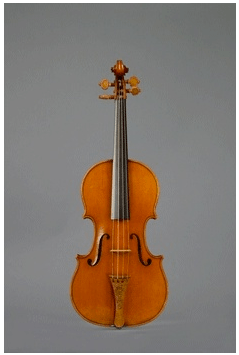 Antonio Stradivari is, perhaps, the only maker of violins who ranks alongside Van Gogh and Turner as an artist. A household name to many, he is associated with secret formulae and mystical processes ensuring his instruments are sought after by the world’s greatest soloists. He excites controversy, although none of his violins have raised so much heated debate as the Ashmolean’s Messiah, making headline news some ten years ago when doubt was cast on its age. Stradivari’s birthplace is unknown, he may have been born in 1644, and even his apprenticeship to Nicola Amati is uncertain. He died rich and famous in Cremona in 1737. Since then his instruments have increased in fame and are now regarded as supreme examples of the violin-maker’s craft. Despite the great fame of Stradivari’s violins, there has never been a monographic exhibition of his work in the UK. It will include 30 instruments, representative of Stradivari’s range and output across the years, alongside exceedingly rare examples of stringed instruments other than those of the violin family.
The prize items to be featured in the exhibition are already in the Ashmolean: The Potter, The Messiah and the guitar of 1688, all works of the greatest rarity. The exhibition and the accompanying catalogue will allow the public to see the work of one of the greatest violin makers of all time. Stradivarius also presents the most recent research on Stradivarius’ instruments.
Contents: Introduction by James Ehnes; essay on Stradivarius by Charles Beare; essay on Stradivarius’ work including dendrachronology of the instruments; “The luthier’s perspective: How Stradivari violins are built and what makes them so good?” by Peter Beare; catalogue entries; technical information.
Charles and Peter Beare are directors at the successful violin dealers Beares. Peter is a qualified luthier. Jon Whiteley is the Senior Assistant Keeper in the Department of Western Art, specializing in paintings drawings and musical instruments.
◊ ◊ ◊ ◊ ◊
From Music at Oxford:
The Dawn of the Stradivarius with James Ehnes and La Serenissima
Sheldonian Theatre, Oxford, 14 June 2013
 In association with The Ashmolean Museum’s extraordinary forthcoming exhibition of the world’s finest Stradivarius instruments, Music at Oxford is proud to present this collaborative concert. Canadian virtuoso and Stradivarius player James Ehnes will perform unaccompanied music by Bach and Paganini on a number of Stradivarius violins and discuss what’s unique about them and the sound they produce. This will be the first time one player has ever had the opportunity to do so in a concert setting. Award-winning period ensemble La Serenissima will follow this by performing a programme of music from the age of Stradivarius by Vivaldi, Valentini and their contemporaries.
This event will open the exhibition, a fascinating exploration of the master maker’s work featuring the largest collection of Stradivarius instruments ever assembled as well as audiovisual footage featuring James Ehnes. Don’t miss this exciting event, our 2012-13 season closer. Tickets are bound to be in great demand so please do book early.
Exhibition | Life at the Château de Prangins in the 18th Century
From the museum’s website:
Noblesse Oblige! Life at a Château in the 18th Century
Swiss National Museum, Château de Prangins, beginning 23 March 2013

Château de Prangins, 2005
(Photo from Wikimedia Commons)
◊ ◊ ◊ ◊ ◊
Château de Prangins is bringing its past to life and showcasing its historical heritage. From 23 March 2013 the former reception rooms, comprising the salon, dining rooms and libraries, will be revealed in their original grandeur as the backdrop for the new permanent exhibition. Boiseries in their original colours, textiles with lustrous motifs and false-marble decorations create the perfect surroundings for 600 objects from the era.
 Noblesse Oblige! Life at a Château in the 18th Century is devoted to the everyday life of a noble family in the Vaud region at the end of the 18th century and explores important issues of cultural history. The exhibition offers an insight into the life of a baron and the way in which he manages his estate, his duties and obligations, his family and social life. Each of the nine rooms is devoted to a specific topic that mirrors its original function: hospitality, wealth and lighting in the salon, servants in the butler’s pantry, and the taste for reading in the library.
Two audioguides – one for adults, the other for younger audiences – and specially produced films featuring the voices of the inhabitants allow visitors to immerse themselves in life at a château.
Project manager: Helen Bieri Thomson
The Met and Crystal Bridges to Share Portrait of Alexander Hamilton
Press release (14 March 2013) from Crystal Bridges:

John Trumbull, Portrait of Alexander Hamilton, 1792. Oil on canvas, 86 x 58 inches (219.1 x 146.1 cm)
An iconic full-length portrait by the celebrated Revolutionary-era painter John Trumbull of Alexander Hamilton, then Secretary of the Treasury under President George Washington, will join the permanent collections of both Crystal Bridges Museum of American Art and The Metropolitan Museum of Art, thanks to a gift from the painting’s owner, the global wealth manager and investment bank Credit Suisse.
Each institution will own a half share of Portrait of Alexander Hamilton (1792), which is currently on view at Crystal Bridges and has been on loan from Credit Suisse and on view since the museum opened. The painting will travel to the Metropolitan Museum in summer 2013 and return to Crystal Bridges in 2014. In subsequent years, each museum plans to exhibit the painting for two-year periods, when it will be integrated into the galleries and, on occasion, included in special exhibitions at each museum.
“We are very grateful to Credit Suisse for the generous gift of this distinguished portrait of Alexander Hamilton, whose political and legal acumen put him at the center of the founding of the new American republic, and whose key contributions to business and banking in Federal-era New York City effectively established the financial marketplace in this country,” stated Thomas P. Campbell, Director and CEO of The Metropolitan Museum of Art. “As the greatest known portrait of Hamilton and one of the finest civic portraits from the Federal period, this painting is a splendid addition to our fine collection of portraits of American political leaders. We are pleased and honored to share this remarkable work with Crystal Bridges.” (more…)
The Met Acquires Work by William Theed
As noted at Art Daily (14 March 2013) . . .
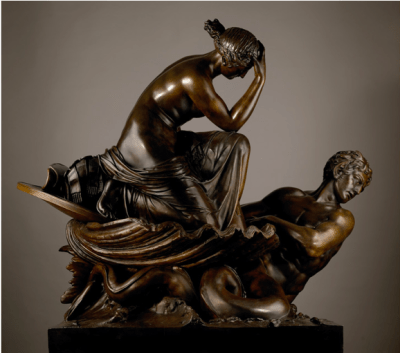
William Theed the Elder (1764-1817), Thetis Returning from Vulcan with the Armour of Achilles. Bronze, cast, chased and patinated, on an integral rectangular plinth. Height: 128 cm; width: 120 cm; length: 143 cm.
For over a year, Tomasso Brothers, the internationally renowned dealers in European sculpture, paintings, furniture and the decorative arts, has been searching for an elegant space in London. Dino and Raffaello are now delighted to announce that from 1 May 2013 they can be found at their new gallery at 12 Duke Street , St James’s. Established in 1993 and based at Bardon Hall, Leeds, Tomasso Brothers is pleased to also have a presence in the heart of London ’s traditional art market where they will showcase exciting pieces from their extensive portfolio.
The two Tomasso brothers are especially renowned for their expertise in European sculpture and boast a number of the world’s greatest museums amongst their clients. Recent sales include a major bronze to the Metropolitan Museum of Art, New York, Thetis Returning from Vulcan with the Armour of Achilles by William Theed the Elder (1764-1817), which was unveiled at the inaugural Frieze Masters in October 2012. This remarkable, almost life-size, bronze depicts the ‘divine Thetis of the silver feet’, most famous of the Nereids in Homer’s Iliad, kneeling by the shield of her son Achilles with the hero’s armour in a giant cockle shell. This spectacular sculpture, described by Sir Timothy Clifford as ‘undoubtedly Theed’s most ambitious work’, was almost certainly originally supplied to the author, philosopher, interior designer and art collector, Thomas Hope (1769-1831) for Duchess Street, London, or his country house Deepdene in Surrey. William Theed was born in London and entered the Royal Academy Schools in 1786. He went to Italy in 1790, returning in 1796. He began his artistic career as a painter but was befriended by the sculptor John Flaxman whilst in Rome and took up sculpture. Flaxman’s designs for Homer’s Iliad clearly made a powerful and lasting impression on the young Theed. Dino Tomasso said: ‘It is hugely gratifying when such a superb sculpture ends up in one of the world’s leading museums’. Dino and Raffaello Tomasso take great pride and pleasure in helping connoisseurs and museums in Europe and America to enhance their collections. In addition the company has promoted and supported through loans and exhibitions major international institutions such as the Fitzwilliam Museum, Cambridge, the Centro Internazionale, Carrara, the National Gallery, Prague, and the Kunsthistorisches Museum, Vienna. Most recently they were one of the sponsors of the landmark show Bronze at the Royal Academy of Arts, London , in 2012.
Tomasso Brothers will be exhibiting at TEFAF, 15 to 24 March 2013, Stand 165, Masterpiece London, 27 June to 3 July 2013, Stand C2, and also joining Master Drawings and Sculpture Week from 28 June to 5 July 2013.
Spring 2013 Issue of ‘Renaissance Quarterly’
The eighteenth century in the current issue of Renaissance Quarterly:
Paula Findlen, “The 2012 Josephine Waters Bennett Lecture: The Eighteenth-Century Invention of the Renaissance: Lessons from the Uffizi,” Renaissance Quarterly 66 (Spring 2013): 1-34.
 This essay explores the role that the eighteenth-century Uffizi gallery played in the invention of the Renaissance. Under the Habsburg-Lorraine rulers, and especially during the reign of Grand Duke Peter Leopold (r. 1765–90), changes to the Medici collections and the gallery’s organization transformed an early modern cabinet of curiosities, paintings, and antiquities into a space in which a historical narrative of art, inspired by rereadings of Giorgio Vasari’s Lives, became visible in a building he designed. A succession of Uffizi personnel was increasingly preoccupied with how to see renaissance, and more specifically Tuscan rinascita, in the collections. The struggles between the director Giuseppe Pelli Bencivenni and his vice-director Luigi Lanzi highlight how different understandings of the Renaissance emerged in dialogue with antiquarianism and medievalism. At the end of the eighteenth century the Uffizi would definitively become a museum of the Renaissance to inspire new forms of historical writing in the age of Michelet and Burckhardt.
Thoughts on Paper: A Blog and a Book
Those of you taken by the materiality of paper may be interested in Lucy Vivante’s blog posting from 15 January 2013 on Paper and Watermarks, in which she interviews Neil Harris and Peter Bower. And if the distance between those traditions of making and our own dependence upon screens leaving you feeling elegiac, you might have a look at Ian Sansom’s new book. -CH
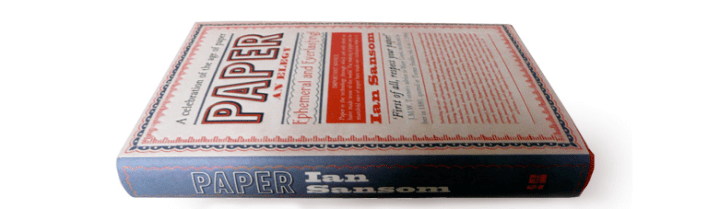
Ian Sansom, Paper: An Elegy (London: Fourth Estate, 2012), 224 pages, ISBN: 978-0007480265, $25.
The history of civilization is bound up with — and bound in — the history of paper. Paper is the technology through which and with which we make sense of the world: knowledge and information is arranged in words, images and numbers on paper; values and ideas are exchanged and transmitted by paper. The making of paper, the trade in it, the use of it, brought about a new era in human civilization.
That era is coming to an end. In 2010, Amazon announced that for the first time it was selling more e-books than paper books. According to Nicholas Negroponte, founder of MIT′s Media Lab, the paper book has five years left to live before becoming extinct. The world we know was made from paper: yet everywhere you look, paper is dying, its influence literally disintegrating.
In Paper: An Elegy Ian Sansom traces the history of paper-making from the 7th-century Chinese workmen who made paper from the inner bark of plants and trees, to the 17th-century vatmen and couchers who dipped and shook and dried paper moulds to make folios and quartos, to today′s billion-dollar paper industry; from papyrus to e-books. Both a cultural overview and a series of warm, personal meditations on the history and meaning of paper in all its forms – as both a means of communication and as an artefact in itself – this book is a lively valediction to the paper it′s printed on.
Free Trial Access to Gale Digital Collections until June 15
ASECS Trial for Gale Digital Collections
Gale Digital Collections is providing a free trial to many of its collections, from now until June 15, 2013. This trial does not require a username or password. Feel free to share this trial with your colleagues. If you find value in any of these collections, please contact your library liaison. Often times, faculty feedback and comments influence library collection development decisions. Here are the digital collections for review in alphabetical order:
British Literary Manuscripts – This extensive digital archive includes hundreds of thousands of pages of poems, plays, essays, novels, diaries, journals, correspondence and other manuscripts from the Restoration through the Victorian era.
Eighteenth Century Collections Online (ECCO) – Consisting of every significant English-language and foreign-language title printed in the United Kingdom during the 18th century, along with thousands of important works from the Americas, Eighteenth Century Collections Online was the most ambitious single scholarly digitization project ever undertaken. Bearing witness to what many scholars consider the three most significant events in world history — The American Revolution, The French Revolution and The Industrial Revolution.
Gale NewsVault – The definitive cross-searching experience for exploring Gale’s range of historical newspaper and periodical collections. Users can simultaneously search or browse across The Times Digital Archive 1785-1985, 17th and 18th Century Burney Collection Newspapers, Financial Times Historical Archive 1888-2006, 19th Century U.S. Newspapers, and many more.
The Making of the Modern World, Parts I&II – This unrivaled online library fully documents the dynamics of Western trade and wealth that shaped the world from the last half of the 15th century to the mid-19th century. Part II adds approximately 5,000 newly scanned titles extends this impressive series into the beginning of the 20th century.
Nineteenth Century Collections Online (NCCO) – The most ambitious scholarly digitization and publication program ever undertaken, this collection is invaluable to research and teaching in one of the most studied historical periods. Rare primary sources, curated by an international team of experts, provide never-before-possible access to important works sourced from leading libraries worldwide.
Sabin Americana, 1500-1926 – This is an online collection of books, pamphlets, serials and other works about the Americas, from the time of their discovery to the early 1900s.
Slavery and Anti-Slavery: A Transnational Archive – The largest and most ambitious project of its kind, this collection is a thematically organized, four-part historical archive devoted to the scholarly study and understanding of slavery from a multinational perspective.
State Papers Online–This collection is the gold standard for anyone conducting research on early modern English politics and culture. Organized in four parts, each cross-searchable and available separately, this online archive of original manuscript documents of British State Papers chronicles domestic and foreign history, from 1509-1714, the period of Henry VIII to Queen Anne.










 Enfilade
leave a comment