Exhibition and Resource | French Pamphlets at The Newberry
From The Newberry:
Politics, Piety, and Poison: French Pamphlets, 1600–1800
The Newberry Library, Chicago, 28 January — 13 April 2013
This exhibition displays French pamphlets published during the transitional period from the Ancien Régime to the French Revolution. They served as modes of dissemination and diversion, teaching tools and educational models, and the foundation for current and future scholarly projects. The exhibition focuses on the ways in which these pamphlets complement and enhance the Newberry’s other vast collections of primary sources documenting early modern European culture and the history of printing. The Newberry’s outstanding collection of French pamphlets was recently cataloged through a grant from the Council on Library and Information Resources.
◊ ◊ ◊ ◊ ◊
About The Newberry’s cataloging project:
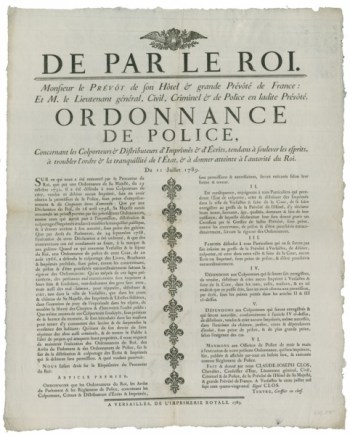
Case Wing Z 144.A1, vol.10 No.87, Ordonance (The Newberry Library)
French Pamphlet Collections at the Newberry Library is a three-year project funded by a Council on Library and Information Resources (CLIR) Cataloging Hidden Special Collections and Archives grant. CLIR administers this national effort with the support of generous funding from The Andrew W. Mellon Foundation. French Pamphlet Collections at the Newberry Library began in January 2010 and will be completed in January 2013. Through the project, the Newberry is creating full, item-level MARC records for 22,000 French pamphlets that date from the 16th to the 19th century.
The Newberry applied for the CLIR grant to support one of its top cataloging priorities of processing hidden collections. A committee comprised of staff with library service, stacks management, curatorial and collection development responsibilities prioritized these uncataloged and undercataloged materials based on its knowledge of researcher requests, scholarship trends, Newberry collection strengths, subject areas in need of development, and strong complementary collections in other institutions. Pamphlet collections were one of the highest priorities. More specifically, the committee identified the French Pamphlet Collections as being an urgent cataloging need. The material complements strengths of the Newberry’s collection and it is in high-demand by researchers. The bulk of the pamphlets date to the period of the French Revolution and are primary sources for legal, social, and cultural history; literary studies; and the history of publishing. These ephemeral documents have often been overlooked and undervalued by past generations of scholars and undercataloged in research collections. They are of particular value to modern scholarship because they move past official histories and contribute to new interpretations. . .
Call for Articles | The Senses of Humour
“The Senses of Humour,” edited by Eugenia Zuroski Jenkins, is a special issue of Eighteenth-Century Fiction that will explore the relationships among various meanings of the term “humour” in the long eighteenth century, from humoral theories of the body to the cultivation and regulation of “senses of humour” in literature, culture, and social interaction. We invite submissions on eighteenth-century legacies of classical humoral theory; the philosophy of laughter; the emergence of modern forms of wit, satire, and other humorous genres in literature and illustration; cul-tural negotiations of body and mind as sites of “humour”; and the role of humour(s) in discourses of feeling, sentiment, sensibility, and sociality. We welcome articles that treat the topic in areas both inside and outside of imaginative prose fiction. Manuscripts (5,000-8,000 words) should reach ECF by 1 May 2013. Electronic submissions are encouraged: visit ECF at Digital Commons & choose “Submit Article.”
Further details about submitting articles can be found at / Les protocoles de la présentation et de la soumission des articles sont consultables à “Editorial Policy.” To submit an article for a special issue, or a call for articles, or a regular issue of the journal, which publishes 4 issues per year, choose “Submit Article.” We encourage electronic submissions at Digital Commons, but if you have any concerns about this online submissions system, you may contact the ECF editors at ecf@mcmaster.ca.
Conference | Peter the Great
From the Fondation Singer-Polignac:
Pierre le Grand et l’Europe Intellectuelle: Contexte, Réseaux, Circulation, Réalisations
Fondation Singer-Polignac, Paris, 28-29 March 2013
 Le règne de Pierre le Grand se scande en deux parties. À son avènement, il comprit les difficultés dues à un certain retard technologique de la Russie. Le transfert (par toutes les filières possibles) et l’acculturation des connaissances venues d’Europe devinrent le leitmotiv de sa politique. De son vivant, le tsar fut comparé à Prométhée. Presque tout était à créer. Le corpus des savoirs nécessaires était insuffisant. Les structures étatiques archaïques, que ce soit dans le domaine diplomatique, militaire ou administratif, ne lui permettaient pas d’affronter les problèmes d’actualité. L’état obsolète de la technique – artillerie, armement, fortifications, mines et métallurgie – freinait les ambitions géopolitiques du monarque. D’autres infrastructures, la marine de guerre par exemple, n’existaient pas. Il manquait également un système d’enseignement et des structures de production scientifiques. Deux décennies durant, Pierre Ier s’efforça à esquiver ou à parer les coups en les anticipant dans la mesure du possible. Il travailla ainsi dans l’improvisation, au gré des nécessités militaires, politiques et sociales. Vers la fin des années 1710, la guerre du Nord touchant à sa fin, il prit conscience d’avoir accumulé suffisamment d’expérience en matière d’appropriation des connaissances européennes ; ses réformes devinrent de plus en plus réfléchies et systématiques. Dans ce nouveau paradigme, les savoirs artistiques, scientifiques et administratifs changèrent de signification et rejoignirent, à titre d’égalité, le transfert des connaissances techniques. Le pragmatisme de Pierre Ier répondait au principe de l’utilité, à une forme d’utilitarisme moral et économique destiné à réaliser un projet sociétal. C’est l’axe majeur de cette rencontre internationale. Les études qui se proposent d’examiner globalement le phénomène de transfert et son impact sur la Russie et l’Europe occidentale restent rares. Dans le cadre de ce colloque, nous nous proposons d’affronter un défi, en réunissant autour de ces grands axes de réflexion des chercheurs ayant mené, depuis une vingtaine d’années, des enquêtes originales et souvent inédites sur les divers aspects des relations entre la Russie et l’Occident à l’époque pétrovienne.
Consulter le programme sur le site de la Fondation Singer-Polignac.
Exhibition | Piranesi, Rome, and the Arts of Design
From the San Diego Museum of Art:
Piranesi, Rome, and the Arts of Design
Giorgio Cini Foundation, Venice, 28 August 2010 — 9 January 2011
Caixa Forum, Madrid, 24 April — 9 September 2012
Caixa Forum, Barcelona, 9 October 2012 — 20 January 2013
San Diego Museum of Art, 30 March — 7 July 2013
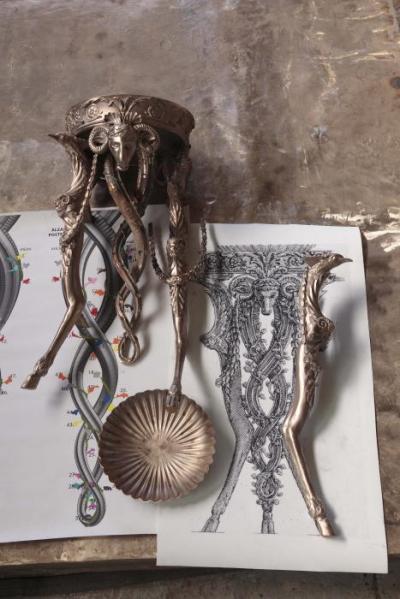 Giovanni Battista Piranesi (1720-1778) was a printmaker, architect, antiquarian, art dealer, theorist, and designer—one of the foremost artistic personalities of the 18th century, whose views of Rome remain the city’s defining image. Fresh, thought-provoking, and innovative, Piranesi, Rome, and the Arts of Design sets out to show the range of the artist’s genius in a 21st-century approach to his creative endeavors. More than 300 original prints have been selected from the world renowned collection of the Fondazione Giorgio Cini in Venice, Italy. These prints are combined with modern-day interpretations in new technologies such as video, photography, and digital modeling. Utilizing the most advanced technologies, the exhibition enables Piranesi’s two-dimensional renderings of a monumental vase, a candelabrum, tripods, a teapot, an altar, and a fireplace to assume their rightful three-dimensional forms. These never-before-seen and never-before-crafted objects take center stage in the exhibition and attest to the creative intellect of Piranesi’s designs. In addition, the exhibition brings to life Piranesi’s most famous works, the Carceri (Prisons), in the form of a virtual reality 3-D installation. The legendary Caffè degli Inglesi is represented as a full scale evocation, and visitors may browse through Piranesi’s sketchbooks using a touchscreen monitor. Strikingly designed by world renowned architect Michele De Lucchi, the exhibition embodies the progressive spirit of Piranesi’s own eclectic visions and his modernity, emphasizing the popular appeal of his work and its continuing relevance to designers and architects. Having previously appeared at the Fondazione Cini in Venice and at the Caixa Forum in Madrid and Barcelona, the show makes its only U.S. stop at The San Diego Museum of Art.
Exhibition conceived by Michele De Lucchi, produced by Fondazione Giorgio Cini, Itatly, together with Factum Arte, Spain, in collaboration with Exhibits Development Groups, USA.
Photos from the installation at the Giorgio Cini Foundation (Le Arti di Piranesi: architetto, incisore, antiquario, vedutista, designer) are available here»
◊ ◊ ◊ ◊ ◊
From Factum Arte:
Michele de Lucchi, Guiseppe Pavanello, John Wilton-Ely, Norman Rosenthal, and Adam Lowe, The Arts of Piranesi: Architect, Etcher, Antiquarian, Vedutista, Designer (Madrid: Caixaforum, 2012), 304 pages, ISBN 978-8461576371, 35€.
 The Arts of Piranesi: Architect, Etcher, Antiquarian, Vedutista, Designer is a catalogue for the homonymous exhibition on the work of Giambattista Piranesi, curated by Michele de Lucchi, Adam Lowe and Giuseppe Pavanello, taking place in CaixaForum Madrid from 25 April to 9 September 2012 and CaixaForum Barcelona from October 2012 to January 2013.
A collaboration between Factum Arte and the Fondazione Giorgio Cini, the exhibition opened in Madrid after receiving great reviews when it was in Venice for the Biennale of Architecture in 2010. In addition to objects realised using traditional and digital modelling from the original designs by Piranesi, the exhibition also contains Gabriele Basilico’s sensitive black and white photographs of the famous Vedute and over 250 etchings by Piranesi.
◊ ◊ ◊ ◊ ◊
From the San Diego Museum of Art:
Symposium: Piranesi, Rome, and the Arts of Design
San Diego Museum of Art, 30 March 2013
Scholars from around the country will offer their insights to contextualize the culture, time period, and artistic concerns of Giovanni Battista Piranesi. Speakers include Christopher M.S. Johns, Norman L. and Roselea J. Golberg, Professor and Chair of the Department of History of Art, Vanderbilt University; John Pinto, Howard Crosby Butler Memorial Professor of Art and Archeology, Princeton University; and Jeffrey L. Collins, Professor and Chair of Academic Programs, Bard Graduate Center; and will be moderated by Dr. John Marciari, Curator of European Art.
◊ ◊ ◊ ◊ ◊
Film | Yo-Yo Ma Inspired by Bach: The Sound of The Carceri
San Diego Museum of Art, 5 April 2013
The Sound of The Carceri explores the deep relationship between music and architecture through a high-tech ‘virtual confrontation’ between Bach and his contemporary, the architect Giovanni Battista Piranesi. Using a striking visual style, director François Girard (The Red Violin and Thirty-Two Short Films about Glenn Gould) places Yo-Yo Ma within a series of computer-generated, three-dimensional recreations of Piranesi’s well-known prison etchings. Through Yo-Yo Ma’s and music producer Steven Epstein’s struggle to recreate and interact with the imaginary space that Ma performs in, the film examines the complexity of illusion, of representation and reality.
◊ ◊ ◊ ◊ ◊
Lecture | Purchasing Piranesi: Buying Art on the Grand Tour
San Diego Museum of Art, 19 April 2013
Buying art was a key element of the British Grand Tour to Italy in the 18th century, and a visit to Piranesi’s workshop was never to be missed. The studio was like a superstore of antiquities where those on the Grand Tour could buy antiquities and prints that recorded them, as well as casts, copies, and forgeries. Making use of unpublished archival research, Dr. John Marciari, Curator, European Art and Head of Provenance Research, will discuss the ways in which travelers set about buying works by Piranesi, Batoni, and others in 18th-century Italy.
◊ ◊ ◊ ◊ ◊
From Factum Arte:
One of the key elements of the exhibition Le Arti di Piranesi: architetto, incisore, antiquario, vedutista, designer (The Art of Piranesi: architect, engraver, antiquarian, vedutista, designer), a 12-minute animation of Piranesi’s Carceri series made by Gregoire Dupond at Factum Arte specifically for the exhibition. This series of 16 visionary images, originally etched by Piranesi when in his late 20s, shows the workings of his imagination, merging his architectural ambitions with his obsessive interest in antiquity. Watching Gregoire Dupond’s animation is literally like entering Piranesi’s mind. A CD containing both high resolution reproductions of the prints and the complete video will be released soon.
Call for Papers | For the Love of Art?
Pour l’amour de l’art ? Les enjeux de la pratique amateur de l’art dans l’Europe des Lumières
Université de Nice Sophia Antipolis, 13 September 2013
Proposals due by 1 April 2013
Appel à communication Pour l’amour de l’art ? Les enjeux de la pratique amateur de l’art dans l’Europe des Lumières — Journée d’études organisée par le Centre de la Méditerranée Moderne et Contemporaine avec le concours de l’Institut Universitaire de France et du projet ANR CITERE Université de Nice Sophia Antipolis Nice, vendredi 13 septembre 2013. Organisateurs scientifiques : David Rousseau et Marie Villion.
Dès leur plus jeune âge, les héritiers de l’aristocratie et de ceux qui dans la haute bourgeoisie aspirent à y parvenir sont sensibilisés aux différentes formes artistiques, tant dans la sphère domestique que dans les institutions d’éducation. Cet engouement pour l’art a bouleversé sa pratique en la diversifiant et en la rendant beaucoup plus personnelle. La forme artistique s’est alors insérée dans les espaces privés et intimes de la vie des élites européennes. Cependant, dans une société où les apparences conditionnent la vie sociale, où les comportements sont réglés par des codes respectant une hiérarchie établie, la pratique désintéressée de l’art semble difficile à concevoir, car ceux qui font vivre l’art pratiquent avec maîtrise et assurance les jeux de distinction sociale que la « vie de société » recèle.
Au-delà des valeurs esthétiques, par quels intérêts sont poussées ces élites dans leur pratique amateur de l’art ? Volonté de se distinguer socialement, désir de sociabilité ? Quelles logiques les conduisent à développer émulation et compétition dans la pratique amateur de l’art ? Que nous apprennent les écrits des protagonistes de ces jeux de société sur leur pratique et celle du monde dans lequel ils rivalisent ? Que nous disent-ils à travers le prisme de la pratique amateur de l’art sur les acteurs qui sont aussi les juges des performances des « sociétés » auxquelles ils appartiennent ? Ces interrogations seront au cœur de la journée d’études du 13 septembre 2013. (more…)
From the ‘Journal of the History of Collections’ March 2013
The eighteenth century in the March 2013 issue of the Journal of the History of Collections:
A R T I C L E S
Linda Bauer and Nello Barbieri, “Forming a Collection of Paintings in Late Baroque Siena,” Journal of the History of Collections 25 (2013): 45-57.
 By the time of his death in 1727, the Cavaliere Marcello Biringucci possessed some 600 paintings. A group of unpublished documents, mainly forty-two sheets in the Archivio di Stato in Siena offers unusual insight into this Sienese nobleman’s collecting activities. The papers – memoranda, lists, invoices, orders for payment, receipts, accounts of expenses – many in the Cavaliere’s own hand, illustrate the range of sources he drew upon, not only geographical but those in the secondary art market. He employed agents, purchased from the estates of other collectors, acquired art at auctions, and even redeemed the pawn of a debtor. The documents include the names of artists – many well known – with prices or values for some works, and by reference to the largely unpublished inventory of his estate, give some indication of which works in the documents Biringucci acquired and how his taste conformed to the prevailing trends of the period. Online appendices to the paper, at http://www.jhc.oxfordjournals.org, reproduce the 1727 inventory, working papers, and a selection of letters.
Ellen Adams, “Shaping, Collecting and Displaying Medicine and Architecture: A Comparison of the Hunterian and Soane Museums,” Journal of the History of Collections 25 (2013): 59-75.
Collections played a critical role as teaching tools for particular disciplinary doctrines in Enlightenment Britain, including medicine and architecture. The two protagonists examined here are the architect Sir John Soane and surgeon John Hunter, whose museums now face one another across Lincoln’s Inn Fields in central London. Skeletons, body parts and artistic models illustrated and explained the workings of the body, while architectural pieces and casts, together with interior design and furnishings, supplied inspiration for architects. These collections dissect, respectively, bodies and buildings in order to build new schools of thought. Hunter’s and Soane’s original house museums were both designed to promote particular disciplinary practices and to impress polite society, through various kinds of representations and methods. They differ, however, in the use of the classical tradition. Hunter strode forwards, leaving this legacy behind, while Soane stood Janus-like, interweaving past and present into a multi-layered narrative.
Elena Dmitrieva, “On the Formation of the Collection of Gem Impressions in the State Hermitage Museum,” Journal of the History of Collections 25 (2013): 77-85.
This article deals with the history of the State Hermitage Museum’s collection of gem casts [initiated in the eighteenth century by Catherine the Great}, with a focus on the dactyliotheca stored in the Department of Classical Antiquity containing over 25,000 pieces and currently kept in storage. This collection of plaster impressions has never been displayed to the public and its contents have not yet been published. Nevertheless, it forms a unique example of a collection of casts made from cameos and intaglios, both antique and modern. It is important in a number of ways, including its usefulness in studying the evolution of engraving techniques and its value in contributing to the repertoire of images encountered on gems. It is also an important resource for the study of gems that have not survived in original form to present day.
R E V I E W S
Christian Tico Seifert, Review of Christien Melzer, Von der Kunstkammer zum Kupferstich-Kabinett: Zur Frühgeschichte des Graphiksammelns in Dresden, 1560-1738 (Zurich: Georg Olms Verlag, 2010), 821 pages, ISBN: 978-3487143460, €75, Journal of the History of Collections 25 (2013): 140-41.
Melzer’s book is a major publication on the history of collecting prints and drawings in Central Europe. The results of her study, a Ph.D. dissertation written under the supervision of Bruno Klein (Dresden) and Michel Hochmann (Paris), go far beyond tracing the history of the Dresdner Kupferstich-Kabinett (Print Room) from the sixteenth to the mid-eighteenth centuries. She combines thorough research on a huge amount of graphic art, treatises and archival material (much of it hitherto unpublished) with theoretical reflection on collecting and the development of classifications and display of collections, a field that has received enormous attention over the past two decades. . .
Mia Jackson, Review of Abigail Harrison Moore, Fraud, Fakery and False Business: Rethinking the Shrager v. Dighton ‘Old Furniture Case’ (London and New York, Continuum, 2011), 224 pages, ISBN: 978-1441115751, £65, Journal of the History of Collections 25 (2013): 143-44.
Abigail Harrison Moore weaves together a rich variety of sources in this account of the infamous ‘Old Furniture Case’, which preoccupied the British media and antiques trade in 1923. Adolph Shrager, a Jewish immigrant from Germany, brought a case of fraud against a prominent London firm of antique furniture dealers, Dighton & Co., in regard to a large quantity of furniture purchased from them between 1919 and 1921. In these two years, Shrager bought over 500 pieces to furnish his new house in Kent. The pieces were largely purported to be English eighteenth-century, and he spent in excess of £111,000. Shrager ran into financial difficulty and ill-health in 1921, and, unable to settle his account with Dighton, who were also feeling the pinch, decided to sell some of his burgeoning collection. The first suspicion that all was not as it might have appeared was raised by Dighton’s pessimism in reply to Mrs Shrager’s suggestion that they sell at Christie’s a suite of furniture for which Mr Shrager had paid £3,000 cash. ‘There is little chance of selling your suite of Chippendale furniture’, came the reply, ‘as there is practically no business’. Shrager called in an expert, (later, and under duress, revealed to be Frederick Litchfield), to advise him on which pieces he could sell ‘so as not to spoil the collection’, and received the devastating judgement that ‘some ninety-eight or ninety-nine percent of them could not be described as genuine antique pieces of furniture of the highest class’. . .
Conference | Architecture and the Street
From the conference website:
Cambridge Conference Talks VII: Architecture and the Street
Harvard University, Cambridge, 29 March 2013
Organized by Morgan Ng and Jason Nguyen
 The PhD program at the Harvard University Graduate School of Design is pleased to invite you to the seventh annual Cambridge Talks conference, entitled Architecture and the Street, which will take place on Friday, March 29, 2013, 9:00-4:30, in Piper Auditorium, Gund Hall.
No building is an island – and in the context of the city, architecture takes shape in relation to the street. Arcades and façade treatments, lighting fixtures and shop windows, setback and building height restrictions: each of these mediate how buildings interact with streets as spaces of visual display and public sociability. More recently, the construction of flyovers and underground transport systems has transformed streets into ever-more complex, multi-layered spatial armatures for architectural intervention. Streets serve as the liminal zones by which architectural form and symbolism meet with the contingencies of urban life.
Cambridge Talks VII seeks to bring fresh historical themes and tools to bear on the problem of Architecture and the Street. New research promises to enrich and challenge perspectives pioneered by Spiro Kostof, Jane Jacobs, and William H. Whyte. How does the infrastructural function of streets as circulation (of people, goods, water, and waste) press against the static character of architecture? How do streets serve as the spatial framework for social control, ceremony, procession, and protest? How might we theorize and historicize modern streets as sites of cultural memory and nostalgia? And above all, what are the effects of such social, political, and technological forces on architectural form?
Cambridge Talks is generously supported by the Harvard University Graduate School of Design, the Weatherhead Center for International Affairs & the GSAS Graduate Student Council. The event is free and open to the public.
P R O G R A M
9:00 Breakfast
9:30 Introduction
9:45 Session I: The Street between Infrastructure and Architectural Form
• Katherine Rinne (California College of the Arts), Walking on Water in Rome: Streets and Water in the Baroque City
• Richard Wittman (UC Santa Barbara), Architecture, Authority and the Street in Eighteenth-Century Paris
• Eric Mumford (WashU), CIAM, Sert and the Street
Discussion, moderated by Sonja Duempelmann (Harvard)
11:15 Break
11:30 Session II: The Street as Territorial Network
• Gabrielle Esperdy (NJIT), The Street, the Strip, and the Freeway: On the Legibility of Place in the Territories of the Car
• Ateya Khorakiwala (Harvard), Street Paint: A Story of India’s National Development
• Keller Easterling (Yale), No Road
Discussion, moderated by Brian Goldstein (Harvard)
1:00 Lunch Break
2:30 Session III: The Street as Space of Social Protest and Control
• Cesare Birignani (Harvard), The Trouble with the Street
• Christopher Heuer (Princeton) and Matthew Jesse Jackson (UChicago), 7 March 1965: Selma and the Architecture of the Event
• Mariana Mogilevich (NYU), Street Psychology and the Politics of Pedestrianization
Discussion, moderated by Neil Brenner (Harvard)
4:30 Closing Remarks
Conference | On the Way to the Museum, Ancient Art in Germany
From Art-Hist:
Interdisziplinäre Tagung: Auf dem Weg zum Museum
Sammlung und Präsentation antiker Kunst an deutschen Fürstenhöfen des 18. Jahrhunderts
Kassel, 19-20 April 2013
Die Erforschung der Geschichte von Museen, ihrer Sammlungen und ihrer Ausstellungspraxis hat in den letzten beiden Jahrzehnten signifikant zugenommen und ist inzwischen zu einem eigenständigen fachübergreifenden Forschungsbereich der historischen Kulturwissenschaften geworden. Die interdisziplinär ausgerichtete Tagung „Auf dem Weg ins Museum“ lenkt den Fokus erstmalig gezielt auf den Umgang mit antiker Skulptur und Kleinkunst in fürstlichen Sammlungen des deutschen Sprachraumes im „langen“ 18. Jahrhundert (1700 – 1815). Welche Ordnungsprinzipien und Vermittlungsabsichten kennzeichneten diese Zusammenstellungen von antiken Artefakten vor der Herausbildung einer Systematik der Kunstmuseen im fortgeschritteneren 19. Jahrhundert? Auf welche internationalen Vorbilder reagierten die Verantwortlichen? Welche Modelle stellten die Ergebnisse ihrer Bemühungen für andere europäische Fürstenhöfe und die späteren öffentlichen Museen bereit? Das
Erkenntnisinteresse der Tagung richtet sich somit nicht nur auf die historische Rekonstruktion einer vergangenen Sammlungspraxis, sondern auch auf die grundlegenden Entstehungsbedingungen der Institution Museum, wie sie in wesentlichen Zügen bis in die Gegenwart fortbesteht.
◊ ◊ ◊ ◊ ◊
F R E I T A G , 1 9 . 0 4 . 2 0 1 3
I. Höfische Antikensammlungen im deutschen Sprachraum im 18. und frühen 19. Jahrhundert
Moderation: Rüdiger Splitter
9.15 Begrüßung/Einführung
9.30 Gisela Bungarten, Museumslandschaft Hessen Kassel: Die Antikensammlung am Braunschweiger Hof im 18. Jahrhundert
10.15 Kordelia Knoll, Staatliche Kunstsammlungen Dresden: „mit königlicher Pracht aufgestellt“ – Die Dresdener Antikensammlung im 18. Jahrhundert
11:00 Reinhard Stupperich, Institut für klass. Archäologie, Universität Heidelberg: Das Antiquarium der Mannheimer Akademie
11.45 Pause
12.15 Hildegard Wiegel, Archäologisches Institut, Universität Göttingen: Die Vasensammlung Anna Amalias in Weimar – Aufstellung und Kontext
13:00 Caterina Maderna, Institut für klass. Archäologie, Universität Heidelberg: Die Antikensammlung Franz I. von Erbach zu Erbach
13.45 Mittagspause
II. Das Beispiel der Kasseler Sammlungen
Moderation: Charlotte Schreiter
15:00 Antje Scherner, Museumslandschaft Hessen Kassel: Kunstkammer, Kunsthaus, Kabinett. Zur Wechselwirkung von Kunstwerk und Sammlungsort im frühen 18. Jahrhundert
15:45 Justus Lange, Museumslandschaft Hessen Kassel: Das Kasseler Galeriegebäude Landgraf Wilhelm VIII.
16:30 Maximiliane Mohl, Universität Heidelberg: Die Architektur des Museum Fridericianum in Kassel
17:15 Andrea Linnebach, Geschichte der Frühen Neuzeit, Universität Kassel: Das Publikum der Antike. Kunsthaus und Museum Fridericianum als ein Ziel von Bildungs- und Forschungsreisen der europäischen Aufklärung
18:00 Pause
19:00 Abendvortrag: Gerrit Walther, Neuere Geschichte, Universität Wuppertal: Antikensammlungen als Element eines adligen Kulturhabitus in der Frühen Neuzeit
S A M S T A G , 2 0 . 0 4 . 2 0 1 3
III. Antikensammlungen in der literarischen Wahrnehmung um 1800
Moderation: Alexis Joachimides
9:30 Adelheid Müller, Berlin: Strategie und Leidenschaft. Weibliche Wege zur Antikensammlung
10:15 Katharina Krügel, Klassikstiftung Weimar: Sammlungen antiker Abgüsse in Weimar. Orte und Präsentationskonzepte
11:00 Pause
11:30 Christoph Frank, Istituto di Storia e teoria dell’arte e dell´architettura, USI, Mendrisio: Im Schatten Winckelmanns: Friedrich Wilhelm von Erdmannsdorff und Friedrich Rehberg und die Dessau-Wörlitzer Antiken
12:15 Martin Dönike, SFB Transformationen der Antike, HU Berlin: Komplementäre Antiken. Zur kunstgeschichtlichen und-theoretischen Rahmung von Antikensammlungen im goethezeitlichen Weimar
13:00 Mittagspause
IV. Residenz und Museum – Von der höfischen zur musealen Repräsentation
Moderation: Gisela Bungarten
14.15 Bénédicte Savoy, Institut für Kunstgeschichte, TU Berlin: Was kostet die Antike? Preisschätzungen im Inventaire des Musée Napoléon (Louvre) um 1800
15:00 Charlotte Schreiter, LVR-Archäologischer Park Xanten/LVR-RömerMuseum: Repräsentation und Kontext – Antike Plastik und Gipsabgüsse in Sammlungen des 18. Jahrhunderts
15:45 Rüdiger Splitter, Museumslandschaft Hessen Kassel: Neue Forschungen zur Kasseler „Société des Antiquités“
16:30 Pause
17:00 Helen Dorey, Deputy Director, Soane’s Museum, London: Sir John Soane’s Collections of Antiquities
17:45 Stephan Schröder, Museo del Prado, Madrid: Sammlung und Ausstellung von Antiken in Spanien bis zur Einrichtung des Prado
◊ ◊ ◊ ◊ ◊
Veranstalter: Universität Kassel in Kooperation mit der Museumslandschaft Hessen Kassel
Ort: Hörsaal der Kunsthochschule Kassel, Menzelstraße 13, 34121 Kassel
Organisation:
Prof. Dr. Alexis Joachimides (Universität Kassel)
Prof. Dr. Rüdiger Splitter (Museumslandschaft Hessen Kassel)
PD Dr. Charlotte Schreiter (LVR-Archäologischer Park Xanten/LVR-RömerMuseum)
Exhibition | Mozart and Goethe: The Quest of Tone Colours
Press release for the exhibition Im Labyrinth der Farben und Töne at the Mozarthuis (additional information is available at The Art Newspaper). . .
In the Labyrinth of Colours and Sounds: Reflections on Mozart
and Goethe with a Picture Cycle by Bernd Fasching
Mozarthaus Vienna, 24 January 2013 — 12 January 2014
Curated by Gernot Friedel

Johann Wolfgang von Goethe, Colour wheel, 1809
The most extensive special exhibition to date at Mozarthaus Vienna, a member of the Wien Holding group, deals with the investigations of science by Mozart and Goethe. Both were interested in the variety of nature, astronomy and the technical accomplishments of the time and they were fascinated by the connection between light, colours and sounds. The presentation looks at this connection on the basis of documents, letters, portrayals of nature and books from their estates, some of which have never been seen in Vienna before. It is accompanied by new, modern pictures and a sculpture by the Viennese painter and sculptor Bernd Fasching, who will attempt in this way to find a new approach to the image of Mozart.
Goethe’s Thoughts on Music and His Admiration of Mozart
Goethe was one of Mozart’s greatest admirers. As director of the Hoftheater in Weimar he organised 282 opera evenings with works by Mozart including 49 performances of Die Entführung aus dem Serail, 20 of The Marriage of Figaro, 68 of Don Giovanni and 82 of The Magic Flute. In the fragment of his theory of sound he developed a view of music that is still valid today, claiming that it should first be enjoyed with the senses and then judged from intellectual, aesthetic, social and scientific standpoints. Sounds were at the centre of Goethe’s thinking, and Mozart’s music seems to have fitted his theories to a large extent. No other poet has had so many works put to music as Goethe. For him music was the oldest art form from which all others were derived and “to which they should all return” as a sign of its merit. One demonstration of the power of music according to Goethe was the fact that good “old music” in fact never gets old. He was also convinced of the therapeutic effect of music, and his understanding of music was centred on its life-giving and balancing effect.
Goethe’s Theory of Colour
 Goethe’s attempt to devise a theory of sound arose in parallel to his work on colour theory, in which he conducted experiments for years to understand and describe the nature of colour in its entirety. Isaac Newton’s light and colour experiments and his finding that the primary colours exist in sunlight was vehemently contested by Goethe. He believed that sunlight contained only white light and that colours was formed in the human brain. In keeping with the philosophy of the time he based his ideas on his own perception, hence the famous formula: “Colours are the deeds of light that first arise in the human mind and then express themselves only there in deeds and suffering.” In other words they were produced purely by the brain – unlike light, which was just colourless brightness.
From Goethe’s ‘Tone Colours’ to Twelve-Tone Music
In the early 20th century the “physiological complementarity of Goethe’s tone colours” became a structural aspect of chromatic music, leading to twelve-tone music. Emancipating itself increasingly from the major-minor tonality, the music was free and atonal, with compositions based on twelve successive related tones. Ideas like this were developed in Vienna at the turn of the century by Arnold Schönberg, Anton Webern and Josef Hauer.
Even as an old man Goethe recalled a concert by the young Mozart in Frankfurt and spoke of his astonishingly “polychromatic” piano playing. Although Mozart’s music felt as if it had just been invented, he believed that it had been created spontaneously and fully formed in his head. Goethe compared Mozart with master painters like Raphael, Leonardo da Vinci or Michelangelo and looked for links between sound and coloured painting. He said that Mozart had the same abiding importance as a genius as these Italian painters. The sentence “Mozart can be compared with Shakespeare” also comes from him.
A Colour Experience by Mozart and Goethe on One and the Same Day
On 10 December 1777 Mozart wrote to his father from Mannheim that the prince elector did not want to hire him after all and that he would travel to Paris. He later wrote to his friend and patron Michael Puchberg about this devastating “grey experience,” that he had almost fallen into a dark black hole and only his music had protected him from it. At the same time, Goethe was walking on the Brocken, the highest mountain in north Germany, and happily observing the colours of the sky, which ended in the “grey light of evening.” He drew a grey sketch of the landscape, the Brocken by moonlight – two completely different experiences, but both to do with the colour grey and both on the same day!
Mozart, Goethe and the Natural Sciences
Mozart and Goethe were both interested in the latest scientific discoveries. They carried out astoundingly similar observations of animals and nature, as telescopes and measuring instruments continued to be refined. Inspired by the work of J. Ebert, Mozart had gradually acquired a picture gallery of birds and other animals, to which he soon added detailed drawings of plants. The following anecdote is illustrative.
Mozart’s father Leopold died on 28 May 1787 in Salzburg, on the same day as Mozart’s bird, a starling, which he had bought on 27 May 1784 and which had shared his study for three years. It could whistle the first five bars of the Rondo from the Piano Concerto in G major for Barbara Ployer note perfect. Mozart invited friends to an almost macabre double burial procession in memory of his father and the dead bird. Everybody had to follow him and the laid out bird to a small grave that had been dug in the garden. He then wrote a poem dedicated to the starling. He bought another bird, a canary, which kept him company on the many lonely nights while his wife was taking a cure in Baden. Mozart set it free a few hours before he died from this deathbed in a small house at Rauhensteingasse, Stadt 970, Vienna.
The exhibition features original objects such as the only living mask of Goethe made by K. G. Weisser around 1807, Goethe’s fragment “Die Zauberflöte Zweyter Theil” from 1798, and many books from the estates of Mozart and Goethe never before seen in Vienna.
◊ ◊ ◊ ◊ ◊
Gernot Friedel, the curator of this special exhibition, grew up in Innsbruck and studied theatre at the Mozarteum in Salzburg, the Max Reinhard Seminar and the University of Vienna. As assistant director at the Burgtheater and the Salzburger Festspiele he worked with the likes of Herbert von Karajan, Heinz Hilpert, Leopold Lindberg, Fritz Kortner and Otomar Krejca. As a permanent assistant to theatre manager and director Ernst Haeussermann he was responsible for the theatre programme of the Salzburger Festspiele and the Theater in der Josefstadt in Vienna. His first venture as a director was Martin Walser’s Zimmerschlacht at Theater in der Josefstadt with Susi Nicoletti and Curd Jürgens. His work in the theatre includes three new productions of Jedermann by Hugo von Hofmannsthal at the Salzburger Festspiele, with Klaus Maria Brandauer, Helmut Lohner, Gerd Voss and Ulrich Tukur in the main roles. He has received an award from the Province of Salzburg for his work. Friedel has worked as a director for films and television with productions like the documentary Mozart und Da Ponte, Die Zauberflöte, Mozart fragen, a film based on his own play, and Salieri sulle tracce die Mozart, with performers like Wilma Degischer, Heinz Marecek, Klaus Maria Brandauer, Helmut Lohner and Mario Adorf. His work includes plays such as Othello darf nicht platzen with Otto Schenk, scripts, literature programmes, exhibitions and novels.
The painter and sculptor Bernd Fasching, born 1955 in Vienna, created a furore in the year 2000 with his project Westwerk at St Stephan’s Cathedral in Vienna, which was specially opened up for his contemporary exhibition. In a project entitled 12 Days, 12 Nights, the artist created twelve pictures in each of seven cities between 1987 and 2006 inspired by the 12 Labours of Hercules and conversations with the people watching him while he worked. With his walk-in sculpture The Hammer of Thor (1990) in the entrance area of the Museum of Applied Arts (MAK) in Vienna, the project Terra Nova (1996–97) in the Dominican Republic and his latest work A More Complex Reality in Istria the sculptor sends visitors on a personal journey of discovery and brings art to life. The works entitled Mozart Vibrations shown in this exhibition are the result of an intensive study of Mozart.
Conference | Berlin in 1800
As noted at Early Modern Architecture:
Die Klassizität des Urbanen. Resümee, Kritik und Fortgang des
Akademienvorhabens “Berliner Klassik”. Eine Großstadtkultur um 1800
Zentrum Preußen-Berlin der Berlin-Brandenburgischen Akademie der Wissenschaften, 14-16 März 2013
Veranstalter: Cord Friedrich Berghahn, Conrad Wiedemann
Mit freundlicher Unterstützung der Stiftung Preußische Seehandlung
Das Akademienvorhaben “Berliner Klassik. Eine Großstadtkultur um 1800” befasste sich zwölf Jahre lang mit der Rekonstruktion einer urbanen Kulturblüte, die von der Forschung beharrlich ausgeblendet wurde, obwohl sie nach Bedeutung und aktueller Wirkung eigentlich nur mit dem Ereignis Weimar-Jena vergleichbar ist. Hauptgegenstand der Forschungsarbeit waren dabei nicht die bekannten großen Einzelfiguren und Einzelleistungen, sondern die soziokulturellen Rahmenbedingungen (Institutionen, Milieus, Kontroversen), aus denen heraus sich deren Besonderheit versteht. Mit der Tagung wollen wir die Vielfalt der geleisteten Quellen- und Konzeptarbeit festhalten und der öffentlichen Diskussion zuführen. Der Eintritt ist frei. Eine Anmeldung ist erwünscht, bitte schreiben Sie an Christopher Drum (bk-stud@bbaw.de).
◊ ◊ ◊ ◊ ◊
D O N N E R S T A G , 1 4 M ä r z 2 0 1 3
14.00 Günter Stock, Präsident der BBAW, Begrüßung
14.10 Cord Berghahn (Braunschweig), Einleitung
14.25 Conrad Wiedemann (Berlin), “Berliner Klassik” als kulturgeographisches Problem. Zu Absicht und Gang eines abgebrochenen Forschungsprojekts
15.30 Pause
15.45 Klaus Gerlach (Berlin), Das Berliner Nationaltheater – Bühne des klassischen Berlin
16.30 Uta Motschmann (Berlin), Die Berliner Vereine als Laboratorien einer großstädtischen Gesellschaft
17.15 Claudia Sedlarz (Berlin), Berliner Klassizismus und die Berliner Akademie der Künste Ende ca. 18.00 Uhr
20.00 Abendvortrag: Werner Busch (Berlin), Die klassizistische Karikatur. Zu Gottfried Schadows Zeichnungen
F R E I T A G , 1 5 M ä r z 2 0 1 3
09.00 Walther Gose (Trier), “… dass die gesunde Vernunft immer mehr und mehr auf den Thron aller menschlichen Angelegenheiten erhoben werde”. Die ‘Gesellschaft von Freunden der Aufklärung’ (Geheime Berliner Mittwochsgesellschaft) 1783-1798
09.45 Iwan Michelangelo D’Aprile (Potsdam), “Wissenschaft von heute” Gegenwartsreflexion und Zeitgeschichtsschreibung in Berlin um 1800
10.30 Pause
10.45 Günter Oesterle (Gießen), Popularität – Urbanität – Freiheit: Kunst der Prosa in Berlin um 1800
11.30 Anne Baillot (Berlin), “Der Hauptzweck einer Akademie der Wissenschaften muss dieser sein, Unternehmungen zu machen und Arbeiten zu liefern, welche kein Einzelner leisten kann” – August Boeckh als Projekt
12.15 Mittagspause
14.00 Cord Berghahn (Berlin), Karl Philipp Moritz’ zirkumpolare Wirkung in Berlin
14.45 Hans-Georg von Arburg (Lausanne), Zur Architekturästhetik von Karl Philipp Moritz und ihren Folgen für
einen klassisch gewordenen Epochenbegriff
15.30 Pause
15.45 Christoph Wingertszahn (Düsseldorf), Die Stadt als Schwall. Karl Philipp Moritz als Zeitungsschreiber
16:30 Matthias Hahn (Berlin), Ein Neuerer der Innendekoration: Louis Catel, Architekt, Berlin, Weimar
17.15 Harald Tausch (Gießen), Gießen oder Berlin. Ortsnamen aus der Sicht eines Berliner Spätromantikers
S A M S T A G , 1 6 M ä r z 2 0 1 3
09.00 Ute Tintemann (Berlin), Isaac Azulay alias Joseph Leonini (1769 – 1840): Ein italienischer Sprachmeister in Berlin
09.45 Jürgen Trabant (Berlin), Der fremde Mund. Über Individualität und Alterität bei Wilhelm von Humboldt
10.30 Pause
10.45 Felix Saure (Hamburg), Wilhelm von Humboldt und Friedrich Ludwig Jahn
11.30 Laurenz Lütteken (Zürich), Konstruktionen der Klassik. Schwierigkeiten im Umgang mit einem musikhistorischen Problem
12.15 Abschlusspanel, Moderation Günter Oesterle










 Enfilade
leave a comment