Call for Papers | James Logan and the Networks of the Atlantic
James Logan and the Networks of Atlantic Culture and Politics, 1699–1751
Philadelphia, 18–20 September 2014
Proposals due by 30 September 2013

The home of James Logan, Stenton was built between 1723 and 1730 in the (then) countryside near Philadelphia.
The McNeil Center for Early American Studies, The Library Company of Philadelphia, The Historical Society of Pennsylvania, and Stenton Museum invite proposals for an international interdisciplinary conference in Philadelphia reconsidering early Pennsylvania culture in an Atlantic World context. James Logan (1674–1751), Provincial Secretary to the Penn family, and his vast political, trade and knowledge networks provide a lens for examination of the Atlantic World in the first half of the eighteenth century. This conference is an effort to consider Logan’s milieu in the widest possible way. James Logan studied the sexuality of plants, mentored Benjamin Franklin and John Bartram, served as Mayor of Philadelphia and Chief Justice of Pennsylvania, shaped his province’s relationships with Native Americans, traded furs, owned slaves, was a gentleman-merchant, book collector, and scholar. His nearly 3,000-volume library remains intact at the Library Company of Philadelphia. The Historical Society of Pennsylvania archives include numerous papers collections related to his activities, and The National Society of The Colonial Dames in America in the Commonwealth of Pennsylvania preserves his house, Stenton.
Committed participants include Anthony Grafton of Princeton University, Bernard Herman of the University of North Carolina, Chapel Hill, and Gary B. Nash of the University of California, Los Angeles. Among possible themes for paper proposals are intellectual history, knowledge networks, natural and moral philosophy; books, poetry and literature, collecting, and botany; religion, in particular Quakerism; material culture, archeology, architecture, houses, foodways, landscapes, land acquisition and urban development; economics, industry, commerce; gender, servitude, enslavement and social structure; and politics, imperialism, and European-Native American interactions.
This conference aims to engage an interdisciplinary dialog. Proposals are encouraged from literary scholars, historians, archeologists, material culture studies, and other disciplines. The organizers will consider both individual papers and panel submissions. Papers for many of the panels will be pre-circulated. PowerPoint presentations, especially those relating to visual and material culture, may also be pre-circulated. Non-traditional panels and presentations (such as tours, workshops, brief papers or demonstrations) will be considered.
Please submit 250-word proposals and a one-page c.v. via e-mail no later than 30 September 2013; proposals should be headed with the title of the paper and the presenter’s name, affiliation, and contact information. Submissions and queries may be directed to mceas@ccat.sas.upenn.edu.
New Title | Ireland and the Picturesque
Due in August from Yale UP:
Finola O’Kane, Ireland and the Picturesque: Design, Landscape Painting, and Tourism, 1700–1840 (London: Paul Mellon Centre for Studies in British Art, 2013), 240 pages, ISBN: 978-0300185386, $85.
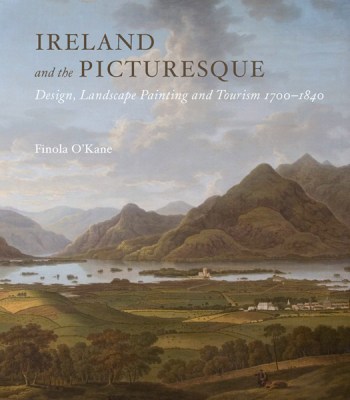 That Ireland is picturesque is a well-worn cliché, but little is understood of how this perception was created, painted, and manipulated during the long 18th century. This book positions Ireland at the core of the picturesque’s development and argues for a far greater degree of Irish influence on the course of European landscape theory and design. Positioned off-axis from the greater force-field, and off-shore from mainland Europe and America, where better to cultivate the oblique perspective? This book charts the creation of picturesque Ireland, while exploring in detail the role and reach of landscape painting in the planning, publishing, landscaping and design of Ireland’s historic landscapes, towns, and tourist routes. Thus it is also a history of the physical shaping of Ireland as a tourist destination, one of the earliest, most calculated, and most successful in the world.
Finola O’Kane is lecturer in the School of Architecture, Landscape and Civil Engineering, University College Dublin.
Exhibition | Prized and Played: The Jon Crumiller Chess Collection
From the World Chess Hall of Fame:
Prized and Played: Highlights from the Jon Crumiller Collection
World Chess Hall of Fame, St Louis, 3 May 2013 — 15 September 2013
Prized and Played showcases over 80 beautiful, antique chess sets from across the centuries and around the world, as well as many interesting artifacts related to the history of chess.

East India ‘John’ Company Chess Set, ca. 1800–1850,
Berhampore, India, ivory. King is 5 1/2 inches high.
(Jon Crumiller Collection). Photo © Bruce M. White, 2013
◊ ◊ ◊ ◊ ◊
Prized
Intended to be shown as objets d’art rather than used in play, ornamental chess sets are testaments to the artistic skill of their creators, as well as the refinement of the wealthy patrons who commissioned them. Freed from the confines of practicality, artists created chess sets of great beauty and originality. Master carvers flaunted their expertise in manipulating luxury materials such as ivory, gold, silver, pearls and precious stones in these ornamental chess sets. Many feature elaborate gilded decoration, delicate carving, and tall forms that made them less than ideal for playing, but perfect as demonstrations of wealth, or as a generous gift for a friend.

Dieppe Europeans vs. Africans Ivory Chess Set, ca. 1800, Dieppe, France, Ivory. King is 3 1/4 inches (Jon Crumiller Collection)
Photo © Bruce M. White, 2013
Ornamental sets were also symbols of the erudition and sophistication of their owners. Several of the ornamental sets in this show have themes drawn from history, mythology, or religion. The Good Versus Evil set contains bishops holding copies of Dante Alighieri’s The Inferno, while another set pits Venus and Bacchus, two figures from Roman mythology, against each other. Other artists turned to contemporary military conflicts for inspiration. The army of the British East India Company combats Indian military forces in John Company sets, while other sets celebrated the exploits of Emperor Napoleon. Ornamental sets could also show that a person was well-traveled. A set from Dieppe, France, where master carvers produced lovely ivory products could indicate the owners had traveled to the popular resort town. Swiss Charlemagne sets, produced in Brieze, Switzerland, were also marketed to tourists in catalogues. These sets were so prized by their owners that, despite their delicate nature and rich materials, they have survived centuries later as examples of the excellent craftsmanship of their makers. They continue to be valued, not only for their aesthetic qualities, but also for the fascinating stories they tell.
Played

François-André Danican Philidor, L’Analyze des échecs (London: 1749)
Photo © Bruce M. White, 2013
In Prized and Played, superb examples of antique playing sets from across Europe and Asia illuminate the fascinating history of stylistic evolution of chess pieces. Though some of the sets in this half of the exhibition feature elaborate decoration, they were all intended for use in play. Their widely varied appearances testify to the imagination and stylistic preferences of the artisans who created them, as well as the artistic tastes of the players who used them over the centuries. They were made of durable materials like wood, ivory, bone, and metal so that players could regularly use them for play over many years. While the style of the simple, brightly colored, and dome-topped Islamic sets in the show stands in contrast to that of the European sets, diverse styles of playing sets were often manufactured within the same country. Some examples include the Directoire, Régence, and Lyon style sets produced in France, or the Barleycorn and Northern Upright style sets manufactured in England.
The nineteenth century brought the rise of modern organized chess tournaments and clubs, which highlighted the need for standardized chess pieces. The regional styles that had proliferated in previous centuries led to confusion and contention when the great players of numerous nations gathered to compete. Prominent chess manufacturers in early-to-mid-nineteenth century England began to stabilize the designs of playing sets into recognizable precursors of the sets we use today. John Calvert set up shop in 1791 at 189 Fleet Street, London, and mass-produced several designs that grew in popularity. These designs, as well as fancier playing sets imported and sold by James Leuchars and other retailers in the initial years of the nineteenth century, influenced subsequent well-known London chess manufacturers such as George Merrifield, Thomas Lund and his son William, and Charles Hastilow.
Finally, the iconic Staunton chess set, designed by architect Nathaniel Cooke and endorsed by the famous English player Howard Staunton, emerged during this period. The sets were first manufactured and sold in 1849 by John Jaques and Son, Ltd, of London, and later became the standard for tournament play. (more…)
Exhibition | Paintings by Hubert Robert from the Musée de Valence
Now on view at the Petit Palais:
Tableaux d’Hubert Robert du Musée de Valence
Le Petit Palais, Paris, May — October 2013
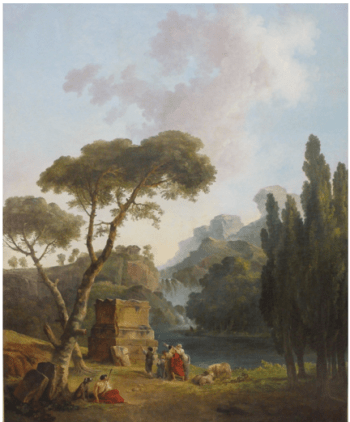
Hubert Robert, Paysage de cascade avec les bergers d’Arcadie
© Musée de Valence, photo Eric Caillet
En avant-première de la réouverture en décembre prochain du musée de Valence (Drôme), quatre des plus beaux tableaux d’Hubert Robert (1733–1808) sont présentés au Petit Palais, aux côtés des dix tableaux de l’artiste des collections permanentes.
Peintre par excellence des ruines de la Rome antique, Hubert Robert séjourna onze ans dans la ville des papes, à partir de 1754. Il en cultiva le souvenir jusqu’à la fin de sa carrière bien qu’il ait été également un chroniqueur inlassable du Paris du XVIIIe siècle. Hubert Robert a enchanté ses contemporains par sa verve, sa poésie et son inventivité – qualités qui ne pouvaient qu’enthousiasmer un critique comme Diderot. Le succès de ses paysages lui valut même la commande de plusieurs jardins qu’il peupla de « fabriques » et de grottes à la manière des tableaux qui avaient fait sa célébrité.
Connu pour sa collection incomparable de dessins d’Hubert Robert offerte par l’amateur Julien-Victor Veyrenc en 1836, le musée de Valence s’est attaché depuis plus d’une vingtaine d’années à étoffer ce fonds par l’acquisition de toiles significatives de l’artiste. L’ensemble formera un des centres de gravité du musée de Valence dont la rénovation, confiée à l’atelier d’architecture Jean-Paul Philippon, est en voie d’achèvement. Le prêt exceptionnel de quelques-uns de ses fleurons à Paris est l’occasion de les faire dialoguer avec les toiles conservées au Petit Palais. Ainsi la vue de la basilique Saint-Pierre du musée de Valence, cadrée de façon audacieuse à travers une baie, rejoint la toile vivement esquissée du Petit Palais montrant un Sculpteur sur un échafaudage dans la nef de Saint-Pierre. Le vaste Paysage de cascade avec les Bergers d’Arcadie, de Valence, est présenté dans la rotonde avec deux grandes toiles tirées des réserves du Petit Palais provenant du décor de l’hôtel Beaumarchais exécutés l’année suivante. A cette occasion, l’ensemble des salles du XVIIIe siècle du musée ont d’ailleurs été réaccrochées et des oeuvres d’autres artistes remises en valeur.
En attendant de parcourir les nouveaux espaces de l’ancien évêché de Valence, ce prêt de quelques mois est aussi une invitation à redécouvrir les galeries du XVIIIe siècle du Petit Palais – musée des Beaux-Arts de la Ville de Paris qui, rappelons-le, sont ouvertes gratuitement au public.
Le Petit Palais est heureux de soutenir la rénovation et l’extension du Musée de Valence. Pour plus d’information, téléchargez le communiqué de presse.
Call for Papers | The Early Modern Villa: The Senses vs. Materiality
From the Call for papers:
The Early Modern Villa: The Senses and Perceptions versus Materiality, 1450–1800
Wilanów Palace, Warsaw, 15–17 October 2014
Proposals due by 30 October 2013
Convenors: Barbara Arciszewska (Warsaw University) and Paweł Jaskanis (Wilanów Palace Museum)
Enhanced interest in sensual perception was one of the mainstays of early modern culture. The development of new visual conventions (most notably the linear perspective) and ‘ocularcentric’ character of early modern science has long focused scholarly attention on the contemporary obsession with sight and with optical illusion. Yet sight, although privileged as a nucleus of artistic theory and analytical instrument in natural philosophy, was but one of the senses which were to be attracted, and then gratified by the display of early modern art and architecture. The complex discourse of sensual perception and gratification embraced all senses, although their role depended on the comparative value assigned to the senses themselves, on their abilities to provoke desire, provide delight, and grant access to knowledge. The diversity of sensual stimuli was perhaps most evident in the villa estate – its architecture and landscape design. The role of the senses and sensual perception in the planning, design, as well as functioning and reception of the villa (c. 1450-1800), will be the focus of this conference, set against the essential materiality of architecture and nature, understood as the framework of reference for the sensual experience rooted in pre-modern concepts of the corporeal sensorium. (more…)
Exhibition | Quilts 1700–1945
From the QAG press release (14 June 2013) . . .
Quilts 1700–1945
Queensland Art Gallery, Brisbane, 15 June — 22 September 2013
Curated by Sue Prichard

Coverlet with sundial, cotton, 1797
(London: Victoria and Albert Museum)
An exhibition of historic British quilts from London’s Victoria and Albert Museum (V&A) is now on view at the Queensland Art Gallery, presenting enthralling social histories and personal stories of more than 200 years of quiltmaking and patchwork. The exhibition includes more than 35 hand-crafted textiles created to provide comfort and commemorate historical events and family occasions between 1690 and 1945, plus a host of associated material such as pin cushions, needlework tools and sewing baskets.
The works come primarily from the esteemed collection of the V&A, the world’s leading decorative arts and design museum. Select pieces have travelled from British regional museums and private collections, and there is the special addition of the much-admired Rajah quilt of 1841, sewn by convict women during transportation to Van Diemen’s Land, on loan from the National Gallery of Australia.
Divided into four thematic sections, the exhibition explores the domestic landscape of the wealthy bedrooms of 18th-century Britain; the private thoughts and political debates that emerged as patchwork spread to aspirational middle class homes in the early 19th century; the movement of quilts to the public sphere for exhibition and display in Victorian England; and the survival of quiltmaking in economically deprived areas in the face of the emergence of mass production in the early 20th century.
“The exhibition has been curated for QAG by Sue Prichard, Curator of Contemporary Textiles at the V&A, based on the popular exhibition Quilts 1700–2010: Hidden Histories, Untold Stories, presented in 2010 at the V&A,” explained Director Chris Saines.
The exhibition is accompanied by the 196-page publication Quilts 1700–1945, a co-edition from QAGOMA and the V&A.
Judge Rules Benjamin West Altarpiece Can Go to Boston
From The Art Newspaper (11 July 2013) . . .
Anglican Court Says Benjamin West Altarpiece Can Go to Boston
City of London church to sell the masterpiece to fund repairs
By Martin Bailey
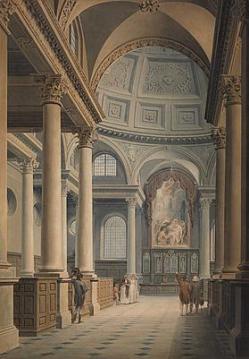
Thomas Malton (1748-1804), St Stephen Walbrook, London, watercolour over pencil, heightened with scratching out, 26 x 18 inches (646 x 447 mm)
Lowell Libson LTD (London).
West’s Devout Men Taking Away the Body of St Stephen is visible at the altar.
A Church of England court has ruled that Benjamin West’s altarpiece, Devout Men Taking Away the Body of St Stephen, 1776, which was made for one of the most important churches in the City of London can be sold for display in the US. The $2.85m painting is being bought by an anonymous foundation, which is due to lend it to the Museum of Fine Arts, Boston (The Art Newspaper, April 2013, pp6–7 and June 2013, p3). West was born in America, but worked in England.
In his judgment, delivered on 10 July, Judge Nigel Seed, chancellor of the consistory court of the Diocese of London, ruled that St Stephen Walbrook should be allowed to sell the masterpiece. The painting had been removed from the church in around 1987, in what he described as “perceived illegal actions”, and has since been kept in storage. . .
The full article is available here»
◊ ◊ ◊ ◊ ◊
As a starting place in the scholarly literature:
Jerry D. Meyer, “Benjamin West’s St Stephen Altar-Piece: A Study
in Late Eighteenth-Century Protestant Church Patronage and English
History Painting,” The Burlington Magazine 118 (September 1976): 634-41.
Conference | Materializing the Spirit: Art and Women Religious
From the conference programme:
Materializing the Spirit: Spaces, Objects, and Art in the Cultures of Women Religious
Histories of Women Religious of Britain and Ireland (HWRBI) 2013 Conference
Institute of Historical Research, Senate House, London, 5–7 September 2013
 This conference explores architecture, art, and design produced by and for women religious in Britain and Ireland from the Middle Ages to the present. Keynote speakers are Mary Schoeser on textiles and interiors, and Julian Luxford on medieval convents. Presenters include Emily Gee (English Heritage), Tim Knox (Fitzwilliam Museum), and Helen Hills (York). The conference also includes a thematic tour of the V&A’s collections. Additional information is available at the HWRBI website.
◊ ◊ ◊ ◊ ◊
T H U R S D A Y , 5 S E P T E M B E R 2 0 1 3
2.00 – 3.30 Women Religious and the Arts at the V&A
Tessa Murdoch (Acting Keeper of Metalwork, Sculpture, Ceramics and Glass, V&A) will lead a tour of the museum’s collections. Places are limited. Further information on registration.
F R I D A Y , 6 S E P T E M B E R 2 0 1 3
9.00 Registration and Refreshments
9.30 Welcome and Introduction
9.45 Session I: Place and Purpose, chaired by Caroline Bowden (QMUL)
• Roderick O’Donnell FSA, ‘The Pugins’ Houses of men and women contrasted’
• Michael O’Boyle (Bluett & O’Donoghue Architects), ‘The nature and character of convent buildings in Ireland in the eighteenth and nineteenth centuries’
• Sue Acheson RSCJ, ‘Space for the Heart: Representing Devotion in the Chapel of the Sacred Heart, Roehampton’
11.15 Break
11.30 Session II: Patrons and Subjects, chaired by Dominic Janes (Birkbeck)
• Tim Knox (Fitzwilliam Museum), ‘A Soldier and a Nun: Two “Ancestral Portraits” of English Sitters by Pietro-Tommaso Labruzzi’
• Patricia Harris CJ, ‘The Mystery of the “Painted Life” of Mary Ward’
• Anselm Nye (QMUL), ‘Artistic and Comic: The cartoon as historical memory amongst the English Dominican Sisters’
1.00 Lunch
2.00 Session III: Material and Immaterial, chaired by Carmen Mangion (Birkbeck)
• Susan O’Brien (Cambridge), ‘A Spirituality Represented: Images of the Holy Child in the Society of the Holy Child Jesus, England since 1846’
• Helen Hills (York), ‘Making Religion Matter?’
3.00 Break
3.15 Teaching and Publishing Session
“…Nuns are a remote reality, detached from the world”: The Challenges of Teaching and Researching Female Religious Life, (Session sponsored by History Lab Plus, IHR & Higher Eduction Academy)
5.00 Break
5.15 Keynote I | Mary Schoeser (President, The Textile Society), ‘Fair and beautiful to behold’
6.15 Reception and H-WRBI Annual Meeting
8.00 Conference Dinner
S A T U R D A Y , 7 S E P T E M B E R 2 0 1 3
9.00 Registration and Refreshments
9.30 Session IV: Space and Context, chaired by Lynne Walker (IHR)
• Ellie Pridgeon (Leicester), ‘Space and Location: The Cloister Paintings at Lacock Abbey’
• Deirdre Raftery (UCD), ‘ “Cover the Earth with Houses”: The form and function of the convents of the Society of
the Sacred Heart in nineteenth-century Ireland, North and South’
• Brenda King (The Textile Society), ‘Stitch and Stone’
11.00 Break
11.30 Session V: Symbolism and Devotion, chaired by Jane Hamlett (RHUL)
• Kate Jordan (UCL), ‘Artists Hidden from Human View: Mysticism and Art in the Victorian Convent’
• Ayla Lepine (Yale), ‘”The Story of a Life”: Nuns at the Epicentre of Modern Visual Culture’
12.30 Lunch
1.30 Session VI: Heritage and Preservation, chaired by Emily Gee (English Heritage)
• Abbot Geoffrey Scott (Catholic Archives Society), ‘The Archives and Collections of English Nuns Deposited at Douai Abbey’
• Frederick O’Dwyer (Conservation architect), ‘Historic Irish Convents, Redundancy and Reuse’
• Sophie Andreae (Vice Chair, Bishop’s Conference Patrimony Committee), ‘Important Artefacts: Some Recent Case Studies’
• Emily Gee (English Heritage, Head of Designation), ‘Reflections on the Heritage Landscape’
3.30 Break
4.00 Keynote II | Julian Luxford, (St Andrews), ‘Nuns, Art and Patronage in Later Medieval England’
5.00 Closing remarks
5.15 Reception
To register online, visit the HWRBI Eventbrite page.
We All Scream for Ice Cream
In case you’re somewhere hot, thinking about ice cream . . . (a full list of contents for the current issue of Past & Present is available here).
Melissa Calaresu, “Making and Eating Ice Cream in Naples: Rethinking Consumption and Sociability in the Eighteenth Century,” Past & Present 220 (August 2013): 35-78.
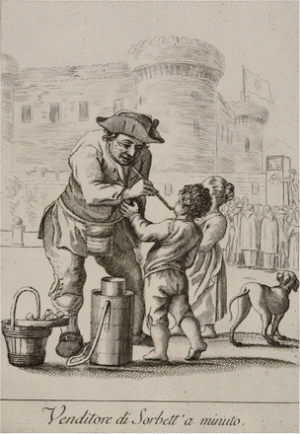
Pietro Fabris, Venditore di sorbett’a minuto, from his Raccolta di varii vestimenti ed arti del Regno di Napoli (Naples, 1773). © British Library Board D-7743.h.13.
Two barefoot children reach out to lick the spoon of the ice-cream seller. He carries a pouch around his waist that hints at the profits that are to be made from his trade. Two wooden containers rest on the ground beside him, one of which has a canister inside it and a strap outside to carry it, while the other holds a tray of cups to serve the ice cream (Plate 1).1 Behind this scene is the Angevin castle in Naples and a crowd gathered around a puppet stall. Pietro Fabris made this engraving as part of a collection depicting the costumes and customs of Neapolitans which was published in 1773 and dedicated to the British emissary to Naples, William Hamilton. Three years later, Fabris would provide elaborate hand-coloured illustrations for Hamilton’s scientific study of the eruptions of Vesuvius published in French and English and dedicated to the members of the Royal Society.2 Both books projected an image of Naples that appealed to the Grand Tourists who were flocking to see the excavations of the ancient cities of Herculaneum and Pompeii and the volcanic spectacle nearby (Vesuvius was particularly active in the last decades of the eighteenth century), and to experience life on the streets of the city. The collection of engravings including the sorbet seller appealed directly to a growing interest in Neapolitan popular culture and presented an image of the city as a theatre of extremes, in which the pleasures of life collided with the extreme poverty of the lazzaroni, and where its poorest inhabitants splurged on what — from a northern European perspective — might be seen as one of the great luxuries of the eighteenth century. We could leave our interpretation of the Fabris engraving there, safely within a history of the vast visual production of the Grand Tour in Italy, but the image conveys more than a tourist discourse about the exotic.3 In fact, the engraving illustrates the eating of a food product that was far from a luxury, and its sale to ordinary people on the streets of Naples, a point that has been completely overlooked by historians of the early modern period. . .
N O T E S
1 There is a variety of vocabulary in English, French and Italian describing ice or frozen desserts and drinks with a water or milk base. In Italian, sorbetto is used in the eighteenth century generally to describe what we know today as both sorbet and ice cream. Here I use the term ‘ice cream’ generically. All translations from Italian are my own unless otherwise stated.
2 Pietro Fabris, Raccolta di varii vestimenti ed arti del Regno di Napoli (Naples, 1773); William Hamilton, Campi Phlegræi: Observations on the Volcanos of the Two Sicilies as They Have Been Communicated to the Royal Society of London, 3 vols. (Naples, 1776–9), i–ii. On Fabris and Hamilton, see the essays in Ian Jenkins and Kim Sloan (eds.), Vases and Volcanoes: Sir William Hamilton and his Collection (London, 1996).
3 The use and the study of the term lazzaroni have a long history. It generally had a pejorative sense in travel accounts describing some of the poorer inhabitants of Naples, meaning ‘scoundrels’ or ‘layabouts’, although the lazzaroni became of increasing ethnographic interest at the end of the eighteenth century: see Melissa Calaresu, ‘From the Street to Stereotype: Urban Space, Travel and the Picturesque in Late Eighteenth-Century Naples’, Italian Studies, lxii (2007).
Bergpark Wilhelmshöhe Now a UNESCO World Heritage Site
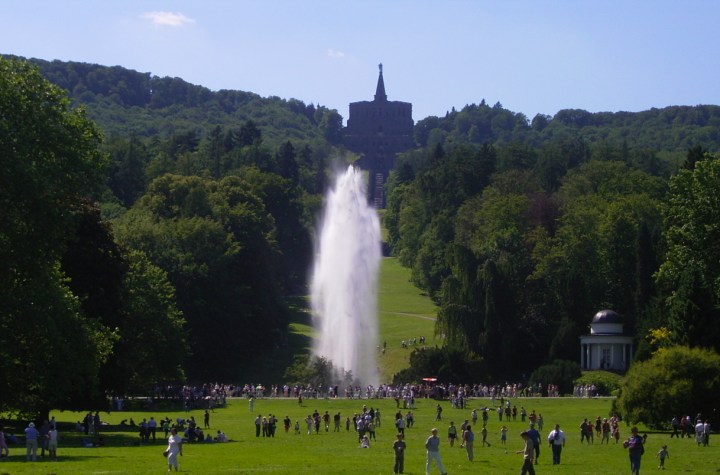 Bergpark Wilhelmshöhe, Kassel, Germany
Photo, 2005, Wikimedia Commons
◊ ◊ ◊ ◊ ◊
From UNESCO (23 June 2013) . . .
Sites in Germany and Italy Bring to 19 the Number of Sites Added to the World Heritage List
Two new sites and one extension to a Polish site were inscribed on UNESCO’s World Heritage List on Sunday afternoon, bringing to 19 the total number of sites added to the List during the 37th session taking place in Phnom Penh.
Bergpark Wilhelmshöhe, Germany
Descending a long hill dominated by a giant statue of Hercules, the monumental water displays of Wilhelmshöhe were begun by Landgrave Carl of Hesse-Kassel in 1689 around an east-west axis and were developed further into the 19th century. Reservoirs and channels behind the Hercules Monument supply water to a complex system of hydro-pneumatic devices that supply the site’s large Baroque water theatre, grotto, fountains and 350-metre long Grand Cascade. Beyond this, channels and waterways wind across the axis, feeding a series of dramatic waterfalls and wild rapids, the geyser-like Grand Fountain which leaps 50m high, the lake and secluded ponds that enliven the Romantic garden created in the 18th century by Carl’s great-grandson, Elector Wilhelm I. The great size of the park and its waterworks along with the towering Hercules statue constitute an expression of the ideals of absolutist Monarchy while the ensemble is a remarkable testimony to the aesthetics of the Baroque and Romantic periods.
◊ ◊ ◊ ◊ ◊
Also from UNESCO:

Bergpark Wilhelmshöhe
Photo by Jens Haines, 2012 from Wikimedia Commons
Inspired by the dramatic topography of its site, the Hercules monument and water features of the Bergpark Wilhelmshöhe created by the Landgrave Carl from 1689 combine in an outstanding demonstration of man’s mastery over nature. The monumental display of rushing water from the Octagon crowned by the massive Hercules statue via the Vexing Grotto and Artichoke Basin with their hydro pneumatic acoustic effects, Felsensturz Waterfall and Giant’s Head Basin down the Baroque Cascade to Neptune’s Basin and on towards the crowning glory of the Grand Fountain, a 50-metre high geyser that was the tallest in the world when built in 1767, is focused along an east-west axis terminating in the centre of the city of Kassel. Complemented by the wild Romantic period waterfalls, rapids and cataracts created under Carl’s great-grandson the Elector Wilhelm I, as part of the 18th-century landscape in the lower part of the Bergpark, the whole composition is an outstanding demonstration of the technical and artistic mastery of water in a designed landscape. Together with the 11.5m high bronze Hercules statue towering above the park and visible from many kilometres, which represents an extraordinary sculptural achievement, they are testimony to the wealth and power of the 18th- & 19th-century European ruling class.
Criterion (iii): The towering statue of Hercules and the water displays of the Bergpark Wilhelmshöhe are an exceptional symbol of the era of European Absolutism.
Criterion (iv): The water displays of Bergpark Wilhelmshöhe are an outstanding and unique example of monumental water structures. Cascades of similar size and artificial waterfalls of comparable height can be found nowhere else. The Hercules statue, towering over the 560 hectare park, is both technically and artistically the most sophisticated and colossal statue of the Early Modern era. The ensemble of water features with their monumental architectural settings is unparalleled in the garden art of the Baroque and Romantic periods. (more…)










 Enfilade
leave a comment