Exhibition | An Indiscreet Look at the Mechanics of Fashion
Sarah Moroz provides a summary of the exhibition for The Daily Beast (5 July 2013). From the Musée des Arts Décoratifs:
La Mécanique des Dessous: Une Histoire Indiscrète de la Silhouette
Behind the Seams: An Indiscreet Look at the Mechanics of Fashion
Musée des Arts Décoratifs, Paris, 5 July — 24 November 2013
Bard Graduate Center, New York, 3 April — 26 July 2015
Curated by Denis Bruna

Panier à coudes articulé, vers 1770, et corps à baleines, vers
1740-60, Paris, Les Arts Décoratifs, Collection Mode et
Textile et dépôt du musée de Cluny, © Patricia Canino
◊ ◊ ◊ ◊ ◊
This exhibition explores the ‘underworld’ of female and male undergarments such as the fly, the pannier, the corset, the crinoline, the bustle, the pouf, the stomach belt, the bra and other vestimentary devices fashioning the body by means of whalebones, hoops and cushions according to the changing dictates of fashion. Modelling the body sometimes to extremes, these ‘mechanical garments’ enabled the wearer to artificially attain the ideal of beauty of the time. This exploration is full of surprising discoveries since, contrary to common belief, these artifices were by no means a 19th-century speciality. Recourse to these concealed architectures has been constant since at least since the 14th century until the present day. Illustrating the diversity of artifices and their mechanics with museum pieces rarely shown to the public, this exhibition – the first of its kind – takes us ‘backstage’, into another, behind-the-scenes history of clothing and fashion.
La Mécanique des dessous. Une histoire indiscrète de la silhouette (Paris, Musée des Arts Décoratifs, 2013), 272 pages, ISBN : 978-2916914428, 55€.
◊ ◊ ◊ ◊ ◊
Exhibition Press release:

Robe de cour, vers 1760, Lyon, musée des Tissus, achat, 1913
© Lyon, musée des Tissus, photo Pierre Verrier.
L’exposition La mécanique des dessous, une histoire indiscrète de la silhouette présentée aux Arts Décoratifs du 5 juillet au 24 novembre 2013 se propose d’explorer les artifices utilisés par les femmes et les hommes, du XIVe siècle à nos jours, pour dessiner leur silhouette. Ce projet original peut être appréhendé comme une longue histoire des métamorphoses du corps soumis aux diktats des modes successives. Quels sont les mécanismes qui ont contraint les corps des femmes afin d’obtenir des tailles resserrées jusqu’à l’évanouissement, des gorges pigeonnantes contrebalançant un fessier rehaussé à l’extrême, des hanches elargies, ou bien applati des seins et des ventres ?
Comment les hommes eux-mêmes ont-ils poussé leur virilité en bombant artificiellement les torses, en rajoutant des formes aux mollets, ou aux braguettes ? Toutes ces structures faites de fanons de baleine, de cerceaux de rembourrage, mais plus encore de laçages, de charnières, de tirettes, de ressorts ou de tissus élastiques dissimulés sous l’habit sont exposés dans une scénographie de Constance Guisset. Près de deux cents silhouettes rassemblant paniers, crinolines, ceintures d’estomac, faux-cul, gaines, « push up » issus des collections publiques et privées françaises et étrangères permettent, pour la première fois, d’aborder une lecture insolite de la mode liée au corps.
Tout d’abord, l’univers masculin et sa quête de la virilité sont évoqués avec les pourpoints étonnamment rembourrés du XIVe au XVIe siècle ainsi qu’avec les braguettes proéminentes de la Renaissance. Le XVIIIe siècle est caractérisé par les vestes matelassées provoquant des torses arqués. Les amplificateurs de mollets, les ceintures d’estomac et les slips-gaines sont révélateurs de la période XIXe-XXIe siècles. Les femmes, quant à elles, ont de tout temps rivalisé d’imagination et d’artifices avec les premiers corsages baleinés, les vertugadins (premières jupes renforcées de cerceaux de rotin ou de métal), les paniers, les crinolines, les tournures, les corsets, les gaines et les push-up d’aujourd’hui. Cet insolite défilé de mode n’oublie pas non plus les enfants qui ont porté des corsets au moins depuis le XVIIe siècle. Renforcées d’armatures et d’autres mécanismes, toutes ces pièces de vêtement permettaient la rectitude, la verticalité tant attendue par une aristocratie, puis par une puissante bourgeoisie, toutes deux soucieuses d’un idéal de supériorité.
Le parcours tant insolite que didactique donnera la part belle au XIXe siècle. En effet, sous le Second Empire et la Troisième République principalement, le corset règne en tyran pour répondre à l’exigence de la « taille de guêpe » accentuée par l’évasement excessif des crinolines. Après 1870, ce jupon à baleines disparaît et se voit remplacé par la tournure – dite aussi le « fauxcul », la « queue d’écrevisse » ou encore le strapontin – qui donne aux femmes un étrange et sinueux profil d’oie. Au XIXe siècle, les sous-vêtements n’ont jamais été aussi abondants et cachés à la fois. Si, au fil de l’histoire de la mode, les formes évoluent et les techniques s’affinent, le dessein du vêtement mécanique est récurrent : effacer le ventre, comprimer la taille jusqu’à la creuser, maintenir la poitrine, rehausser les seins – parfois les aplatir –, arrondir les hanches. Bref, le confort a souvent cédé le pas à l’apparence jusqu’à ce que, vers 1900, Nicole Groult, Paul Poiret et Madeleine Vionnet instaurent, pour un temps, le goût de la ligne «naturelle».
L’exposition se poursuit avec le soutiengorge, la gaine (et ses exemples masculins). Si le souci du soutiengorge n’est plus de comprimer ou de rehausser les seins mais de les emboîter et les séparer, a-t-il perdu pour autant le rôle essentiel des vêtements baleinés d’autrefois : modeler la silhouette ? De nos jours, les soutiens-gorge « ampliformes » et pigeonnants en vue de créer un effet plongeant même sur les silhouettes les plus menues, répondent encore aux diktats des canons de beauté à une époque où l’on façonne moins son corps par des vêtements que par des régimes, le body building et la chirurgie.
Toutefois, l’histoire du corset, de la crinoline ou de la tournure n’est pas révolue pour autant puisque des créateurs comme Thierry Mugler, Jean Paul Gaultier, Rei Kawakubo pour Comme des Garçons, Christian Lacroix ou Vivienne Westwood, etc. ont livré d’étonnants exemples permettant de clamer que les XXe et XXIe siècles ont fait du dessous d’autrefois un dessus expérimental.
Parallèlement aux deux-cents dessous présentés – et habits complets formés grâce à ces structures dissimulées –, l’exposition montre des mannequins couverts de reconstitutions de paniers, de crinolines ou de tournures, etc., toutes animées afin de saisir l’ingéniosité des mécanismes. De plus, un espace du parcours est spécialement dédié à l’essayage de corsets, de paniers du XVIIIe ou de crinolines, tous spécialement faits à l’identique, afin que le visiteur puisse porter et comprendre ces structures qui ont joué un rôle essentiel dans l’histoire de la mode et des usages vestimentaires.
◊ ◊ ◊ ◊ ◊
Note (added 14 January 2015) — The Bard Graduate Center venue was not part of the original posting; more information is available here»
New Book | Livio Pestilli’s ‘Paolo de Matteis’
From Ashgate:
Livio Pestilli, Paolo de Matteis: Neapolitan Painting and Cultural History in Baroque Europe (Aldershote: Asghate, 2013), 502 pages, ISBN: 978-1409446200, $125.
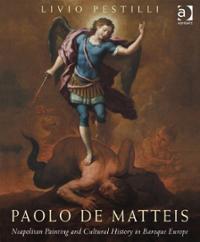 This volume represents a long overdue reassessment of the Neapolitan painter Paolo de Matteis (1662-1728), an artist largely overlooked in English language scholarly publications, but one who merits our attention for the quality of his work and the originality of its iconography, as well as for his remarkable ability to respond creatively to his patrons’ aesthetic ideals and agendas.
Following a meticulous examination of the ways in which posterity’s impression of de Matteis has been conditioned by a biased biographical and literary tradition, Livio Pestilli devotes rich, detailed analyses to the artist’s most significant paintings and drawings. More than just a novel approach to de Matteis and the Neapolitan Baroque, however, the book makes a significant contribution to the study and understanding of early eighteenth-century European art and cultural
history in general, not only in Naples but in other major European centers,
including Paris, Vienna, Genoa, and Rome.
Livio Pestilli is Director and Professor of Art History at Trinity College–Rome Campus.
C O N T E N T S
Introduction
Part I
Framing the Artist: A fabricated life
Enter the critic
Part II Paintings
‘Napoli nobilissima’
Circa 1700
Naples again
A Herculean feat
The celebratory self
Supporting authorship
The skill of a ‘Valentuomo’
Portraying Carthusian values
Campanian connections
The remains of the day
Part III Drawings
‘And truly Paolo was a great draftsman…’
Epilogue; Appendices; Index.
Tim Knox as New Director of the Fitzwilliam Museum
Tim Knox stepped into his new role at the Fitzwilliam Museum earlier this spring. Press release (7 December 2012) from the Soane’s Museum:
 After nearly eight highly successful years as Director of Sir John Soane’s Museum, Tim Knox has been appointed to succeed Timothy Potts as Director and Marlay Curator of the Fitzwilliam Museum in Cambridge.
During his time at the Soane Museum Tim Knox masterminded the restoration of the two houses, Nos. 12 and 14 Lincoln’s Inn Fields, which flank Soane’s original Museum at No. 13. The ambitious OUTS (Opening up the Soane) project, which has involved raising over £7 million, is now fully planned and financed, and ready to move into its second phase, the first having provided a new exhibition gallery, new conservation studios and a new museum shop. At the same time many of Sir John Soane’s original arrangements have been meticulously restored, notably his Picture Room The reinstatement of Soane’s lost private apartments, including his Model Room, is planned and fully funded for 2013.
There has also been notable progress in cataloguing the Museum’s collections and making them available on the Soane’s website; in education; in outreach and access, including disabled access; and in building up support for the Museum among its many generous friends, old and new, here and in the United States.
The Trustees of Sir John Soane’s Museum are, naturally, saddened at the prospect of Tim’s departure, but will set about the task of finding a worthy replacement, confident that the Museum is in very good heart, with plans for the future fully in place and all its systems in excellent order. Simon Swynfen Jervis, Chairman of the Trustees, commented: “Working with Tim has been an exciting and rewarding experience, and we shall greatly miss him, while wishing him the very best in his new role at the Fitzwilliam Museum.”
Knox studied History of Art at the Courtauld Institute of Art. He was appointed Assistant Curator at the Royal Institute of British Architects Drawings Collection in 1989. In 1995 he moved to the National Trust as its Architectural Historian, becoming Head Curator in 2002. He was much involved with the restoration of the gardens at Stowe in Buckinghamshire, and championed the acquisition of the Workhouse in Southwell, Nottinghamshire, Tyntesfield in Somerset, and the restoration of the Darnley Mausoleum in Cobham Park, Kent.
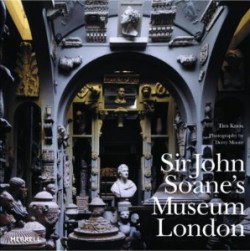 He was appointed Director of Sir John Soane’s Museum in London in 2005, and has since striven to restore Sir John Soane’s glittering architectural treasury to its appearance in 1837, just as its founder wished. In 2009 the next door house, No 14 Lincoln’s Inn Fields, was restored to provide Education facilities, a Research Library and offices for the Museum. In July 2012, the first phase of the £7 million Opening up the Soane project was unveiled, with a new Gallery for temporary exhibitions, a Shop, Conservation Studios and a lift. The next phase of the project, the restoration of Soane’s private apartments, began in April 2013, and the Opening up the Soane project will be fully complete in 2015.
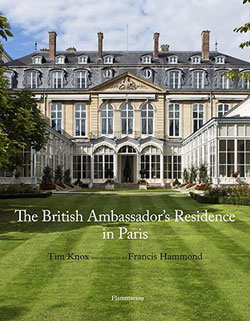 Knox is Historic Buildings Adviser to the Foreign and Commonwealth Office – advising on the presentation of historic ambassadorial residences abroad – and is Chairman of the Government’s Acceptance in Lieu Committee, He sits on the Royal Mint Advisory Committee on the Design of Coins, Medals, Seals and Decorations. He is a Trustee of the Pilgrim Trust and is Patron of the Mausolea and Monuments Trust, which he helped found and Chaired 2000-2005. He is a Fellow of the Society of Antiquaries of London and a Member of the Society of Dilettanti. His Publications include Sir John Soane’s Museum London (Merrell, 2009) and The British Ambassador’s Residence in Paris (Flammarion, 2011).
The Fitzwilliam press release is available here»
Exhibition | Fashioning Switzerland
From The Fitzwilliam:
Fashioning Switzerland: Portraits and Landscapes by Markus Dinkel and His Contemporaries
The Fitzwilliam Museum, Cambridge, 4 June — 15 September 2013
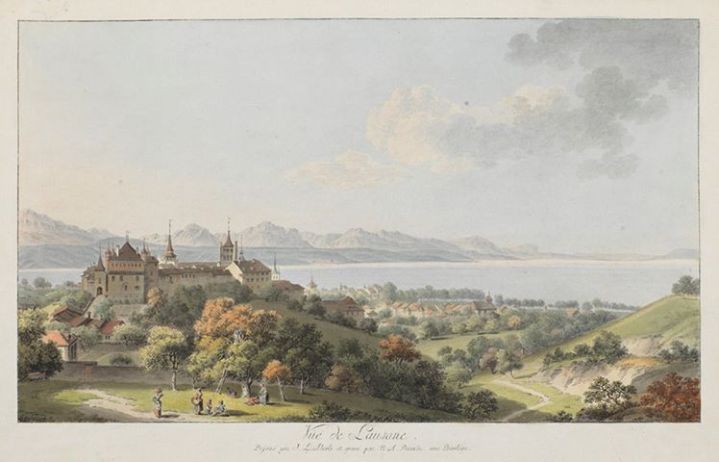
Vue du Lausane (Cambridge: The Fitzwilliam Museum)
◊ ◊ ◊ ◊ ◊
An exhibition of Swiss watercolours and prints featuring a rare selection of finely drawn and coloured portraits of Swiss women in regional costume, by the Bernese artist Markus Dinkel (1762–1832). These are accompanied by other artists’ picturesque views of the Swiss landscape, largely etched and each one delicately hand finished in watercolours.
The prints and drawings on show were made in the century before the establishment of the Swiss federal state in 1848, at a time when foreign tourists were discovering the delights of the various cantons (districts). The images show an affectionate attachment to Swiss landscapes and culture, felt not only by those native to the country, but by the many foreign visitors who collected them as permanent reminders of their travels.
◊ ◊ ◊ ◊ ◊
From Averil King’s review of the exhibition for Apollo Magazine ( 28 June 2013) . . .
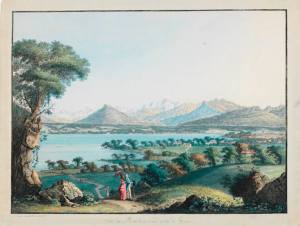
Carl Ludwig Hackert, Vue du Montblanc et Une Partie de Genéve, 1781 (Cambridge: The Fitzwilliam Museum)
Fashioning Switzerland is built around two bequests to the Fitzwilliam Museum: one, in 1910, by the Master and Fellows of Trinity College, Cambridge, of works by the Swiss watercolourist Markus Dinkel (1762–1832); and a later donation, by the Reverend Alfred Valentine-Richards of the Cambridge University Alpine Club, of a number of early views of Swiss mountain scenery. While we may be aware of Swiss artists such as Arnold Böcklin, Jean-Étienne Liotard, Félix Vallotton and Giovanni Giacometti, Dinkel’s name is not a familiar one, and this exhibition, showing his engaging watercolours of Swiss women in regional costume alongside landscapes by his contemporaries, comes as an agreeable surprise. . .
By the late 18th century the formidable mountain chain comprising the Mönch, Eiger and Jungfrau, in the Bernese Alps, was already becoming a tourist destination. So too was the nearby Chamonix (Mont Blanc) range, situated in south-eastern France but clearly visible from the Swiss city of Geneva (as shown in Carl Ludwig Hackert’s View of Mont Blanc and Part of Geneva, 1781). For sightseers, often English Grand Tourists wanting to extend their journeys, the Bernese ‘Three Sisters’ would in time become truly iconic, being portrayed by artists as diverse as Ferdinand Hodler and Emil Nolde. . .
Call for Papers | Society for Emblem Studies Conference
Call for Papers from the Kunsthistorisches Institut at Kiel:
10th International Conference of the Society for Emblem Studies
Some light up, when we read them / Manche leuchten, wenn man sie liest
Christian-Albrechts-Universität zu Kiel, Kunsthistorisches Institut, 28 July — 1 August 2014
Proposals due by 1 September 2013
The conference will devote itself to the entire spectrum of emblem studies, and papers on all aspects of emblematics are welcome. Please submit proposals by 1 September 2013. In additional to a traditional focus on emblem books, the conference will focus on four thematic clusters:
The Domains of the Emblem: Changes in Medium

University Library Kiel. Text was designed by Elsbeth Arlt (Flensburg) in 2002, from André Gide, Les nourritures terrestres et Les nouvelles nourritures (1897), translated into German by Hans Prinzhorn (1930). Photo: Katrin Ulrich, Kunsthistorisches Institut, Kiel.
While emblems are closely associated with the development of printing, emblems can be found in all aspects of life and culture, and they were adapted to these new spaces and uses beyond the page. The choice, application, space, adaption and invention, the compilation of emblematic programs in sacred and secular architectural spaces, and their application to furniture and objects constitute one thematic cluster of the conference. This includes, of course, ephemeral emblems in festivals and theater, and in baptismal and funeral rituals. Emblems in devotional books, novels and other literary genres, on title pages and in paintings and graphics are further topics for consideration. This rubric also includes transitional forms of emblematic expressions, such as emblematized fables and imprese and devices as manifestations of individual or dynastic maxims.
History of Emblem Research
The Tenth Conference of the Society for Emblem Studies provides the opportunity to continue the impetus from the Glasgow conference in 2011 by looking both forward and backward. The beginnings and development of the study of emblems and its most important representatives, beginning with Henry Green, the discoverer of Alciato, and the scholar of mannerism, Mario Praz, will provide the focus here. It will be particularly interesting to compare the various national research traditions and various directions in emblem research with one another, as well as to discover other relationships and contexts. The critical look back is intended to give impetus to new directions in research.
Digitization and Documentation
This area has increasingly become an important focus of research. In addition to completed individual emblem projects with a national or thematic focus, Emblematica Online and its OpenEmblem Portal are now established, providing cross-repository searching across international boundaries. While work continues to expand the scope of the Portal, there now exists a substantial online corpus for emblem studies that facilitates and supports comparative research. There is now greater access to emblem books than ever before. This also supports the study of non-literary emblems.
Text and Image Combinations in Modern Art
The juxtaposition of textual and pictorial elements can be observed in many forms of modern art: photography and painting with integrated or accompanying texts, films, and videos, interactive and internet-based art, and performative art strategies and interventions in public spaces create tension between image and language/text elements. Previously unknown and entirely new forms of expression have been created by assuming textual structures into pictorial forms and by fixing and encoding syntactic models in pictorial contexts. This thematic cluster of the conference is dedicated to questions concerning how modern art employs emblematic strategies that are, however, distinctly different from emblematic ways of constituting meaning. An exhibition in Kiel’s Kunsthalle will complement this part of the conference.
Papers and entire panels on all aspects of your research into emblematics, in addition to these topics, are welcome. Papers can be given in German, English, French, or Spanish. Please let us know if you would like to suggest a panel or moderate a section. Please send us your abstract for a twenty-minute presentation by 1 September 2013.
ihoepel@kunstgeschichte.uni-kiel.de
kunstgeschichte@email.uni-kiel.de
Exhibition | Mengs & Azara: Portrait of a Friendship
Press release (3 July 2013) from The Prado:
Mengs & Azara: Portrait of a Friendship / El Retrato de una Amistad
Museo Nacional del Prado, Madrid, 3 July — 13 October 2013
Curated by Stephen Schröder and Gudrun Maurer
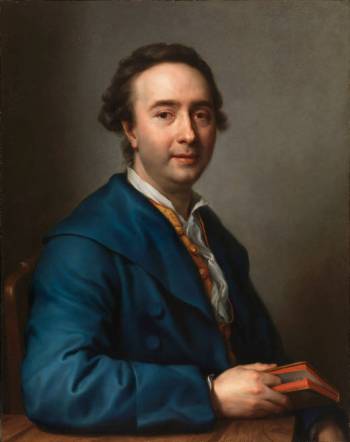
Rafael Mengs, José Nicolás de Azara, oil on panel, 77 x 61.5 cm, 1774 (Madrid, Museo Nacional del Prado)
To mark the Museum’s recent acquisition of one of Mengs’s finest portraits, his Portrait of José Nicolás de Azara, the Prado has recreated the friendship and close collaboration between the Neo-classical painter and his sitter, a leading exponent of the Spanish Enlightenment. This small exhibition, on display in Room 38 of the Villanueva Building until 13 October, consists of 24 works – paintings, sculptures, prints, medals and books – from the Museum’s own holdings or loaned from private collections. The addition of this work to the Prado’s collections will enrich the Museum’s holdings of 18th-century paintings and add to its group of portraits by Mengs.
The recent acquisition by the State and its entry into the Prado of the remarkable Portrait of José Nicolás de Azara, painted in 1774 by Anton Raphael Mengs, has led to the organisation of this small exhibition, which evokes the friendship and close collaboration that existed between the two men: Mengs, the
Neoclassical painter from Bohemia, and Azara, one of
the leading names of the Spanish Enlightenment.
Portrait of José Nicolás de Azara by Mengs
This intimate and strikingly simple image, painted in Florence in early 1774, is an outstanding example of Mengs’s particular classicism and is considered one of his finest portraits. It is also important due to the identity of the sitter, who was one of the most prominent representatives of the Spanish Enlightenment.
Mengs’s portrait conforms to the taste of the time in its use of a pure Neo-classical mode, of which the artist was one of the principal exponents. Azara is depicted with a sublime dignity and naturalness that suggest his intellectual integrity. He has none of the accessories normally used to evoke power and authority but is portrayed with a psychological depth that reveals his character. Particularly striking is his lyrical expression, with its slight smile conveyed through the “gentle movement of the mouth and eyes” that Azara considered the Ancient Greeks to have used to represent the movements of the soul. His expression transmits his friendship with Mengs, his sensibility and his passion for literature. The latter is also indicated by the book that he holds, which he momentarily sets aside in order to focus on the artist with a spontaneity of the kind newly fashionable in 18th-century portraits.
The Exhibition
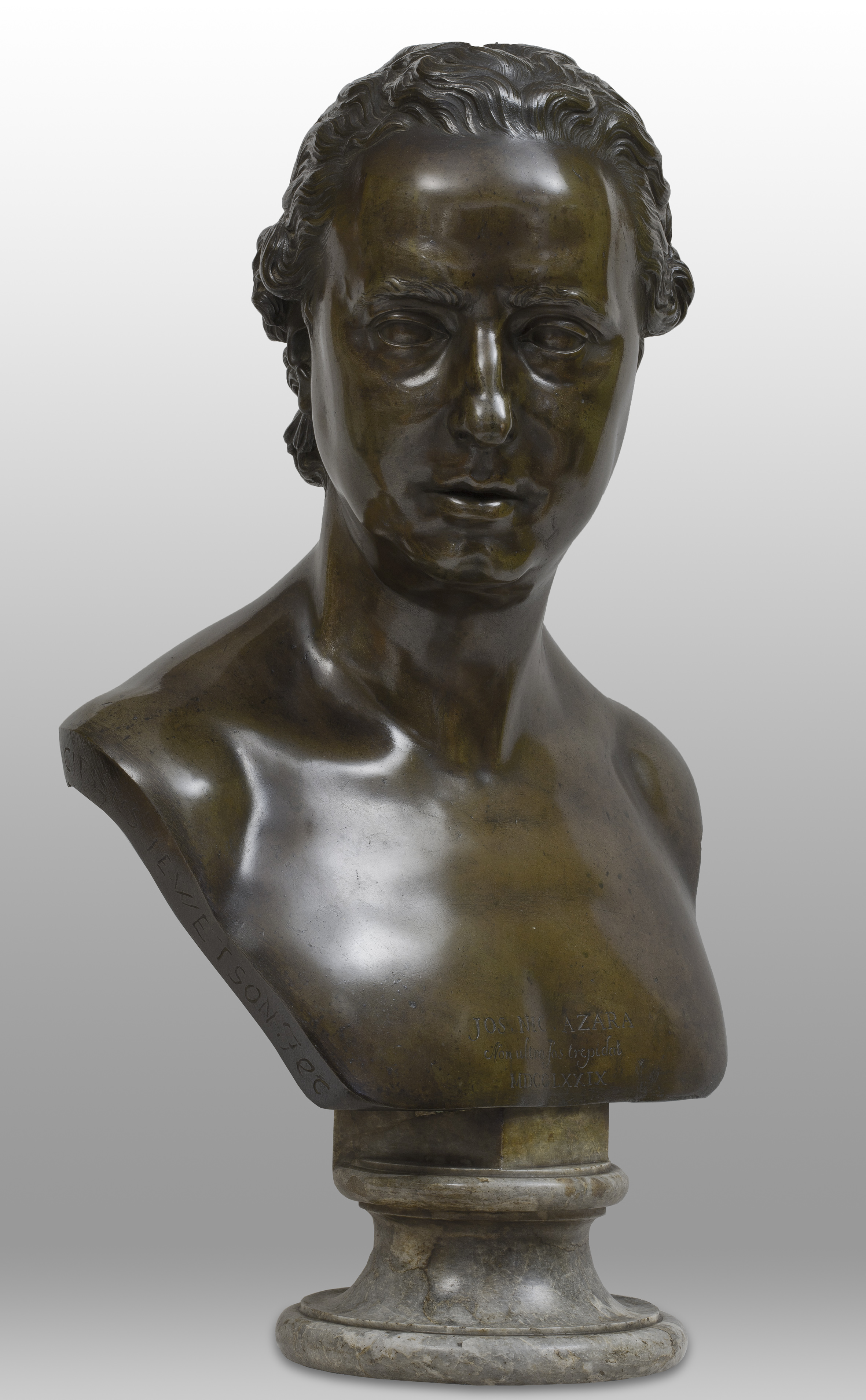
Christopher Hewetson, José Nicolás de Azara, bronze, 52 x 39 x 29 cm, 1779 (Private collection)
The exhibition focuses on the friendship between Mengs and Azara, the affinities between their aesthetic ideas and their close artistic collaboration. It also looks at the way they were depicted in portraits, Azara’s collecting activities, and his role in the promotion and dissemination of Mengs’s works.
In addition to the recently acquired painting, other eloquent proofs of the friendship between the artist and his patron are the two bronze busts of Azara and Mengs of 1779 by the Irish sculptor Christopher Hewetson. The exhibition also includes a Self-portrait by Mengs (ca.1761–1765) dating from the time he first met Azara and their collaboration on the production of a medal to commemorate the marriage of the Prince and Princess of Asturias, which is also on display. Another later Self-portrait of around 1774–1776 was the primary model for the dissemination of the artist’s image in Spain. It is present here through a copy in pastel by Mengs’s daughter, Ana María, and a print after it by Ana María’s husband, Manuel Salvador Carmona.
As examples of the affinity between the two men’s aesthetic ideas, the exhibition includes a drawing by Mengs of the classical sculpture of Antinous as Osiris (original in the Vatican Museums), and a print after a drawing by Mengs of one of the mural paintings in the
Villa Negroni.

Christopher Hewetson, Anton Raphael Mengs, bronze, 51 x 38 x 26 cm, 1779 (Madrid, Museo Nacional de Artes Decorativas)
In 1779 Azara initiated an excavation project in Tivoli near Rome. Following the discovery of fifteen portraits of Greek philosophers and poets and other small sculptures in the so-called Villa dei Pisoni, Azara began to collect classical portraits and sculptures, possessing around 70 examples by the end of his life. His collection, which is now divided between the Real Casa del Labrador in Aranjuez and the Museo del Prado, is represented here by sculpted portraits of the poets Homer and Menander, the Epicurian philosopher Hermarcus and the Attic general Miltiades, in addition to a statue of a Dacian from Trajan’s Forum in Rome and one of Fortuna.
Also on display is a copy of the Life of Cicero by Conyers Middleton, edited and translated by Azara and illustrated with prints of sculptures from his own collection. Azara’s role in protecting and disseminating Mengs’s artistic legacy is conveyed in the exhibition through a print of his portrait by Mengs, engraved by Domenico Cunego; a commemorative medal of the “philosopher painter” by Caspar Joseph Schwendimann, in which Azara included his own image; Las Obras de D. Antonio Rafael Mengs, edited and with commentaries by Azara, published in Parma and Madrid in 1780; and the first biography of the artist written in 1780 by Ludovico Bianconi and illustrated with a print relating to Azara’s homage to Mengs after his death when he installed a bust of him by Hewetson in the Pantheon in Rome.
Finally, Azara’s friendship with Napoleon arising from his diplomatic mission of 1796 is documented through two works: a commemorative gold medal issued that year by the Senate in Rome in honour of Azara and his negotiation of the Armistice of Bologna; and a medal with a portrait of Napoleon that commemorates the Peace of Amiens, which Azara signed in 1802 as the representative of the Spanish monarch.
Stephen Schröder and Gudrun Maurer, Mengs & Azara: El Retrato de una Amistad (Madrid: Museo Nacional del Prado, 2013), 48 pages, ISBN: 978-8484802648, 10€.
The exhibition is accompanied by an essay-catalogue written by the curators, Stephen Schröder, Head of the Department of Classical and Renaissance Sculpture, and Gudrun Maurer, Curator in the Department of 18th-century Spanish Painting and Goya, both at the Museo del Prado.
Azara and Mengs
The relationship between the two men yielded its first artistic results in 1765 when Azara requested the collaboration of Mengs in the design of a medal to commemorate the marriage of the Prince and Princess of Asturias.
José Nicolás de Azara (Barbuñales, 1730 – Paris, 1804) became widely known in Spain from the time of his first appointment as a civil servant in the Government Office in 1760. He subsequently achieved international renown through his diplomatic post in Rome, where he remained for more than thirty years, followed by Paris from 1798 to 1803 as Spanish ambassador at a delicate period in the last decade of the 18th century and early years of the following century. Among Azara’s numerous friendships with leading cultural and political figures were those with Winckelmann, the theoretician of classical art, the famous typographer Bodoni, Pope Pius VI and politicians such as Godoy in Spain and Napoleon and Talleyrand in France.
Anton Raphael Mengs (Aussig, 1728 – Rome, 1779) initially trained with his father Ismael Mengs in Dresden then went to Italy to study the works of the Italian masters including Raphael, Michelangelo, Carlo Maratti, Correggio, the Carracci, and Titian. In 1751 he was appointed painter to the privy chamber by the Elector of Saxony, Frederick August II. During his time in Rome from 1752 to 1761, where he met the German archaeologist Johann Joachim Winckelmann, Mengs evolved the theories that formed the basis of his writings on ideal beauty and the recovery of the perfection of art through the study of the great models of the ideale classico. After painting the fresco of the Parnassus in the Villa Albani, which can be considered the embodiment of Neo-classical art, Mengs was summoned to Madrid by Charles III, the Elector of Saxony’s son-in-law, to supervise the decoration of the Royal Palace.
Appointed painter to the privy chamber in 1766, he introduced the new artistic trends into Spain and supported Spanish painters such as Maella, the Bayeu brothers and Goya. Due to poor health, Mengs returned to Rome in 1769. As a commission from Charles III, in 1770 in Florence he painted the portraits of the families of the Grand Dukes of Tuscany (Museo Nacional del Prado), at which point he made plaster casts of the most important classical and Renaissance sculptures in their collection, which he used for teaching purposes. In Rome the artist was appointed director of the Academy of Saint Luke and received important commissions for paintings for the Museo Clementino and the basilica of Saint Peter’s. Having returned to Madrid in 1774 he went to Rome again in 1776, where he died of tuberculosis in 1779. Mengs’s output encompasses history paintings, religious works, frescoes on religious, mythological and allegorical subjects, and an important group of portraits.
A checklist of the 24 works on display is available at the end of the press release.
The Slave Owner, the Cook, His Sister, and Her Lover
Published last September, Craughwell’s book underscores Jefferson’s complicated attitudes and debts to slavery. On, this, the day of the United State’s birth and Jefferson’s death, that strikes me as useful. It’s certainly fascinating to see the American introduction of macaroni and cheese as part of a trans-Atlantic story involving both Europe and Africa. Happy Independence Day. –CH
◊ ◊ ◊ ◊ ◊
From Quirk Books:
Thomas J. Craughwell, Thomas Jefferson’s Crème Brûlée: How a Founding Father and His Slave James Hemings Introduced French Cuisine to America (Philadelphia: Quirk Books, 2012), 256 pages, ISBN: 978-1594745782, $20.
 This culinary biography recounts the 1784 deal that Thomas Jefferson struck with his slaves, James Hemings [brother of Sally Hemings]. The founding father was traveling to Paris and wanted to bring James along “for a particular purpose”— to master the art of French cooking. In exchange for James’s cooperation, Jefferson would grant his freedom.
Thus began one of the strangest partnerships in United States history. As Hemings apprenticed under master French chefs, Jefferson studied the cultivation of French crops (especially grapes for winemaking) so the might be replicated in American agriculture. The two men returned home with such marvels as pasta, French fries, Champagne, macaroni and cheese, crème brûlée, and a host of other treats. This narrative history tells the story of their remarkable adventure—and even includes a few of their favorite recipes.
Abram Barkshian reviewed the book for The Wall Street Journal (14 September 2012).
Exhibition | From Colony to Nation: 200 Years of American Painting
Press release (6 June 2013) from the New-York Historical Society:
From Colony to Nation: 200 Years of American Painting
New-York Historical Society, New York, 7 June — 8 September 2013
Curated by Linda S. Ferber

Charles Peale, The Peale Family, 1773–1809, 57 x 90 inches
(New York-Historical Society)
Capturing the spirit of the United States through two centuries of artistic expression, From Colony to Nation: 200 Years of American Painting features more than eighty works dating from 1720 to 1918, drawn from the New-York Historical Society’s large holdings of American paintings. On view June 7 through September 8, 2013, the exhibition interweaves art history and American history into a richly textured visual panorama, with subjects ranging from early Colonial portraits to urban Impressionism. The exhibition also highlights the story of the artists, patrons, and collectors whose contributions informed the history of New-York Historical.
Many works in From Colony to Nation will be exhibited for the first time in decades, following conservation of both the paintings and their period frames. Among the exhibition highlights is John Singer Sargent’s portrait Mrs. Jacob Wendell (1888), a recent gift to the New-York Historical Society from The Roger and Susan Hertog Charitable Fund and Jan and Warren Adelson. The first painting by Sargent in New-York Historical’s collection, the work was created during the young expatriate artist’s first professional foray on American soil.
The exhibition is organized into six overarching themes that interweave art history and American history into a richly textured national narrative beginning in the early 18th century and ending in the early 20th. Colonial Painting: Faces, Places & a Bible Story features a number of New-York Historical’s early portraits of the men, women and children who comprised the thriving populations of colonial New York and Philadelphia. Among the treasures on display are seven Beekman family portraits, dating from the 1760s and still in their original frames—a rare instance of an entire suite of portraits of a prominent family represented in a single collection. Also on view is Charles Willson Peale’s monumental The Peale Family (1773–1809), which brings together several generations in the artist’s studio for one of the most ambitious group portraits of the 18th century. The Peale family saga is played out over several decades and generations, coming to a close when the elderly Peale added a memorial portrait of his beloved dog Argus. Another exhibition highlight is the recent acquisition The Finding of Moses (ca. 1720), a rare scripture painting attributed to Gerardus Duyckinck. The Dutch community valued such Biblical narrative paintings for their religious content and as a reflection of their political experience, identifying with the exiled Israelites in their own struggles against the domination of Spain in the Netherlands and the English in New York.
Artists featured in the exhibition are also well-represented in New-York Historical’s portrait collection—The World of the American Artist features a selection of these likenesses, along with depictions of noted art collectors and patrons. Expatriate artist Benjamin West’s London studio was the destination for a first generation of aspiring Colonial painters, including Gilbert Stuart, Charles Willson Peale, and Abraham Delanoy, who painted West in 1766 at the height of the artist’s early fame as a history painter. Portraits of Asher B. Durand and Thomas Cole represent a later generation of American masters who focused upon the American landscape. Important collectors and patrons depicted in the exhibition include Luman Reed and Thomas Jefferson Bryan, whose collections formed the early core of New-York Historical’s collection.
The Early Republic: Patriots, Citizens & Democratic Vistas features founding fathers, New York merchants and Pennsylvania farmers, with several joined by their wives to create charming pairs. Iconic portraits of Washington, Jefferson, Hamilton, and Lafayette portray the heroes of the Revolutionary generation. Gilbert Stuart portrays the dashing Schulyers as a newly married couple (1807), and Jacob Eichholtz’s captures the genteel charm of Pennsylvania country gentry in his portraits of Mr. and Mrs. Frederick Eichelberger (ca. 1819). Scenic wonders of the new nation include John Trumbull’s 1808 epic panoramas of Niagara Falls, contrasted with the 1818 record of a lively transportation hub at the New York waterfront captured by visiting Swiss painter J.H. Jenny. (more…)
Imagining the Shantytown Dwellings at Fort Mifflin
I’m sorry I learned of this Philadelphia project only a few days ago (after the close of the festival, which looks to have been positively exhilarating). Still, it seems worth noting, a useful counterweight perhaps to all the magnificence within the period’s historiography. One of the artists, Ben Neiditz, is, incidentally, on staff at the Penn Museum. -CH
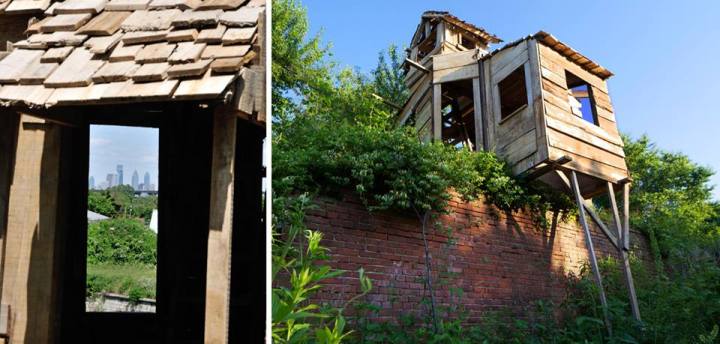
Ben Neiditz and Zach Webber, Ruins at High Battery,
Fort Mifflin, Philadelphia, 2013. Photo by Peter Woodall
◊ ◊ ◊ ◊ ◊
In connection with Philadelphia’s Hidden City Festival (23 May — 30 June 2013), Ben Neiditz and Zach Webber have constructed improvised dwellings that recall Revolutionary War-era shantytowns along the Delaware River at Fort Mifflin, a stunning remnant of the Revolutionary War. Playing with notions of permanence and impermanence, the artists’ settlement recalls the shantytowns that have dotted the Delaware River wetlands since the 18th century–while also imagining the DIY settlements of the future. . .
Read more at the festival website; additional photos can be found at Street Department, Conrad Benner’s blog dedicated to art on the streets of Philadelphia.
◊ ◊ ◊ ◊ ◊
From the Fort Mifflin website:
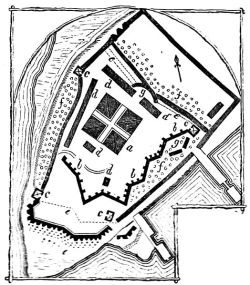
Fort Mifflin, 1777, from Benson John Lossing’s Field Book of the Revolution, 2 volumes (New York: Harper Brothers, 1853), vol. 2, p. 90. Image from Wikimedia Commons
[At Fort Mifflin, in the fall of 1777,] on the frozen, marshy ground within the walls of a stone and wood fort, the American Revolution produced a shining moment. Cold, ill and starving, the young garrison of (now) 400 men at Fort Mifflin refused to give up. The valiant efforts of the men at Fort Mifflin held the mighty British Navy at bay providing Washington and his troops time to arrive safely at Valley Forge where they shaped a strong and confident army. This battle escalated into the greatest bombardment of the American Revolution and one that many say changed the course of American history. . .
Call for Papers | American Art History and Digital Scholarship
From the symposium and workshop website:
American Art History and Digital Scholarship: New Avenues of Exploration
Archives of American Art, Smithsonian Institution, Washington, D.C., 15–16 November 2013
Proposals due by 15 August 2013; registration due by 30 September 2013
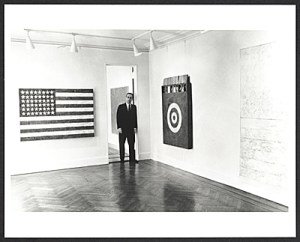
Leo Castelli in a room of the Jasper Johns exhibit at the Castelli Gallery, 1958 (Archives of American Art)
The Archives of American Art announces an upcoming symposium, American Art History and Digital Scholarship: New Avenues of Exploration, to be held at the Donald W. Reynolds Center for American Art and Portraiture, in Washington, DC, on Friday, November 15, followed by a one-day workshop at the Archives of American Art on Saturday, November 16. We seek proposals for Friday’s presentations and applications for participation in Saturday’s moderated workshop.
The symposium will convene scholars, archivists, librarians, graduate students, technical experts, and the public to consider American art history in a digital world, examining ways to integrate digital tools and resources into the study of
American art and to encourage collaboration. (more…)










 Enfilade
leave a comment