MFA Appoints Frederick Ilchman as Chair, Art of Europe
Press release (27 February 2014) from Boston’s MFA:
Frederick Ilchman has been appointed Chair, Art of Europe at the Museum of Fine Arts, Boston (MFA). Ilchman will continue to serve as the Mrs. Russell W. Baker Curator of Paintings, a position he has held since 2009. Ilchman joined the MFA in 2001 as Assistant Curator of Paintings. A specialist in the art of the Italian Renaissance, he has curated numerous exhibitions, organized international conferences, contributed to scholarly publications and lectured and taught in the United States and abroad. Ilchman’s acclaimed exhibition, Titian, Tintoretto, Veronese: Rivals in Renaissance Venice (2009), organized with the Musée du Louvre, was the first major exhibition dedicated to the competition among these three renowned artists and the emergence of their signature styles. The exhibition won several awards including “Outstanding Exhibition (Eastern Time Zone)” from the Association of Art Museum Curators and was selected as one of the year’s top 10 exhibitions by the Wall Street Journal. In October 2014, an exhibition he is co-curating, Goya: Order and Disorder, will open in the MFA’s Ann and Graham Gund Gallery. In 2003, he served as the Boston curator for the traveling exhibition Thomas Gainsborough, 1727—1788, a major retrospective organized by Tate Britain, and was part of the curatorial team for the exhibition Tintoretto (2007) at the Museo Nacional del Prado in Madrid. Recently, Ilchman curated Visiting Masterpiece: Piero della Francesca’s Senigallia Madonna: An Italian Treasure, Stolen and Recovered (2013), and co-curated the exhibition Paolo Veronese: A Master and his Workshop in Renaissance Venice (2012) at the Ringling Museum in Sarasota.
Ilchman holds a Bachelor of Arts in Art and Archaeology from Princeton University, where he graduated summa cum laude (1990), and a Master of Arts (1992) and Master of Philosophy (1996) in Art History from Columbia University. He will receive his Ph.D. in Art History from Columbia University in May 2014. He has been awarded numerous fellowships, including the Gladys Krieble Delmas Foundation Grant (2006), Save Venice Inc. Art History Fellowship (1999–2001), the Theodore Rousseau Fellowship, Metropolitan Museum of Art (1996–1997, 1998–1999) and a Fulbright Fellowship (IIE), Italy (1997–1998). In 2010, he was a Fellow at the Center for Curatorial Leadership in New York City. Ilchman has been on the board of directors of Save Venice Inc., the largest private organization devoted to preserving the art and architecture of Venice, since 2005, and now is co-Project Director. He also has served as Chair of the Boston Chapter of Save Venice since 2011.
MFA Appoints Benjamin Weiss as Chair, Prints, Drawings, & Photographs
Press release (27 February 2014) from Boston’s MFA:
Benjamin Weiss has been named Chair, Prints, Drawings and Photographs at the Museum of Fine Arts, Boston (MFA). Weiss will continue to serve in his current position, Leonard A. Lauder Curator of Visual Culture, which he has held since 2011. In that role, he co-curated The Postcard Age: Selections from the Leonard A. Lauder Collection (2012) and most recently organized Audubon’s Birds, Audubon’s Words (2013); he is currently preparing further exhibitions and publications drawn from the Leonard A. Lauder Postcard Archive, including an exhibition devoted to “real photo” postcards of the early 20th century. In addition to the Lauder Archive, Weiss has had responsibility for the MFA’s other collections of posters, postcards, illustrated books, graphic design and ephemera of all sorts.
Prior to taking his current position in Prints, Drawings and Photographs, Weiss spent seven years in the MFA’s Education Department as Head of Interpretation (2009–2012) and Manager of Adult Learning Resources (2005–2009). He was integral to the opening of the Art of the Americas Wing in 2010, when he was responsible for interpretation for 5,000 objects on view. He also oversaw the written and educational materials for all special exhibitions and installations of the collection, including brochures, multimedia tours and in-gallery wall texts and labels.
Weiss holds a Master of Arts in History from Princeton University (1991) and a Bachelor of Arts from Harvard College (1989). Before coming to the MFA, he worked at the Burndy Library, of the Dibner Institute for the History of Science and Technology at MIT for seven years, where he was Curator of Rare Books and Head of Exhibitions and Publications. While at Burndy, he curated more than a dozen exhibitions, on subjects as varied as color theory, 19th-century American bridge engineering and the history of obelisks. That last exhibition resulted in the collaborative monograph Obelisk: A History, co-written with Anthony Grafton, Pamela O. Long and Brian Curran, and published by MIT Press. A Renaissance historian by training, with a specialty in the history of cartography, Weiss maintains an interest in the history of maps, and specifically in the history of ancient geographical texts in the 15th and 16th centuries.
New Book | The Backstory of Wallpaper: Paper-Hangings, 1650–1750
An interesting example of a self-published book (easily accessible through Barnes & Noble and Amazon) that many scholars may find extremely useful. It’s among the titles under consideration for Historic New England’s 2014 Book Prize . . .
Robert M. Kelly, The Backstory of Wallpaper: Paper-Hangings, 1650–1750 (Lee, Massachusetts: Wallpaper Scholar, 2013), 190 pages, ISBN: 978-0985656102, $30.
 Wallpaper design has captivated Western consumers for 300 years, but this book looks closer—at wallpaper use. It tells how single-sheet wallpaper developed in Europe, found wide acceptance in England and France, and was successfully transplanted to the North American colonies. By 1750, wallpaper was well-established and poised for phenomenal growth.
Robert M. Kelly has been working with wallpaper as a paperhanger, consultant, and writer for over 30 years. He attended the Attingham Summer School program in 1993. He has worked at the White House, Andrew Jackson’s Hermitage, Martin Van Buren’s Lindenwald estate, The Gracie Mansion in New York City, and many other governmental sites. He’s written over 50 articles on wallpaper, many for the Wallpaper History Society Review.
An interview with Robert Kelly appears at Kunstpedia.
Four Centuries of Massachusetts Furniture

◊ ◊ ◊ ◊ ◊
Press release (21 May 2013) for the collaboration Four Centuries of Massachusetts Furniture:
A first-time collaboration among eleven founding institutions and numerous other organizations throughout the state, Four Centuries of Massachusetts Furniture highlights Massachusetts furniture-making, from the 1600s to the present day, through a series of exhibitions, symposia, public programs, and a dedicated website. Founding institutions consist of the Colonial Society of Massachusetts; Concord Museum; Fuller Craft Museum; Historic Deerfield; Historic New England; Massachusetts Historical Society; Museum of Fine Arts, Boston; North Bennet Street School; Old Sturbridge Village; Peabody Essex Museum; and Winterthur Museum, Garden and Library. Never before have so many renowned institutions in the Northeast joined forces to exhibit, study, and promote a single topic in the field of American Decorative Art. Four Centuries of Massachusetts Furniture is an unprecedented celebration of the Bay State’s remarkable furniture-making legacy. From the earliest products of newly arrived immigrants in the 1600s, to the outstanding work of present-day studio furniture-makers, Massachusetts holds one of the most prominent places in American furniture-making history.
Four Centuries of Massachusetts Furniture will include seven museum exhibitions, each focusing on a different aspect of Massachusetts furniture-making. The Massachusetts Historical Society will mount a display of documented Boston furniture from private collections, supplemented with rarely seen items in the Society’s collection, including relevant paintings, prints, account books, and ledgers. The exhibition at Historic Deerfield will take a fresh look at two centuries of furniture-making in western Massachusetts, showcasing a wealth of objects, many of which are new acquisitions. The Concord Museum’s exhibition will explore the remarkable life and career of William Munroe through the objects he made and a rare collection of shop records and Old Sturbridge Village will explore the career of prominent Federal-period artisan Nathan Lombard. The exhibition at the Fuller Craft Museum will feature contemporary studio furniture from the Bay State over the past half century and the final exhibition, slated to open at the Peabody Essex Museum in 2014, examines the career of eminent Salem cabinetmaker Nathaniel Gould. In addition, Winterthur Museum has installed fifty of its finest pieces of Boston furniture in an exhibition titled Boston Furniture at Winterthur and numerous other institutions throughout the state will highlight key pieces of Massachusetts furniture in their collections. (more…)
Subject of Art History Added to Oxford Bibliographies
Under the direction of Editor-in-Chief Thomas DaCosta Kaufmann, Art History is the latest subject to be added to OUP’s subscription-based resource Oxford Bibliographies (as of January 2014). At present there are only 50 articles—ranging from ‘Art of the Aztec Empire’ to ‘Yuan Dynasty Art’—with plans for a few dozen more to be added in the coming months. And so for now, the resource is better at showcasing potential than providing a truly useful, comprehensive collection of bibliographies. That said, Dorothy Johnson’s entry for Jacques-Louis David provides a promising glimpse of what the future might entail, and the larger Oxford Bibliographies project ranked among Choice’s Top Ten Internet Resources for 2013 (along with ARTstor). All of the usual concerns about expensive, subscription-based resources, inevitably, remain relevant. -CH
◊ ◊ ◊ ◊ ◊
◊ ◊ ◊ ◊ ◊
From the Art History page of Oxford Bibliographies:
Art history is a vast discipline, geographically, historically, and intellectually. In its initial centuries, art history dealt with Western art, but the boundaries of the field have since expanded. The canon continues to be redefined as histories of art in regions that had previously been ignored are brought into the mainstream. Traditional emphases on European art have been reduced, as the discipline reaches world-wide dimensions in which connections as much as differences have increasingly come into focus. Originating as a study much informed by ancient art, and then by the art of the Renaissance, the historical dimension of the discipline has also continuously advanced with time. More and more works and types of objects are made throughout the world, and art historians’ interests have increasingly shifted to more recent art. In the past half century art historians have also engaged more and more with questions of theory, method, and the history of the discipline. New approaches, often borrowed from other fields, have proliferated.
As a result of all this flux and ferment, it has become progressively more difficult to grasp the literature of the field, and to gain an orientation to current and perennial problems. Oxford Bibliographies in Art History responds to these needs and offers a trustworthy pathway through the thicket of information overload. Whether an expert in contemporary European art needs to read up on the art of ancient China for a book project or an undergraduate student needs to start a research paper on iconography in Renaissance art, Oxford Bibliographies in Art History will provide a trusted source of selective bibliographic guidance.
Exhibition | Genius and Grace
From the exhibition press release:
Genius and Grace: Franҫois Boucher and the Generation of 1700
Cincinnati Art Museum, 14 February — 11 May 2014
Curated by Esther Bell

François Boucher, Venus Presenting Aeneas to Jupiter and Juno, 1747, black chalk, pen with brown ink, and brush with brown wash and touches of white gouache on tan antique laid paper (Boston: The Horvitz Collection)
◊ ◊ ◊ ◊ ◊
This spring, the verve, grace, and exuberance of 18th-century French drawings will be on display at the Cincinnati Art Museum. The Cincinnati Art Museum will show drawings by the talented group of artists responsible for an unprecedented level of artistic and cultural production in the France of Louis XV in an exhibition titled Genius and Grace: Franҫois Boucher and the Generation of 1700, on view from February 14 to May 11, 2014. Franҫois Boucher, Charles-Joseph Natoire, Carle Vanloo, and their contemporaries, born in or around 1700, executed virtuoso compositions whose refined elegance epitomizes the French grand manner. Along with Boucher, Natoire, and Vanloo, the exhibition will also celebrate lesser known but equally talented figures such as Louis-Gabriel Blanchet and Joseph Franҫois Parrocel, as well as several pastels, including a rare example by Jean-Baptiste-Siméon Chardin. More than seventy master drawings, many of which have never before exhibited or published, will be on view.
This exhibition is organized by the Horvitz Collection in Boston—the preeminent private collection of early French art in the United States. Twenty-nine of the most distinguished artists of this period will be featured, along with a fully illustrated catalogue edited by Alvin L. Clark, Curator of the Horvitz Collection and the J.E.Horvitz Research Curator, Department of Drawings, Harvard Art Museums/Fogg Museum. The Cincinnati Art Museum venue for Genius and Grace: François Boucher and the Generation of 1700 is organized by Dr. Esther Bell, Curator of European Paintings, Drawings, and Sculpture; it is the first old master drawings exhibition to take place at the Cincinnati Art Museum in more than thirty years. “These are some of the most beautiful and sexiest images the Old Masters ever produced,” commented Cincinnati Art Museum Director Aaron Betsky. “They are stunning in their display of talent and the sensuality they convey.”

François Boucher, Recumbent Female Nude, ca. 1742–43, red chalk, heightened with white chalk (Boston: The Horvitz Collection)
◊ ◊ ◊ ◊ ◊
Sixteen of the works on view were created by Franҫois Boucher, who an eighteenth-century critic called “the painter of voluptuousness and grace.” One of the artist’s drawings, Recumbent Nude, depicts a luscious female figure. This may, at first, seem to be a provocative and erotically charged image, but it may have simply developed from a figure study intended to be used when painting a sea nymph or other historical subject. Also part of the exhibition is Carle Vanloo’s Saint Augustine Disputing with the Donatists, which has never before been exhibited. This masterpiece is remarkable for its heavy contours and energetic forms encased within a scene of monumental Italian architecture.
According to Cincinnati Art Museum Curator Dr. Esther Bell, “A selection of master drawings was selected that best tell the story of the unfolding eighteenth century. Not only will visitors be able to enjoy the sumptuous forms of the high Rococo, but also the virtuoso drawings that resulted from rigorous academic training and the cool and classicizing manifestations of these artists’ Italian journeys.”
◊ ◊ ◊ ◊ ◊
From Artbooks.com:
Alvin Clark, ed., Genius and Grace: Franҫois Boucher and the Generation of 1700 (Boston: The Horvitz Collection, 2014), 151 pages, ISBN: 978-0991262502, $34.
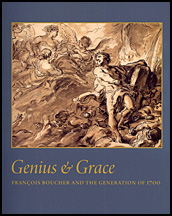 Genius and Grace: Franҫois Boucher and the Generation of 1700 features over seventy master drawings from the Horvitz Collection, Boston—widely considered the preeminent collection of French art in the United States. The exhibition features works by a group of artists known as the Generation of 1700. This talented group of artists born in or around the year 1700, such as François Boucher, Charles-Joseph Natoire, Carle Vanloo, and their contemporaries, will be celebrated for their virtuoso compositions whose curvilinear elegance epitomizes the French grand manner. From Boucher’s sumptuous reclining female nude, to a rare, early pastel by Jean-Baptiste-Siméon Chardin, to Director of the French Academy Charles Coypel’s mature self portrait—the works on view celebrate Dezallier d’Argenville’s comment of 1745: “A painter’s way of drawing is as distinctive as handwriting and more so than a writer’s style.” Includes: A. Clark, “The Generation of 1700: Draftsmen, Drawings, and Questions”; F. Joulie, “Reflections on the Early Drawings of Boucher and His Contemporaries”; and E. Bell, “Charles Coypel and the Age of Eclecticism.”
Conference | Russian Art: Exhibitions, Collections, and Archives
From the conference programme:
Exhibit A: Russian Art | Exhibitions, Collections, and Archives
The Courtauld Institute of Art, London, 21–22 March 2014
Exhibit A: Russian Art | Exhibitions, Collections and Archives, is the second conference in an on-going collaborative project between Moscow Lomonosov State University and the Cambridge Courtauld Russian Art Centre (CCRAC). Speakers will explore contemporary and historical practices of exhibiting and collecting Russian art and the potential of collections, exhibitions and documentary archives as important material resources and objects of study in their own right. The conference is also intended as a forum through which to showcase important but less familiar collections of Russian art and documentary material located inside and outside of Russia. It is conceived without chronological boundaries, and papers will address topics ranging from the earliest instances of collecting, exhibiting and writing about Russian art to contemporary practice in these three areas.
Organised by Natalia Budanova (The Courtauld Institute of Art) and Jenn Brewin (University of Cambridge) in collaboration with Moscow Lomonosov State University and the Cambridge Courtauld Russian Art Centre (CCRAC), with additional support from the Russian Art World (РХМ).
Ticket/entry details: £25 (£15 students, Courtauld staff/students and concessions) Book online or send a cheque made payable to ‘The Courtauld Institute of Art’ to: Research Forum Events Co-ordinator, Research Forum, The Courtauld Institute of Art, Somerset House, Strand, London WC2R 0RN, stating ‘CCRAC conference’.
◊ ◊ ◊ ◊ ◊
F R I D A Y , 2 1 M A R C H 2 0 1 4
13:45 Registration
14:15 Opening remarks
14:30 Session 1 | Collecting Russian Religious and Folk Art
Chair: Nicola Kozicharow (University of Cambridge)
• Engelina Sergeevna Smirnova (Moscow Lomonosov State University), The collection of antiquities in sixteenth-century Russia: motivations and methods
• Aleksandr Sergeevich Preobrazhenskii (Moscow Lomonosov State University), Icon collections of Moscow Old Believers in the early nineteenth century: evidence of owners’ inscriptions
• Valery Stefanovich Turchin (Moscow Lomonosov State University), Collectors of lubki [Russian popular prints] and the development of the avant-garde in Russia (In Russian)
15:40 Coffee
16:10 Session 2 | Collections and Exhibitions in Eighteenth-Century Russia
Chair: Natalia Budanova (The Courtauld Institute of Art)
• Andrey Aleksandrovich Karev (Moscow Lomonosov State University), The portrait gallery in eighteenth-century Russia as an ensemble: a typological aspect
• Zalina Valerievna Tetermazova (Moscow Lomonosov State University), Collecting Russian portrait engravings from the age of Peter to the twentieth century: an outline of the phenomenon and its main features
• Vera Sergeevna Naumova (Moscow Lomonosov State University), The art collection of Count K. Razumovskii: the history of the collection’s formation and composition
• Rosalind P. Blakesley (University of Cambridge), Exhibiting Russian success?: the 1770 exhibition at the Imperial Academy of Arts
17:45 Drinks reception (more…)
Journal of the History of Collections 26 (March 2014)
The eighteenth century in the current issue of the Journal of the History of Collections:
Journal of the History of Collections 26 (March 2014)
A R T I C L E S
José Saporiti Machado and Miguel Telles Antunes, “Aniceto Rapozo’s Cabinet at the Lisbon Academy of Sciences: A Window into Brazilian Eighteenth-Century Timber Resources,” pp. 21–33.
From the end of the eighteenth until the beginning of the nineteenth century, wood samples were regularly sent to the Royal Army Arsenal in Lisbon for testing. The large number and variety of samples, as well as increasing interest on Brazil, explain why, in 1805, the Prince Regent of Portugal commissioned the preparation of four collections containing 1,213 timber specimens from Brazil and twelve from other origins. One of these collections, housed in a cabinet at the Lisbon Academy of Sciences, is now being studied in order to reveal its origins and to identify the wood samples. Botanical identifications will provide valuable information about the wood resources and the species used by furniture-makers in the late eighteenth and early nineteenth centuries.
Arthur MacGregor, “Patrons and Collectors: Contributors of Zoological Subjects to the Works of George Edwards (1694–1773),” pp. 35–44.
Through his lavishly illustrated and eminently accessible Natural History of Uncommon Birds (1743–51) and Gleanings of Natural History (1758–64), George Edwards became one of the most influential naturalists and illustrators of mid-eighteenth-century England. The specimens on which he relied – either alive, stuffed, or in spirits – were generally in the ownership of others and his practice of carefully acknowledging the source of each of his subjects sheds considerable light on the extent to which exotic birds and animals were to be found in the possession of a range of owners from wealthy grandees to humble citizens, as well as specialist traders who emerged to supply this growing market. Edwards’s texts are drawn upon here to chart the degree to which exotic species, alive or dead, had begun to penetrate households great and small by the mid 1700s, particularly in the London area; an online appendix lists and identifies those who supplied him with specimens.
Debora J. Meijers, “An Exchange of Paintings between the Courts of Vienna and Florence in 1792–1793: A Logical Step Taken at the Right Moment,” pp. 45–61.
It may come as a surprise that in the turbulent political period of spring 1792 a decision was taken at the courts of Vienna and Florence to carry out an exchange of paintings, the aim of which was ‘to complete’ the collections of the Emperor and the Grand Duke, each ‘with the profusion of the other’. There are, however, signs that this step originated in the recent past of both galleries and further that it related to the developments of that particular historical moment. The exchange can be interpreted as a logical consequence of the recently introduced taxonomic division into schools, the advancement of which would lead to an unprecedented level of ‘completeness’. Besides being a perfect seed-bed for emerging artists, the presentation of ‘all’ the schools could also be seen as a metaphor for political power. But in this time of war with France the exchange served mainly as a bond between two brothers who were pursuing very different political courses.
R E V I E W S
• David Howarth, Review of Christopher Rowell, ed., Ham House: 400 Years of Collecting and Patronage (2013), pp. 117–19.
• Rosemary Sweet, Review of Noah Heringman, Sciences of Antiquity: Romantic Antiquarianism: Natural History and Knowledge Work (2013), pp. 119–20.
• Arthur MacGregor, Review of Glyn Williams, Naturalists at Sea: Scientific Travellers from Dampier to Darwin (2013), pp. 120–22.
• Mark A. Roglán, Review of Shelley M. Bennett, The Art of Wealth: The Huntingtons in the Gilded Age (2013), p. 125.
• Fiona Savage, Review of Sarah Longair and John McAleer, eds., Curating Empire: Museums and the British Imperial Experience (2012), pp. 125–26.
• Francesco Paolo de Ceglia, Review of Medical Museums: Past, Present, Future (2013), pp. 126–27.










 Enfilade
leave a comment