New Book | Silver in Georgian Dublin
From Routledge:
Alison FitzGerald, Silver in Georgian Dublin: Making, Selling, Consuming (New York: Routledge, 2016), 256 pages, ISBN: 978-1472427878, $150.
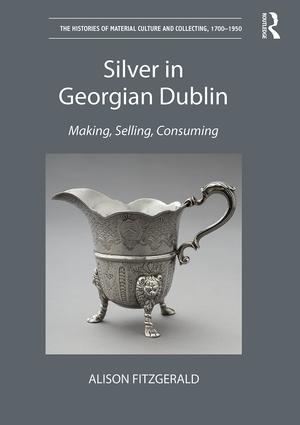 Georgian Dublin is synonymous with a period of unprecedented expansion in the market for luxury goods. At a time when new commodities, novel technologies, and fashionable imports seduced elite society, silver enjoyed an established association with gentility and prestige. Earlier studies have focused predominantly on the issue of style. This book considers the demand for silver goods in Georgian Ireland from the perspectives of makers, retailers, and consumers. It discusses the practical and symbolic uses of silverware, interpreted through contemporary guild accounts, inventories, trade ephemera, and culinary manuscripts. For the first time the activities of Dublin’s goldsmiths and their customers are considered in the context of the British Isles, acknowledging Dublin’s ‘second city’ status in relation to London. How did the availability of new products like English porcelain and Sheffield Plate affect the demand for silver in Dublin, and how did silver imports from London affect the Dublin trade? To what extent do the practices of Dublin goldsmiths mirror their North American counterparts seeking to infer associations with the fashionable metropolis of London? Drawing on an extensive range of documentary and object evidence this wide-ranging analysis considers the context in which silver goods were made, used, valued, and displayed in Georgian Ireland.
Alison FitzGerald is a Lecturer in the Department of History at Maynooth University, Ireland.
◊ ◊ ◊ ◊ ◊
C O N T E N T S
Introduction
1 The Business of Becoming a Goldsmith in Eighteenth-Century Dublin
2 Goldsmiths and Market Forces in Eighteenth-Century Ireland
3 Shopping for Plate in Dublin and London
4 Silver and Its Meaning in Georgian Ireland
5 The Silver Trade in Post-Union Ireland
Conclusion
Exhibition | Elegance and Intrigue: French Society in Prints and Drawings

Charles Thévenin, The Storming of the Bastille, 14 July 1789, etching, 1790, sheet: 41.6 × 58.5 cm
(The Cleveland Museum of Art, 2015.21)
◊ ◊ ◊ ◊ ◊
From the The Cleveland Museum of Art:
Elegance and Intrigue: French Society in 18th-Century Prints and Drawings
The Cleveland Museum of Art, 16 July — 6 November, 2016
Curated by James Wehn
Sumptuous designs, classical tales, political zeal, and erotic rendezvous pervade this selection of more than ninety prints, drawings, and decorative objects from the final decades of the ancien régime through the French Revolution and the early years of Napoleon’s empire.
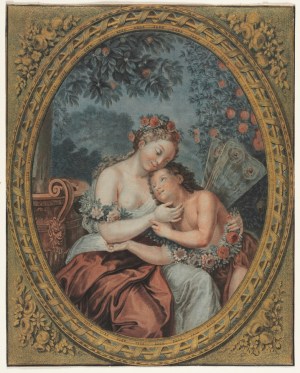
Jean François Janinet, after Antoine Coypel, Zephyre and Flore, ca. 1776, color wash-manner etching and engraving with applied gold leaf; 33.3 × 26.5 cm (The Cleveland Museum of Art, 1987.91)
In celebration of the CMA’s centennial year, Elegance and Intrigue: French Society in 18th-Century Prints and Drawings showcases works from the museum’s collection, including a rare impression of Jean-Antoine Watteau’s etching The Clothes Are Italian, several prints and drawings by court favorite François Boucher, and Jean-Honoré Fragonard’s ravishing drawing Invocation to Love.
At the heart of the exhibition is a selection of color etchings and engravings meticulously crafted to imitate chalk and gouache drawings, a trend in elite home décor at the time. Charles Thévenin’s expressive etching The Storming of the Bastille captures a sense of revolutionary spirit, while Juste-Aurèle Meissonnier’s Tureen, a quintessential masterpiece of silverwork fashioned for the English duke of Kingston, is displayed alongside Gabriel Huquier’s etching featuring two views of the tureen set in a lavish rococo interior.
James Wehn’s extended description of the exhibition is available here.
Exhibition | A Civic Utopia: France 1760–1840
The display is part of Somerset House’s larger celebration Utopia 2016: A Year of Imagination and Possibility, marking the 500th anniversary of the publication of Thomas More’s inspirational text, Utopia—with a varied and vibrant programme of special events, exhibitions, new commissions, and activities across the entire site, spanning the realms of art, literature, society, fashion, design, architecture, theatre, and film.
A Civic Utopia: France 1760–1840
The Courtauld Institute of Art, London, 8 October 2016 — 8 January 2017
Curated by Nicholas Olsberg
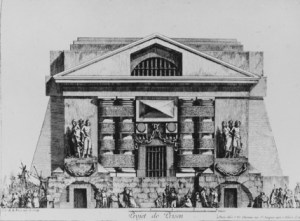
Jean Charles Delafosse, Project for a Prison (exterior view, rear), 18th century (London: Courtauld Institute of Art)
A Civic Utopia: France 1760–1840 examines the place of architecture in establishing the notion of public life. Bringing together a number of drawings of public buildings and spaces from the late Ancien Régime through to the early years of King Louis-Philippe in France, the display explores the idea of a ‘scientific’ city, in which rational and symbolic expressions of civic life established a pattern for the improvement of society. If Utopia is defined as the imagining of a comprehensive ideal system or pattern of civil organisation, then we can see this French vision as utopian, in which public places and buildings function to encourage the moral character of society.
Exhibition | Versailles and the American Revolution
Now on view at Versailles:
Versailles and the American Revolution / Versailles et l’Indépendance Américaine
Château de Versailles, 5 July — 17 October 2016
Curated by Valérie Bajou
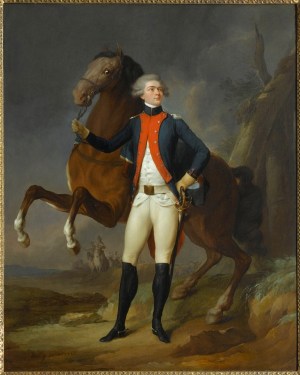
Louis-Léopold Boilly, Portrait de La Fayette, 1788 (RMN-Grand Palais / Château de Versailles)
From 5 July to 2 October 2016, on the occasion of the 240th anniversary of the Declaration of Independence, the Palace of Versailles dedicates an exhibition highlighting the war during which the fate of three countries met: the United States, the United Kingdom, and France.
As the first country to recognise the United State of America as a new nation, it was France’s duty to commemorate the event, especially at Versailles where this decision was taken, where the War of Independence was supported, and where the peace treaty with England was signed in 1783. The exhibition aims to remind viewers of facts that are often forgotten but which bear testimony to the circumstances, scale, and consequences of France’s involvement in the war.
The exhibition recounts the events and highlights the context of French and English rivalry after the Seven Years’ War as well as internal divisions in the French side, the American side between ‘patriots’ and ‘loyalists’, and the English side due to some opposition to the way the settlers were treated. It recounts the decision-making process at Versailles, the personalities of key figures—notably Benjamin Franklin—and the exact locations in the palace where discussions were held. Finally, it explains the international spread of the fighting—from India across the Mediterranean Sea, to the shores of America—and the human losses due to the violence and scale of the battles, the largest of both the 18th and 19th centuries.
The War of Independence has been interpreted by artists from all three countries; so iconic works seen for the first time outside the USA will illustrate the exhibition’s discourse. The generosity of the loans granted must also be stressed, a key example being the Diamond Eagle of George Washington from the Society of the Cincinnati.
The exhibition is the result of scientific collaboration with researchers from American museums and universities, the Congress, and the Society of the Cincinnati, as well as French, Spanish, and English historians. It aims to present different points of view in order to avoid presenting a perspective of the events which is too narrow.
The exhibition will be held in an unusual location, the Battles Gallery, near The Battle of Yorktown, which represents the deciding battle of 1781. Commissioned in 1835 by Louis-Philippe, a year after the death of Lafayette, this commemorative painting indicates that the memory of the war and the sacrifices made had not been forgotten but were kept alive on the other side of the Atlantic like a debt of blood, also explaining the fervour in the famous expression of 1917: “Lafayette, here we are!”
Valerie Bajou : Curator in chief at the national museum of the Palaces of Versailles and Trianon
Scenographer : Loretta Gaïtis
A symposium opened the exhibition on July 5; the programme is available as a PDF file here.
◊ ◊ ◊ ◊ ◊
The catalogue is available from ACC Distribution:
Valérie Bajou, ed., Versailles and the American Revolution (Montreuil: Gourcuff Gradenigo, 2016), 208 pages, ISBN: 978-2353402465, £35 / $40.
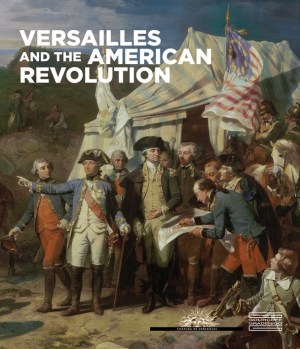 Published to accompany an exhibition at the Palace of Versailles, this catalogue is a collective work bringing together contributions from French, American, and British specialists in this field, which together shed light on the importance of the relationship between France and America in the closing years of the Ancien Régime. During the reign of Louis XVI, the Palace of Versailles—the seat of power and government in France—played a crucial role in the history of America, in its struggle for independence, and in the recognition of the United States by the great European powers. In tracing this remarkable story, the catalogue demonstrates the constant interest displayed in the fledgling United States by the French monarchy.
Richly illustrated throughout, it documents the events of the War of Independence, before exploring the consequences of the entry of France into the war, the siege of Yorktown, and the peace treaty signed at Versailles in 1783. Finally, it analyses the origins and development of the mythology of the ‘American Revolution’ in both France and the United States, a source of enduring inspiration for artists and history painters.
New Book | Una Rivoluzione di Cera: Francesco Orso
Published by Officina Libraria and available from Artbooks.com:
Andrea Daninos, Una Rivoluzione di Cera: Francesco Orso e e i «cabinets de figures» in Francia (Milano: Officina Libraria, 2016), 160 pages, ISBN: 978-897737759, 20€ / $35.
 Con questo studio Andrea Daninos riporta alla luce per la prima volta la figura dello scultore piemontese Francesco Orso, attivo nella seconda metà del Settecento. Unico tra gli scultori piemontesi ad essersi specializzato nella realizzazione di ritratti in cera policromi raffiguranti membri della corte sabauda, opere dall’impressionante realismo, Francesco Orso fu anche l’unico scultore italiano a trasferirsi stabilmente dal 1785 a Parigi, vivendo in tal modo in prima persona negli anni successivi, i momenti cruciali della Rivoluzione francese. A Parigi Orso, che aveva mutato il nome in Orsy, aprirà un’esposizione di figure in cera, che sarà talvolta al centro degli eventi rivoluzionari. Di Francesco Orso viene ricostruita per la prima volta la vita, unitamente al catalogo delle sue opere, sia in cera che in terracotta, molte delle quali sinora inedite. Per meglio delineare la presenza di Orso a Parigi il volume si propone di analizzare la storia delle esposizioni di figure in cera a grandezza naturale in Francia alla fine del Settecento, all’origine dei moderni musei delle cere. Una storia sinora mai studiata compiutamente e che attraverso le biografie dei principali protagonisti di questo genere di esposizioni riporta alla luce un fenomeno che godette di grande popolarità per più di due secoli. In particolare vengono analizzate estesamente la vita e le opere di Philippe Curtius, padre della futura Madame Tussaud, che operò a Parigi negli anni della Rivoluzione francese vivendone alcuni momenti chiave in prima persona. Suoi erano i busti in cera di Necker e del duca d’Orléans portati in trionfo dalla folla il 12 luglio 1789 negli scontri alle Tuileries che diedero il via ai moti rivoluzionari. Completano il volume il catalogo delle opere di Francesco Orso e la trascrizione di numerosi documenti inediti, frutto di capillari ricerche negli archivi francesi e italiani.
Andrea Daninos dedica da anni allo studio della ceroplastica e sul tema ha pubblicato vari articoli. Nel 2009 ha tenuto un corso di specializzazione all’Università Statale di Milano sulla storia della scultura in cera. Vive e lavora a Milano.
New Book | Rome, Travel, and the Sculpture Capital, c. 1770–1825
From Routledge:
Tomas Macsotay, ed., Rome, Travel, and the Sculpture Capital, c. 1770–1825 (New York: Routledge, 2016), 268 pages, ISBN: 978-1472420350, $150.
 The world that shaped Europe’s first national sculptor-celebrities, from Schadow to David d’Angers, from Flaxman to Gibson, from Canova to Thorvaldsen, was the city of Rome. Until around 1800, the Holy See effectively served as Europe’s cultural capital, and Roman sculptors found themselves at the intersection of the Italian marble trade, Grand Tour expenditure, the cult of the classical male nude, and the Enlightenment republic of letters. Two sets of visitors to Rome—the David circle and the British traveler—have tended to dominate Rome’s image as an open artistic hub, while the lively community of sculptors of mixed origins has not been awarded similar attention. Rome, Travel, and the Sculpture Capital, c. 1770–1825 is the first study to piece together the labyrinthine sculptors’ world of Rome between 1770 and 1825. The volume sheds new light on the links connecting Neo-classicism, sculpture collecting, Enlightenment aesthetics, studio culture, and queer studies. The collection offers ideal introductory reading on sculpture and Rome around 1800, and its provocative perspectives will appeal to a readership interested in understanding a modernized Europe’s transnational desire for Neo-classical, Roman sculpture.
Tomas Macsotay has held postdoctoral grants from the Henry Moore Foundation and the Marie Curie Co-fund Programme M4 Human, Gerda Henkel Foundation. He is currently based in Barcelona.
Display | Drawn to Sicily: Early British Exploration
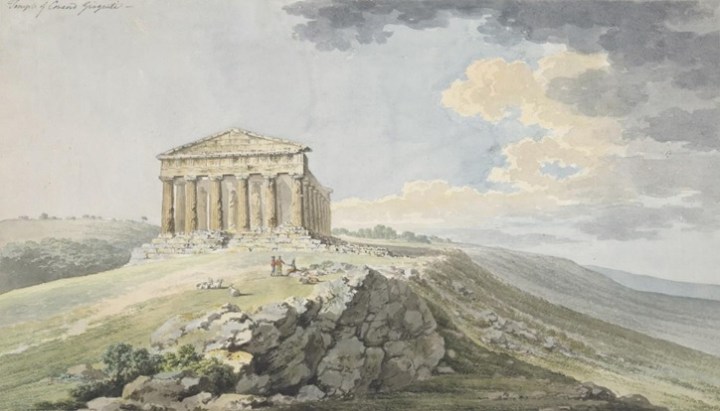
Charles Gore, View of the Temple of Concord at Agrigento, 1777, watercolour over graphite, with some pen and ink
(London: The British Museum)
◊ ◊ ◊ ◊ ◊
Closing this week at The British Museum:
Drawn to Sicily: Early British Exploration of the Classical World
The British Museum, London, Late April — 14 July 2016
In the 18th century, Sicily was a Grand Tour destination only for the intrepid few, an optional extension to the more conventional tour that focused on Rome, Florence, Venice, and Naples. Travel on the rural, rugged island was challenging and many parts were inaccessible. Furthermore, the countryside could be dangerous, as groups of bandits preyed on travelers. Yet those with a specific interest in ancient art and architecture went to admire and study first-hand the remains of the majestic Greek temples.
The presence of European diplomats at the court of the Kingdom of the Two Sicilies in Naples made access to, and travel in, Sicily somewhat easier. Diplomats could provide travel passes—such as one which was issued to Charles Townley (1737–1805) and displayed in this show—as well as letters of introduction to the cultured élite in the main cities: Palermo, Catania, and Syracuse. A travel pass could ensure lodging when presented, as English visitors were well-respected. This display illustrates four expeditions undertaken by some of Britain’s best-known Grand Tourists and renowned architects.
Exhibition | The Ince Blundell Collection of Classical Sculpture

Pantheon interior Blundell Hall
◊ ◊ ◊ ◊ ◊
Now on view at The Atkinson:
Pantheon: Roman Art Treasures from the Ince Blundell Collection
The Atkinson, Southport, 11 June 2016 — 12 March 2017
At the end of the eighteenth century local landowner Henry Blundell (1724–1810) of Ince Blundell Hall amassed a spectacular collection of antique sculpture to rival that of the British Museum. Housed in a scaled-down replica of the Pantheon at Rome, the collection included highly characterful Roman portraits, classical subjects, and elaborate funerary sculpture. The collection has remained virtually intact and this exhibition brings together many of its highlights. The story of Henry Blundell’s creation of the collection and the magnificent setting in which he housed it is a fascinating one and brings to life a powerful and driven personality who played a major role in the art market of the time.
◊ ◊ ◊ ◊ ◊
And due out in October from Liverpool University Press:
Elizabeth Bartman, The Ince Blundell Collection of Classical Sculpture (Liverpool: Liverpool University Press, 2016), 272 pages, ISBN: 978-1781383100, £75 / $125.
This book investigates the important antiquities collection formed by Henry Blundell (1724–1810) of Ince Blundell Hall outside Liverpool in the late eighteenth century. Consisting of more than 500 ancient marbles—the UK’s largest collection of Roman sculptures after that of the British Museum—the collection was assembled primarily in Italy during Blundell’s various ‘Grand Tour’ visits. As ancient statues were the preeminent souvenirs of the Grand Tour, Blundell had strong competition from other collectors, both British nobility and European aristocrats, monarchs, and the Pope. His statues represent a typical cross-section of sculptures that would have decorated ancient Roman houses, villas, public spaces, and even tombs, although their precise origins are largely unknown. Most are likely to have come from Rome and at least one was found at Hadrian’s Villa at Tivoli.
Although most of the works are likely to have been broken when found, in keeping with the taste of the period they were almost all restored. Because of their extensive reworking, the statues are today not simply archaeological specimens but rather, artistic palimpsests that are as much a product of the eighteenth century as of antiquity. Through them we can learn what antiquarians and collectors of the eighteenth century—a key period in the development of scientific archaeology as a discipline—thought about antiquity. Steeped in the work of such writers as Alexander Pope, an educated Englishman like Blundell sought a visual expression of a lost past. Restoration played a major role in creating that visual expression, and the book pays close attention to the aims and methods by which the Ince restorations advanced an eighteenth-century vision of the ‘classical’. The image of antiquity formed at this time has continued to exert a profound effect on how we see these pieces today. The book will be the first to examine the ideal sculpture of Ince Blundell Hall in nearly a century. In so doing it aims to rehabilitate the reputations of a collector and collection that have largely been been ignored by both art-lovers and scholars in post-war Britain.
Elizabeth Bartman was President of the Archaeological Institute of America between 2011 and 2014 and is a Fellow of the Society of Antiquaries, London, as well as a Fellow of the American Academy in Rome. Elizabeth is also a Paul Mellon Visiting Senior Fellow at the Center for the Advanced Study of the Visual Arts, National Gallery of Art, Washington, DC and a Corresponding Member for the Deutsches Archäologisches Institut.
Display | Jacques-Louis David’s ‘Napoleon’
Now on view at AIC:
Jacques-Louis David’s Napoleon
Art Institute of Chicago, 28 May — 9 October 2016

Jacques-Louis David, The Emperor Napoleon in His Study at the Tuileries, 1812 (Washington, D.C.: National Gallery of Art)
The dominant French painter of the late 18th and early 19th century, Jacques-Louis David responded with brilliant artistry to the extraordinary events unfolding during the French Revolution and its aftermath. With his painting The Emperor Napoleon in His Study at the Tuileries, David created the quintessential image of the legendary leader as a figure of deliberation and action. At the time, Napoleon’s empire was at its height—he had not yet led his army on the disastrous invasion of Russia—and David himself had referred to Napoleon as “the man of the century.” For his painting of this exalted figure, David drew on the tradition of the state portrait, a full-length standing representation that had served as the public image of a ruler since the Renaissance, but he brought new life to the conventional type by placing Napoleon in the foreground and framing him with details that tell a story. David described that story in this way: “Having passed the night composing his Napoleonic code, [the emperor] only realizes that it is dawn from the guttering candles that are about to go out. The clock has just struck four in the morning. With that, he rises from his desk to strap on his sword and review his troops.”
The loan of this great painting from the National Gallery of Art, Washington, D.C., provides occasion to highlight related paintings, works on paper, and sculpture in the Art Institute’s own collection. Featured objects include a rarely exhibited sketchbook of studies for another renowned Napoleonic painting by David, The Distribution of the Eagle Standards, which records the ceremonial oath-taking of the generals and officers of the imperial army following Napoleon’s coronation in 1804. This original sketchbook is displayed near an interactive digital reconstruction that allows visitors to turn the book’s pages.
In addition to the NGA loan, the display includes Marie Denise Villers’s 1801 portrait of Charlotte du Val d’Ognes, on loan from The Met (though I’ve been unable to find any mention of it online). The digitized sketchbook is remarkable, but I’m not sure why it’s not also available through the AIC website. –CH
◊ ◊ ◊ ◊ ◊
Lecture | Napoleon, and the Legacy of the Storming of the Bastille
Fullerton Hall, Art Institute of Chicago, 14 July 2016, 2:00pm
In honor of Bastille Day, this lecture interweaves a discussion of Jacques-Louis David’s Napoleon with the history of the Bastille as event, monument, and symbol. Registration required—register today!
At Sotheby’s | English Watches
Press release (8 July 2016) from Sotheby’s, via Art Daily:
Celebration of the English Watch, Part II
John Harrison’s Enduring Discovery, Sale #L16055
Sotheby’s London, 7 July 2016

John Arnold, silver consular cased pocket chronometer, 1781.
At Sotheby’s London, auction records for watches made by two of England’s most important watchmakers were set when a silver pocket chronometer by John Arnold (Lot 38) sold for £557,000 ($722,318) and a gold pocket chronometer by Thomas Earnshow (Lot 39) fetched £305,000 ($395,524).
Made in 1781 and estimated at £130,000–150,000, the large silver consular cased pocket chronometer by John Arnold is remarkable in that it has survived in its completely original state. Arnold introduced the ‘double S’ balance in 1780. The ‘S’ sections of the balance were shaped bi-metallic bars that were designed to overcome the changing elasticity of the balance spring and expansion of the balance’s rim. The watch sold yesterday is the only example of a watch by Arnold which survives without restoration and with its original case, dial, pivoted detent and ‘double S’ balance.
Thomas Earnshaw invented the spring detent escapement and Thomas Wright, watchmaker to King George III, agreed to pay for the patent in his name. Dating from 1784, the gold pair cased pocket chronometer in yesterday’s sale was the only surviving example of a watch made strictly to Wright’s patent details (est. £250,000–300,000).
The sale included some of the finest precision timekeepers of the English horological Golden Age. It was the second part in a series of sales entitled Celebration of the English Watch, featuring the most important collection of English watches in private hands.










 Enfilade
leave a comment