Call for Fellowship Applications | Center for Netherlandish Art, 2023–24
From CNA:
Center for Netherlandish Art Fellowships, 2023–24
Museum of Fine Arts, Boston
Applications due by 15 January 2023
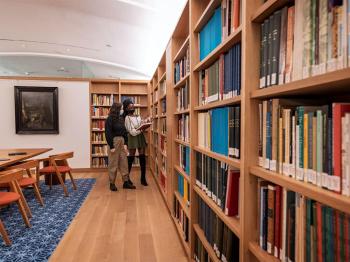 The CNA’s call for 2023–24 academic year fellowship applications is now open. Apply for a fellowship through the MFA’s job portal here. Applications are accepted on a rolling basis until 15 January 2023. Candidates are encouraged to apply early.
CNA fellowships provide opportunities for talented individuals at different stages of their careers—from recent MA graduates to emerging scholars at the postdoctoral level—to conduct independent research connected to the MFA’s collection of Netherlandish art. This may include preparation for submission of a PhD proposal, dissertation research and writing, and preparing a publication, among other research activities. To encourage creative thinking and new scholarship, the program is open to individuals in all professional and academic fields. Fellows are drawn from a highly competitive international application pool and receive a workspace in the CNA Library. Compensation includes a salary and travel allowance, as well as a generous benefits package.
Fellows are fully incorporated into the work of the MFA and may consult on projects related to their research. They also share their research through the CNA’s and MFA’s public programs and online platforms to benefit a range of audiences.
Call for Papers | Community/Collaboration in Dutch and Flemish Art
From the Call for Papers:
Community and Collaboration in Dutch and Flemish Art, 1560–1800
Center for Netherlandish Art, Museum of Fine Arts, Boston, 12 May 2023
Organized by Rachel Kase and Sarah Mallory
Proposals due by 1 February 2023
The Center for Netherlandish Art (CNA) seeks 20-minute papers from emerging scholars that critically and creatively engage with the theme of Community and Collaboration in Dutch and Flemish Art in the long 17th century (ca. 1560–1800), with a particular interest in topics that explore new methods or histories.
Topics might include but are not limited to:
• Visualizations of artists’ studios and other spaces of cooperation
• Physical and psychological isolation and exile within and beyond the Dutch Republic and Flanders
• Artists as community leaders
• The role of gender and gender identity in community
A total of three papers will be selected for presentation during the 2023 CNA Colloquium, scheduled for Friday, 12 May 2023. This daylong event offers a platform for selected emerging scholars to share original research with the international community of experts in the field. The program will be held in a hybrid format, allowing for both in-person and virtual participation. Further event details will be shared closer to the event date.
We invite contributions from MA students, PhD candidates, and postdoctoral researchers with less than five years of working experience. Individuals of all nationalities may apply. As we amplify our efforts toward becoming truly inclusive, ensuring that diversity and equity are lived values, we actively encourage candidates from traditionally underrepresented backgrounds to submit proposals.
Please submit a title and abstract (500 words maximum) and a CV in one single PDF file to cna@mfa.org, with ‘Call for Papers’ included in the email’s subject line. Submissions are accepted on a rolling basis through February 1, 2023. Selected participants will be notified by 17 February 2023. Selected candidates will have the opportunity to workshop their papers during a rehearsal presentation one week prior to the event.
Scholarship and museum exhibitions have long recognized the artistic achievements of individual artists like Rembrandt, Vermeer and Rubens, but in the 17th-century Netherlands collaboration, partnership, and studio practices fueled artistic creativity and production. Studio practices, such as those described by Rembrandt’s pupil Samuel van Hoogstraten, could also reinforce and reflect power and hierarchy. Likewise, Rubens and his pupil Anthony van Dyck together shaped—and re-shaped—visual convention for aristocratic portraiture. Artists reached outside the studio to engage with collaborators in other professions, forming partnerships that resulted in various types of printed, visual, and performing arts. Artist studios, guilds, chambers of rhetoric, marketplaces, universities, churches, and private homes—to name a few places—also served as sites of artistic mentorship, teaching, and innovation.
On the other hand, long periods of travel and infrequent correspondence made it difficult to forge lines of communication or connection. Though many artists were active in creative and commercial centers, some were not. Some may have experienced uncomfortable isolation—phases of boredom and restlessness, social confinement, or geographic remoteness—not dissimilar to the experience that many people had early in the COVID-19 pandemic.
The work of Frans Post and Albert Eckhout demonstrates some ways in which Dutch artists attempted to represent ideas of community and isolation beyond the Republic, while Dutch and Flemish artists such as the Bamboccianti and Bentvueghels sought the companionship of their countrymen even while pursuing new ideas and experiences in Rome. Gender, political beliefs, religious affiliations, and other aspects of personal identity also informed artistic collaboration and a sense of community; as much as some artists were embraced for their abilities and beliefs, others were exiled. From Pieter Bruegel the Elder and Jan Steen’s crowded and lively scenes of taverns and domestic life, to the isolation seen in Rembrandt’s later self-portraits—works of art from this period show a spectrum of collaboration and community throughout the period.
Organized by Rachel Kase and Sarah Mallory, with support from the Center for Netherlandish Art at the Museum of Fine Arts, Boston.
New Book | Jena 1800: The Republic of Free Spirits
From Macmillan:
Peter Neumann, Jena 1800: The Republic of Free Spirits, translated by Shelley Frisch (New York: Farrar, Straus and Giroux, 2022), 256 pages, ISBN: 978-0374178697, $27.
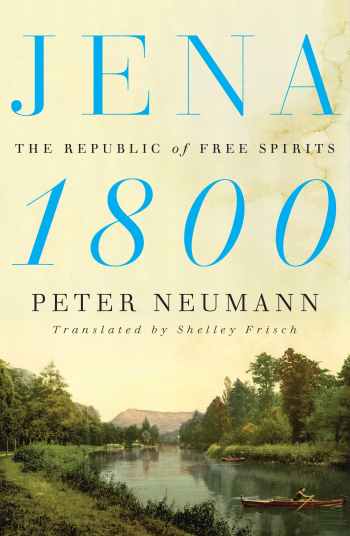 Around the turn of the nineteenth century, a steady stream of young German poets and thinkers coursed to the town of Jena to make history. The French Revolution and the Napoleonic Wars had dealt a one-two punch to the dynastic system. Confidence in traditional social, political, and religious norms had been replaced by a profound uncertainty that was as terrifying for some as it was exhilarating for others. Nowhere was the excitement more palpable than among the extraordinary group of poets, philosophers, translators, and socialites who gathered in this Thuringian village of just four thousand residents.
Jena became the place for the young and intellectually curious, the site of a new departure, of philosophical disruption. Influenced by Johann Wolfgang von Goethe, then an elder statesman and artistic eminence, the leading figures among the disruptors—the translator August Wilhelm Schlegel; the philosophers Friedrich ‘Fritz’ Schlegel and Friedrich Schelling; the dazzling, controversial intellectual Caroline Schlegel, married to August; Dorothea Schlegel, a poet and translator, married to Fritz; and the poets Ludwig Tieck and Novalis—resolved to rethink the world, to establish a republic of free spirits. They didn’t just question inherited societal traditions; with their provocative views of the individual and of nature, they revolutionized our understanding of freedom and reality. With wit and elegance, Peter Neumann brings this remarkable circle of friends and rivals to life in Jena 1800, a work of intellectual history that is colorful and passionate, informative and intimate—as fresh and full of surprises as its subjects.
Peter Neumann studied philosophy, political science, and economics in Jena and Copenhagen. He holds a PhD in philosophy and writes for the weekly newspaper Die Zeit. He is the author of the poetry collections secure and areas & days, which have been awarded several prizes and scholarships.
Shelley Frisch’s translations from the German―which include biographies of Friedrich Nietzsche, Albert Einstein, Leonardo da Vinci, Marlene Dietrich/Leni Riefenstahl (dual biography), and Franz Kafka―have been awarded numerous translation prizes. She lives in Princeton, New Jersey.
New Book | Magnificent Rebels: The First Romantics
From Penguin Random House:
Andrea Wulf, Magnificent Rebels: The First Romantics and the Invention of the Self (New York: Knopf, 2022), 512 pages, ISBN: 978-0525657118, $35.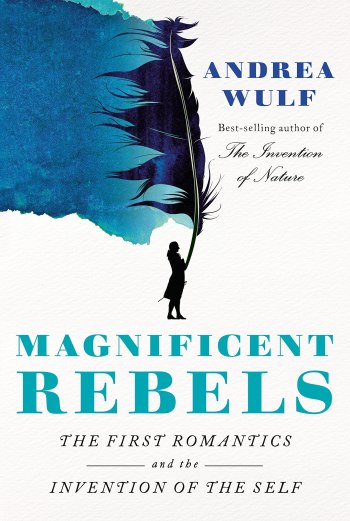 When did we begin to be as self-centered as we are today? At what point did we expect to have the right to determine our own lives? When did we first ask the question, How can I be free? It all began in Jena, a quiet university town in Germany, in the 1790s, when a group of playwrights, poets, and writers put the self at center stage in their thinking, their writing, and their lives. This brilliant circle included the famous poets Goethe, Schiller, and Novalis; the visionary philosophers Fichte, Schelling, and Hegel; the contentious Schlegel brothers; and, in a wonderful cameo, Alexander von Humboldt. And at the heart of this group was the formidable Caroline Schlegel, who sparked their dazzling conversations about the self, nature, identity, and freedom.
The French revolutionaries may have changed the political landscape of Europe, but the young Romantics incited a revolution of the mind that transformed our world forever. We are still empowered by their daring leap into the self, and by their radical notions of the creative potential of the individual, the highest aspirations of art and science, the unity of nature, and the true meaning of freedom. We also still walk the same tightrope between meaningful self-fulfillment and destructive narcissism, between the rights of the individual and our responsibilities toward our community and future generations. At the heart of this inspiring book is the extremely modern tension between the dangers of selfishness and the thrilling possibilities of free will.
Andrea Wulf was born in India and moved to Germany as a child. She is the author of Founding Gardeners, Brother Gardeners, and The New York Times best seller The Invention of Nature, which has been published in twenty-seven languages and won fifteen international literary awards. Wulf has written for many newspapers and magazines, including The New York Times, The Guardian, The Los Angeles Times, The Wall Street Journal, and The Atlantic. She is a member of PEN America and a fellow of the Royal Society of Literature. She lives in London.
When did we begin to be as self-centered as we are today? At what point did we expect to have the right to determine our own lives? When did we first ask the question, How can I be free? It all began in Jena, a quiet university town in Germany, in the 1790s, when a group of playwrights, poets, and writers put the self at center stage in their thinking, their writing, and their lives. This brilliant circle included the famous poets Goethe, Schiller, and Novalis; the visionary philosophers Fichte, Schelling, and Hegel; the contentious Schlegel brothers; and, in a wonderful cameo, Alexander von Humboldt. And at the heart of this group was the formidable Caroline Schlegel, who sparked their dazzling conversations about the self, nature, identity, and freedom.
The French revolutionaries may have changed the political landscape of Europe, but the young Romantics incited a revolution of the mind that transformed our world forever. We are still empowered by their daring leap into the self, and by their radical notions of the creative potential of the individual, the highest aspirations of art and science, the unity of nature, and the true meaning of freedom. We also still walk the same tightrope between meaningful self-fulfillment and destructive narcissism, between the rights of the individual and our responsibilities toward our community and future generations. At the heart of this inspiring book is the extremely modern tension between the dangers of selfishness and the thrilling possibilities of free will.
Andrea Wulf was born in India and moved to Germany as a child. She is the author of Founding Gardeners, Brother Gardeners, and The New York Times best seller The Invention of Nature, which has been published in twenty-seven languages and won fifteen international literary awards. Wulf has written for many newspapers and magazines, including The New York Times, The Guardian, The Los Angeles Times, The Wall Street Journal, and The Atlantic. She is a member of PEN America and a fellow of the Royal Society of Literature. She lives in London.
Huge New Discovery of Notes on Hegel’s Lectures
From The Guardian:
Sara Tor, “Manuscript Treasure Trove May Offer Fresh Understanding of Hegel,” The Guardian (29 November 2022).
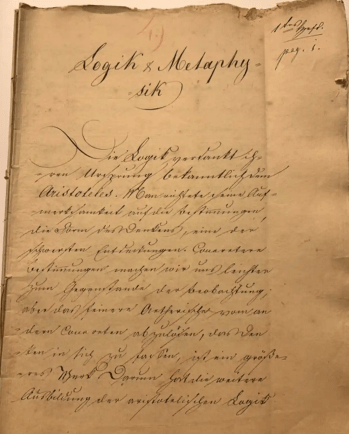
One of the papers from a trove of 4,000 notes on Hegel, found by Professor Klaus Vieweg (Photograph: Marko Fuchs/Copyright Archiv und Bibliothek des Erzbistums München und Freising).
Library discovery of undocumented transcripts of German philosopher’s lectures like ‘finding new Beethoven score’
A biographer researching the German philosopher Hegel (1770–1831) has uncovered a massive treasure trove of previously undocumented lectures that could change perceptions regarding one of the leading figures of modern western philosophy. More than 4,000 pages of notes on Georg Wilhelm Friedrich Hegel’s lectures were found by Klaus Vieweg in the library of the archdiocese of Munich and Freising.
“The discovery of these manuscripts is comparable to finding a new score by Beethoven or a previously unseen painting by Constable,” said Vieweg, a professor at the Friedrich Schiller University Jena in Germany.
He said an early reading of the notes had hinted at a fresh understanding of how Hegel formed his influential ideas on aesthetics, the philosophy around beauty and art, and how he analysed Shakespeare’s plays to help develop his ideas.
The transcripts are thought to have been written by Friedrich Wilhelm Carové, one of the first students at Heidelberg University to be taught by Hegel during the philosopher’s time there between 1816 and 1818. Hegel’s ideas and works are notable for their formidable difficulty. The British philosopher Bertrand Russell described him as “the hardest to understand of the great philosophers.” Vieweg hopes the new find might bring clarity. The papers will now be compiled into an annotated edition by a team of international experts, headed by Vieweg and Christian Illies, a professor of philosophy at the University of Bamberg.
“Major sections of Hegel’s work are only known through his lectures, so scholars have long been trying to find transcripts,” said Illies. “Several were found and published in the 19th and 20th centuries, but over the years uncovering new material has become less and less likely.”
Vieweg’s find is probably the single largest of its kind ever made. It was unearthed after a reader of his recent biography on Hegel pointed him to the archive of Friedrich Windischmann. Windischmann was a professor of Catholic theology in Munich whose father, Karl Joseph Hieronymous Windischmann, was a philosopher and friend of Hegel. A letter between Hegel and Karl Windischmann shows that Carové gave the set of manuscripts to the latter as a gift.
Although research on the material has only just begun, there has already been one significant find: the boxes contain a transcript from one of the very first lectures Hegel gave on aesthetics. Currently, any knowledge of Hegel’s thoughts on aesthetics originates from much later lectures given in Berlin. These were published after his death by his student Heinrich Gustav Hotho using a combination of lecture transcripts and Hegel’s own notes. As there have been no other sources to compare this with, questions have arisen as to how far this material was influenced by Hotho. The discovery of early lectures, therefore, could help to finally clear up the uncertainty. . . .
The full article is available here»
Exhibition Catalogue | Dare to Know
Now available for purchase, the catalogue for the exhibition is one of The New York Times’ ‘best art books of 2022’. Congratulations to everyone involved! The show is on view until 15 January 2023.
Edouard Kopp, Elizabeth Rudy, and Kristel Smentek, eds., Dare to Know: Prints and Drawings in the Age of Enlightenment (Cambridge: Harvard Art Museums, 2022), 334 pages, ISBN: 978-0300266726, $50.
 Are volcanoes punishment from God? What do a fly and a mulberry have in common? What utopias await in unexplored corners of the earth and beyond? During the Enlightenment, questions like these were brought to life through an astonishing array of prints and drawings, helping shape public opinion and stir political change. Dare to Know overturns common assumptions about the age, using the era’s proliferation of works on paper to tell a more nuanced story. Echoing the structure and sweep of Diderot’s Encyclopédie, the book contains 26 thematic essays, organized A to Z, providing an unprecedented perspective on more than 50 artists, including Henry Fuseli, Jean-Honoré Fragonard, Francisco Goya, Jean-Baptiste Greuze, William Hogarth, Giovanni Battista Piranesi, and Giambattista Tiepolo. With a multidisciplinary approach, the book probes developments in the natural sciences, technology, economics, and more—all through the lens of the graphic arts.
Edouard Kopp is the John R. Eckel, Jr., Foundation Chief Curator at the Menil Drawing Institute in Houston; Elizabeth M. Rudy is the Carl A. Weyerhaeuser Curator of Prints at the Harvard Art Museums, Cambridge, MA; and Kristel Smentek is associate professor of art history in the Department of Architecture at the Massachusetts Institute of Technology, Cambridge, MA.
With contributions by J. Cabelle Ahn, Elizabeth Saari Browne, Rachel Burke, Alvin L. Clark, Jr., Anne Driesse, Paul Friedland, Thea Goldring, Margaret Morgan Grasselli, Ashley Hannebrink, Joachim Homann, Kéla Jackson, Penley Knipe, Edouard Kopp, Ewa Lajer-Burcharth, Heather Linton, Austėja Mackelaitė, Tamar Mayer, Elizabeth Mitchell, Elizabeth M. Rudy, Brandon O. Scott, Kristel Smentek, Phoebe Springstubb, Gabriella Szalay, and Christina Taylor.
New Book | Building Greater Britain
Distributed by Yale UP:
G. A. Bremner, Building Greater Britain: Architecture, Imperialism, and the Edwardian Baroque Revival, 1885–1920 (London: Paul Mellon Centre for Studies in British Art, 2022), 368 pages, ISBN: 978-1913107314, £50 / $65.
 This innovative study reappraises the Edwardian Baroque movement in British architecture, placing it in its wider cultural, political, and imperial contexts
The Edwardian Baroque was the closest British architecture ever came to achieving an ‘imperial’ style. With the aim of articulating British global power and prestige, it adorned civic and commercial structures both in Britain and in the wider British world, especially in the ‘white settler’ Dominions of Australia, New Zealand, Canada, and South Africa. Evoking the contemporary and emotive idea of ‘Greater Britain’, this new book by distinguished historian G. A. Bremner represents a major, groundbreaking study of this intriguing architectural movement in Britain and its empire. It explores the Edwardian Baroque’s significance as a response to the growing tide of anxiety over Britain’s place in the world, its widely perceived geopolitical decline, and its need to bolster confidence in the face of the Great Power rivalries of the period. Cross-disciplinary in nature, it combines architectural, political, and imperial history and theory, providing a more nuanced and intellectually wide-ranging understanding of the Edwardian Baroque movement from a material culture perspective, including its foundation in notions of race and gender.
G. A. Bremner is professor of architectural history at the University of Edinburgh, where he specializes in the history of Victorian and Edwardian architecture, with a particular focus on British imperial and colonial architecture and urbanism.
Call for Papers | Constructing Coloniality: British Imperialism

Adolphe Duperly, The Destruction of the Roehampton Estate in the Parish of St. James, Jamaica, January 1832, 1833, hand colored lithograph, 29 × 41 cm. This copy of the print was sold at Christie’s on 24 April 2012; Sale 4826, Lot 282.
◊ ◊ ◊ ◊ ◊
From ArtHist.net and The Bartlett School of Architecture:
Constructing Coloniality: British Imperialism and the Built Environment Annual Conference of the Society of Architectural Historians of Great Britain The Bartlett School of Architecture, University College London, 12–14 May 2023
Organized by Eva Branscome and Neal Shasore
Proposals due by 27 January 2023
Demands to ‘decolonise’ have grown louder and louder in recent years, not least in architecture, architectural history, and heritage. In Britain public monuments and spaces have loomed large in discussions about the legacies of slavery and empire and the processes of repair, from Edward Colston in Bristol and Cecil Rhodes in Oxford, to Winston Churchill, and numerous others in London—as has the ‘colonial countryside’ manifest in National Trust and English Heritage properties and their interpretation. Meanwhile, the dynamics and effects of British colonialism play out in buildings, cities, and landscapes across the world: in the reshaping of the Raj’s New Delhi by the Indian government, for example, or in the perpetuation of plantation structures in the Caribbean. In seeking to forge a decolonial architecture, architectural history, and heritage practice amid a polarised debate, it is necessary to deepen our understanding of the built environment’s complex entanglements with coloniality—not just the act of colonialism, but also the social, economic, and political relations and attitudes that spawned, sustained, and endured beyond it. Moreover, the disciplines involved in the production of knowledge about built environments and how they are formed in different temporalities and geographies must take a broader view, scrutinising not just the subjects of research, but the methods deployed and the modes used to disseminate the results. This conference focuses on the coloniality of architecture and heritage in relation to the British Empire, from the early years of expansionism and the escalation of the slave trade in the seventeenth and eighteenth centuries, through the physical and political force wielded in the nineteenth and early twentieth centuries and the development of racial capitalism, to the subsequent and ongoing struggles for independence, freedom, and justice. Contributions are welcomed that reassess the built environment in Britain and (former) British colonies in terms of its relationship to colonial systems and ideas, including but not limited to • Domestic environments • Urban environments, including streets, squares, and gardens • Factories and other sites of industrial production • Sites of assembly, leisure, and entertainment • Places of worship • Buildings for colonial administration • Infrastructure such as ports, waterways, and railways • Intercolonial networks and infrastructures • Experiences of colonial dispossession, displacement, and exclusion • Heritage sites and conservation Alongside or in the process of examining such subjects, typologies, and morphologies, we welcome reflections on the following historiographical and methodological questions: • How have the professions, disciplines, and discourses of architecture, design, and heritage been shaped by and participated in imperialism, coloniality, and racism? • What the knowledge systems and epistemologies are that construct ideas of ‘architecture’ and ‘heritage’, and what is excluded and why? • How teaching and its institutional contexts reinforce these frameworks? • How financial systems, supply chains, and concepts of tenure and relations to the land shape the production of built environments? • How does the coloniality of architecture and heritage relate to histories of extractivism and energy use? The conference organisers are Dr Eva Branscome (Bartlett School of Architecture) and Dr Neal Shasore (London School of Architecture), with advice from an International Academic Committee. We encourage participants to submit their paper to the SAHGB’s journal Architectural History for consideration. Fuller details about the conference and how to book will be publicised in due course. Abstracts of a minimum of 300 words and maximum of 500 words are invited for this major architectural history conference being held in person at the Bartlett School of Architecture in mid-May 2023. Up to three pages of images can also be supplied. However, all of the text/images in each case must be combined together into one single Acrobat PDF file for submission or else will not be accepted. We invite conventional paper proposals, but welcome other appropriate formats to our subject matter such as poster presentations, films etc. Prospective contributors should submit titles and abstracts to conference2023@sahgb.org.uk by 27 January 2023 with participation confirmed by 27 February 2023. To ensure equal treatment for all submissions, the organisers will not respond to any individual queries about the content of papers or about the thematic categories. The selection panel will assess each of the proposed papers on an anonymous basis. Applicants need to ensure that they have their own sources of funding available to take part in the conference as online presentations will not be possible. This three-day conference is hosted by The Society of Architectural Historians of Great Britain (SAHGB) in collaboration with UCL and the London School of Architecture.◊ ◊ ◊ ◊ ◊
Note on the image from Christie’s: “The Christmas Rebellion, also known as the Christmas Uprising and the Great Jamaican Slave Revolt of 1831–32, was a 10-day rebellion that mobilised as many as 60,000 of Jamaica’s 300,000 slave population. This lithograph illustrates the destruction of the mill yard and slave village at the Roehamton Estate owned by J.Baillie Esq., in January 1832.”Dyrham Park (NT) Acquires Painting of the Port of Bridgetown, Barbados
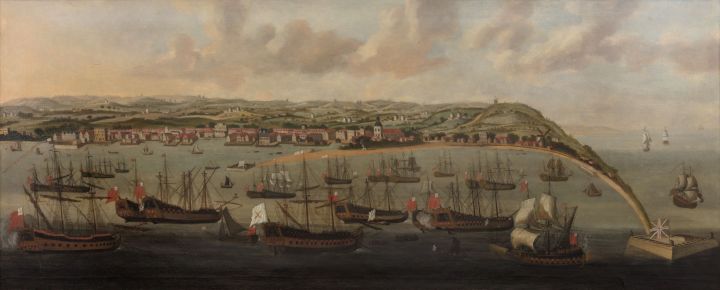
A View of the Port of Bridgetown, Barbados with Extensive Shipping, Anglo-Dutch or Anglo-Flemish School, 1695–1715, oil on canvas, 112 × 282 cm (National Trust, Dyrham Park, acquired in 2022). The painting hung at Dyrham Park, the home of William Blathwayt (c.1649–1717), the leading colonial administrator of his age, in a house intended to project his colonially derived status and prestige.
◊ ◊ ◊ ◊ ◊
Rupert Goulding’s catalogue entry for the painting, an extract of which appears here, was prepared with assistance from Phillip Emanuel, Peter van der Merwe, Louis Nelson, and Gabriella de la Rosa.
This large panorama depicts Bridgetown, the principal port city of Barbados, the most prosperous English Caribbean colony of the early eighteenth century. It was an economy based on sugar—visible through the presence of wind-powered cane mills, warehouses, wharves, and ships—and the toil of enslaved Africans, who are notably absent from the scene.
Substantial in scale, the painting is amongst very few known paintings depicting Barbados from the early eighteenth century. [1] It shows the second largest city in the English colonies, after Boston, and the town before it was partially destroyed by fire in 1766. [2]
The view is landward, showing the town and harbour beneath green hills with sugar processing windmills. Three land defences are identified with flags: James Fort to the left, Willoughby Fort in the centre, and to the right at the end of Needham’s Point lies Charles Fort jutting into Carlisle Bay. The townscape includes wharfs, stores, houses, and some substantial buildings including the Nidhe Israel Synagogue (left of centre) and St Michael’s church (right of centre). There are small rowing boats aside the shore, but no people are represented. Within the harbour are multiple armed galleons or warships, most at anchor, and flying English flags except a single Spanish ship at the centre of the composition, identifiable by the Cross of Burgundy naval, mercantile, and colonial ensign. Several ships have numerous people standing on their decks depicted in simple silhouette form, with occasional flashes of colour to indicate hats and dress. Some of the ships appear to be firing cannon in salute; they may represent a Barbados-based naval squadron or warships protecting merchant convoys. Amongst them small boats move passengers and goods in bales and barrels.
The painting is by an unknown Anglo-Dutch or Anglo-Flemish School artist of the early eighteenth century. There is a possible association with an engraving by Johannes Kip (1653–1722) A Prospect of Bridgetown in Barbados, drawn by Samuel Copen in 1695, considered the earliest view of an English Caribbean colony, which offers a similar perspective and composition. [3] Little is known about Copen, who may be part of a Flemish ‘Coppens’ family of artists active at this date. It may be coincidental that Kip also engraved Dyrham Park for inclusion in Sir Robert Atkyn’s The Ancient and Present State of Glostershire (1712), with Kip’s fee paid by William Blathwayt. [4] . . . .
The full essay is available here»
Provenance: Likely acquired by William Blathwayt as Auditor General of Plantation Revenues; potentially listed in a sale catalogue of 1765 as ‘A View of a Sea Port, Large’ (Lot 14, Day 2), or related to ‘A View of a Sea Port with Carriages, Horses, and Figures, Bridge-town, Barbados’ (Lot 21, Day 2), or to ‘A Sea View, very large, with Shipping, also Figures’ (Lot 30, Day 3); by descent to Justin Blathwayt (1913–2005), who sold Dyrham Park to the Ministry of Works in 1956; Private Collection; purchased in 2022 with support from the Art Fund, Arts Council England/V&A Purchase Grant Fund, a fund set up by the late Hon. Simon Sainsbury, and Mr John Maynard.
Notes
1. A picture was sold from Dyrham Park in 1765 with a similar description: A View of a Sea Port with Carriages, Horses, and Figures, Bridge-town, Barbados (Lot 21, Day 2); see the provenance above for other possible matches (it seems that not everything in the catalogue sold, and some items that did sell may have returned to the house later). A painting similar to the new acquisition—and of similar size—is in the Barbados Museum and Historical Society collection: Governor Robinson Going to Church, by an unknown early eighteenth-century artist, oil on canvas, 124 × 297 cm.
2. See Frederick Smith and Karl Watson, “Urbanity, Sociability, and Commercial Exchange in the Barbados Sugar Trade: A Comparative Colonial Archaeological Perspective on Bridgetown, Barbados in the Seventeenth Century,” International Journal of Historical Archaeology 13.1 (2009): 63–79.
3. Examples found within the Library of Congress and John Carter Brown Library at Brown University.
4. NT 452643.
Dr Rupert Goulding, FSA is Senior National Curator for Research, and the South West at the National Trust. He is the author of the guidebook William Blathwayt and Dyrham Park (National Trust, 2018); he co-edited (with David Taylor) the exhibition catalogue Prized Possessions: Dutch Paintings from National Trust Houses (National Trust, 2018); and he contributed a chapter to the collected volume Interim Report on the Connections between Colonialism and Properties Now in the Care of the National Trust, Including Links with Historic Slavery (National Trust, 2020). More recently, he co-authored, with Phillip Emanuel, “‘The Whole Story of the Cocoa’: Dyrham Park and the Painting and Planting of Chocolate in Jamaica,” Arts, Buildings, and Collections Bulletin (Autumn 2021): 5–9 (available for free download from the National Trust here); and, with Louis Nelson, the forthcoming essay “Cartography, Collecting, and the Construction of Empire at Dyrham Park,” in Global Goods and the Country House, c.1650–1800, edited by John Stobart (UCL Press, 2023). Rupert also serves on the editorial board for the National Trust’s Cultural Heritage Publishing.
New Book | St James’s Palace
From Yale UP and the Royal Collection Trust:
Simon Thurley, Rufus Bird, and Michael Turner, St James’s Palace: From Leper Hospital to Royal Court (New Haven: Yale University Press, 2023), 308 pages, ISBN: 978-0300267464, £60 / $75.
 The first modern history of St James’s Palace, shedding light on a remarkable building at the heart of the history of the British monarchy that remains by far the least known of the royal residences
In this first modern history of St James’s Palace, the authors shed new light on a remarkable building that, despite serving as the official residence of the British monarchy from 1698 to 1837, is by far the least known of the royal residences. The book explores the role of the palace as home to the heir to the throne before 1714, its impact on the development of London and the West end during the late Stuart period, and how, following the fire at the palace of Whitehall, St James’s became the principal seat of the British monarchy in 1698. The arrangement and display of the paintings and furnishings making up the Royal Collection at St James’s is chronicled as the book follows the fortunes of the palace through the Victorian and Edwardian periods up to the present day. Specially commissioned maps, phased plans, and digital reconstructions of the palace at key moments in its development accompany a rich array of historical drawings, watercolors, photographs, and plans. The book includes a foreword by His Royal Highness The Prince of Wales.
Simon Thurley is a leading historian of royal palaces and the sixteenth- and seventeenth-century English court. Rufus Bird is a furniture specialist and former Surveyor of The Queen’s Works of Art, Royal Collection Trust. Michael Turner is an architectural historian and a former Inspector of Historic Buildings and Areas for Historic England.
C O N T E N T S
Foreword, HRH The Prince of Wales
Acknowledgments
Notes for the Readers
Simon Thurley, Introduction
1 Simon Thurley, From the Hospital of St James to the Civil War
2 Simon Thurley, The Restoration to Queen Anne
3 Rufus Bird, The Georgian Court
4 Michael Turner, George IV to the Second World War
5 Simon Thurley, The Palace Today
Notes
Abbreviations and Bibliography
Index
Illustration Credits
Plans A–D










 Enfilade
leave a comment