New Book | Italian Watermarks, 1750–1860
From Brill:
Theo Laurentius and Frans Laurentius, Italian Watermarks, 1750–1860 (Leidin: Brill, 2016), 175 pages, ISBN: 978-9004310612, €175 / $210.
 The knowledge of papermaking spread slowly over Italy from the start of the 13th century. Scholarly interest in the history of Italian paper manufacture has concentrated especially on the earliest period. Research into Italian paper from the 17th, 18th, and 19th centuries has lagged somewhat behind.
Watermarks are extremely important for investigating the origins of paper. Until quite recently watermarks were copied and reproduced by placing them on a light source and then tracing them over onto some kind of transparency. It should be clear, however, that in many instances this technique could never achieve reproductions that were one hundred per cent accurate. Italian Watermarks, 1750–1860 offers x-rays and descriptions of approximately three hundred Italian watermarks. A selection of paper produced in different areas of Italy is presented with an identification.
Theo Laurentius has been active as a paper researcher for over fifty years. He has published several studies on watermarks and paper, including two important catalogues: Watermarks 1600–1650 Found in the Zeeland Archives (Hes & De Graaf, 2007) and Watermarks 1650–1700 Found in the Zeeland Archives (Hes & De Graaf, 2008).
Frans Laurentius, Ph.D., is an art historian. He has published several studies on graphic arts, Dutch pottery, and watermarks, as well as a monograph on the Dutch print dealer Clement de Jonghe: Clement de Jonghe (ca. 1624–1677): Kunstverkoper in de Gouden Eeuw (Hes & De Graaf, 2010).
New Book | Silver in Georgian Dublin
From Routledge:
Alison FitzGerald, Silver in Georgian Dublin: Making, Selling, Consuming (New York: Routledge, 2016), 256 pages, ISBN: 978-1472427878, $150.
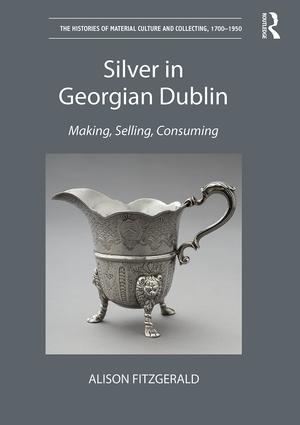 Georgian Dublin is synonymous with a period of unprecedented expansion in the market for luxury goods. At a time when new commodities, novel technologies, and fashionable imports seduced elite society, silver enjoyed an established association with gentility and prestige. Earlier studies have focused predominantly on the issue of style. This book considers the demand for silver goods in Georgian Ireland from the perspectives of makers, retailers, and consumers. It discusses the practical and symbolic uses of silverware, interpreted through contemporary guild accounts, inventories, trade ephemera, and culinary manuscripts. For the first time the activities of Dublin’s goldsmiths and their customers are considered in the context of the British Isles, acknowledging Dublin’s ‘second city’ status in relation to London. How did the availability of new products like English porcelain and Sheffield Plate affect the demand for silver in Dublin, and how did silver imports from London affect the Dublin trade? To what extent do the practices of Dublin goldsmiths mirror their North American counterparts seeking to infer associations with the fashionable metropolis of London? Drawing on an extensive range of documentary and object evidence this wide-ranging analysis considers the context in which silver goods were made, used, valued, and displayed in Georgian Ireland.
Alison FitzGerald is a Lecturer in the Department of History at Maynooth University, Ireland.
◊ ◊ ◊ ◊ ◊
C O N T E N T S
Introduction
1 The Business of Becoming a Goldsmith in Eighteenth-Century Dublin
2 Goldsmiths and Market Forces in Eighteenth-Century Ireland
3 Shopping for Plate in Dublin and London
4 Silver and Its Meaning in Georgian Ireland
5 The Silver Trade in Post-Union Ireland
Conclusion
Exhibition | Versailles and the American Revolution
Now on view at Versailles:
Versailles and the American Revolution / Versailles et l’Indépendance Américaine
Château de Versailles, 5 July — 17 October 2016
Curated by Valérie Bajou
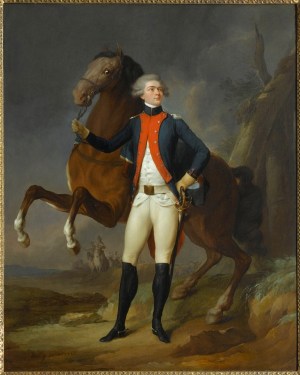
Louis-Léopold Boilly, Portrait de La Fayette, 1788 (RMN-Grand Palais / Château de Versailles)
From 5 July to 2 October 2016, on the occasion of the 240th anniversary of the Declaration of Independence, the Palace of Versailles dedicates an exhibition highlighting the war during which the fate of three countries met: the United States, the United Kingdom, and France.
As the first country to recognise the United State of America as a new nation, it was France’s duty to commemorate the event, especially at Versailles where this decision was taken, where the War of Independence was supported, and where the peace treaty with England was signed in 1783. The exhibition aims to remind viewers of facts that are often forgotten but which bear testimony to the circumstances, scale, and consequences of France’s involvement in the war.
The exhibition recounts the events and highlights the context of French and English rivalry after the Seven Years’ War as well as internal divisions in the French side, the American side between ‘patriots’ and ‘loyalists’, and the English side due to some opposition to the way the settlers were treated. It recounts the decision-making process at Versailles, the personalities of key figures—notably Benjamin Franklin—and the exact locations in the palace where discussions were held. Finally, it explains the international spread of the fighting—from India across the Mediterranean Sea, to the shores of America—and the human losses due to the violence and scale of the battles, the largest of both the 18th and 19th centuries.
The War of Independence has been interpreted by artists from all three countries; so iconic works seen for the first time outside the USA will illustrate the exhibition’s discourse. The generosity of the loans granted must also be stressed, a key example being the Diamond Eagle of George Washington from the Society of the Cincinnati.
The exhibition is the result of scientific collaboration with researchers from American museums and universities, the Congress, and the Society of the Cincinnati, as well as French, Spanish, and English historians. It aims to present different points of view in order to avoid presenting a perspective of the events which is too narrow.
The exhibition will be held in an unusual location, the Battles Gallery, near The Battle of Yorktown, which represents the deciding battle of 1781. Commissioned in 1835 by Louis-Philippe, a year after the death of Lafayette, this commemorative painting indicates that the memory of the war and the sacrifices made had not been forgotten but were kept alive on the other side of the Atlantic like a debt of blood, also explaining the fervour in the famous expression of 1917: “Lafayette, here we are!”
Valerie Bajou : Curator in chief at the national museum of the Palaces of Versailles and Trianon
Scenographer : Loretta Gaïtis
A symposium opened the exhibition on July 5; the programme is available as a PDF file here.
◊ ◊ ◊ ◊ ◊
The catalogue is available from ACC Distribution:
Valérie Bajou, ed., Versailles and the American Revolution (Montreuil: Gourcuff Gradenigo, 2016), 208 pages, ISBN: 978-2353402465, £35 / $40.
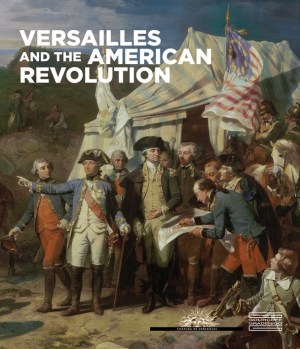 Published to accompany an exhibition at the Palace of Versailles, this catalogue is a collective work bringing together contributions from French, American, and British specialists in this field, which together shed light on the importance of the relationship between France and America in the closing years of the Ancien Régime. During the reign of Louis XVI, the Palace of Versailles—the seat of power and government in France—played a crucial role in the history of America, in its struggle for independence, and in the recognition of the United States by the great European powers. In tracing this remarkable story, the catalogue demonstrates the constant interest displayed in the fledgling United States by the French monarchy.
Richly illustrated throughout, it documents the events of the War of Independence, before exploring the consequences of the entry of France into the war, the siege of Yorktown, and the peace treaty signed at Versailles in 1783. Finally, it analyses the origins and development of the mythology of the ‘American Revolution’ in both France and the United States, a source of enduring inspiration for artists and history painters.
New Book | Una Rivoluzione di Cera: Francesco Orso
Published by Officina Libraria and available from Artbooks.com:
Andrea Daninos, Una Rivoluzione di Cera: Francesco Orso e e i «cabinets de figures» in Francia (Milano: Officina Libraria, 2016), 160 pages, ISBN: 978-897737759, 20€ / $35.
 Con questo studio Andrea Daninos riporta alla luce per la prima volta la figura dello scultore piemontese Francesco Orso, attivo nella seconda metà del Settecento. Unico tra gli scultori piemontesi ad essersi specializzato nella realizzazione di ritratti in cera policromi raffiguranti membri della corte sabauda, opere dall’impressionante realismo, Francesco Orso fu anche l’unico scultore italiano a trasferirsi stabilmente dal 1785 a Parigi, vivendo in tal modo in prima persona negli anni successivi, i momenti cruciali della Rivoluzione francese. A Parigi Orso, che aveva mutato il nome in Orsy, aprirà un’esposizione di figure in cera, che sarà talvolta al centro degli eventi rivoluzionari. Di Francesco Orso viene ricostruita per la prima volta la vita, unitamente al catalogo delle sue opere, sia in cera che in terracotta, molte delle quali sinora inedite. Per meglio delineare la presenza di Orso a Parigi il volume si propone di analizzare la storia delle esposizioni di figure in cera a grandezza naturale in Francia alla fine del Settecento, all’origine dei moderni musei delle cere. Una storia sinora mai studiata compiutamente e che attraverso le biografie dei principali protagonisti di questo genere di esposizioni riporta alla luce un fenomeno che godette di grande popolarità per più di due secoli. In particolare vengono analizzate estesamente la vita e le opere di Philippe Curtius, padre della futura Madame Tussaud, che operò a Parigi negli anni della Rivoluzione francese vivendone alcuni momenti chiave in prima persona. Suoi erano i busti in cera di Necker e del duca d’Orléans portati in trionfo dalla folla il 12 luglio 1789 negli scontri alle Tuileries che diedero il via ai moti rivoluzionari. Completano il volume il catalogo delle opere di Francesco Orso e la trascrizione di numerosi documenti inediti, frutto di capillari ricerche negli archivi francesi e italiani.
Andrea Daninos dedica da anni allo studio della ceroplastica e sul tema ha pubblicato vari articoli. Nel 2009 ha tenuto un corso di specializzazione all’Università Statale di Milano sulla storia della scultura in cera. Vive e lavora a Milano.
New Book | Rome, Travel, and the Sculpture Capital, c. 1770–1825
From Routledge:
Tomas Macsotay, ed., Rome, Travel, and the Sculpture Capital, c. 1770–1825 (New York: Routledge, 2016), 268 pages, ISBN: 978-1472420350, $150.
 The world that shaped Europe’s first national sculptor-celebrities, from Schadow to David d’Angers, from Flaxman to Gibson, from Canova to Thorvaldsen, was the city of Rome. Until around 1800, the Holy See effectively served as Europe’s cultural capital, and Roman sculptors found themselves at the intersection of the Italian marble trade, Grand Tour expenditure, the cult of the classical male nude, and the Enlightenment republic of letters. Two sets of visitors to Rome—the David circle and the British traveler—have tended to dominate Rome’s image as an open artistic hub, while the lively community of sculptors of mixed origins has not been awarded similar attention. Rome, Travel, and the Sculpture Capital, c. 1770–1825 is the first study to piece together the labyrinthine sculptors’ world of Rome between 1770 and 1825. The volume sheds new light on the links connecting Neo-classicism, sculpture collecting, Enlightenment aesthetics, studio culture, and queer studies. The collection offers ideal introductory reading on sculpture and Rome around 1800, and its provocative perspectives will appeal to a readership interested in understanding a modernized Europe’s transnational desire for Neo-classical, Roman sculpture.
Tomas Macsotay has held postdoctoral grants from the Henry Moore Foundation and the Marie Curie Co-fund Programme M4 Human, Gerda Henkel Foundation. He is currently based in Barcelona.
Exhibition | The Ince Blundell Collection of Classical Sculpture

Pantheon interior Blundell Hall
◊ ◊ ◊ ◊ ◊
Now on view at The Atkinson:
Pantheon: Roman Art Treasures from the Ince Blundell Collection
The Atkinson, Southport, 11 June 2016 — 12 March 2017
At the end of the eighteenth century local landowner Henry Blundell (1724–1810) of Ince Blundell Hall amassed a spectacular collection of antique sculpture to rival that of the British Museum. Housed in a scaled-down replica of the Pantheon at Rome, the collection included highly characterful Roman portraits, classical subjects, and elaborate funerary sculpture. The collection has remained virtually intact and this exhibition brings together many of its highlights. The story of Henry Blundell’s creation of the collection and the magnificent setting in which he housed it is a fascinating one and brings to life a powerful and driven personality who played a major role in the art market of the time.
◊ ◊ ◊ ◊ ◊
And due out in October from Liverpool University Press:
Elizabeth Bartman, The Ince Blundell Collection of Classical Sculpture (Liverpool: Liverpool University Press, 2016), 272 pages, ISBN: 978-1781383100, £75 / $125.
This book investigates the important antiquities collection formed by Henry Blundell (1724–1810) of Ince Blundell Hall outside Liverpool in the late eighteenth century. Consisting of more than 500 ancient marbles—the UK’s largest collection of Roman sculptures after that of the British Museum—the collection was assembled primarily in Italy during Blundell’s various ‘Grand Tour’ visits. As ancient statues were the preeminent souvenirs of the Grand Tour, Blundell had strong competition from other collectors, both British nobility and European aristocrats, monarchs, and the Pope. His statues represent a typical cross-section of sculptures that would have decorated ancient Roman houses, villas, public spaces, and even tombs, although their precise origins are largely unknown. Most are likely to have come from Rome and at least one was found at Hadrian’s Villa at Tivoli.
Although most of the works are likely to have been broken when found, in keeping with the taste of the period they were almost all restored. Because of their extensive reworking, the statues are today not simply archaeological specimens but rather, artistic palimpsests that are as much a product of the eighteenth century as of antiquity. Through them we can learn what antiquarians and collectors of the eighteenth century—a key period in the development of scientific archaeology as a discipline—thought about antiquity. Steeped in the work of such writers as Alexander Pope, an educated Englishman like Blundell sought a visual expression of a lost past. Restoration played a major role in creating that visual expression, and the book pays close attention to the aims and methods by which the Ince restorations advanced an eighteenth-century vision of the ‘classical’. The image of antiquity formed at this time has continued to exert a profound effect on how we see these pieces today. The book will be the first to examine the ideal sculpture of Ince Blundell Hall in nearly a century. In so doing it aims to rehabilitate the reputations of a collector and collection that have largely been been ignored by both art-lovers and scholars in post-war Britain.
Elizabeth Bartman was President of the Archaeological Institute of America between 2011 and 2014 and is a Fellow of the Society of Antiquaries, London, as well as a Fellow of the American Academy in Rome. Elizabeth is also a Paul Mellon Visiting Senior Fellow at the Center for the Advanced Study of the Visual Arts, National Gallery of Art, Washington, DC and a Corresponding Member for the Deutsches Archäologisches Institut.
Exhibition | Bouchardon: Royal Artist of the Enlightenment
Opening in September at the Louvre:
Bouchardon: A Sublime Idea of Beauty / Une idée du beau
Bouchardon: Royal Artist of the Enlightenment
Musée du Louvre, Paris, 14 September — 5 December 2016
The Getty Center, Los Angeles, 10 January — 2 April 2017
Curated by Anne-Lise Desmas, Edouard Kopp, Guilhem Scherf, and Juliette Trey

Edme Bouchardon, Femme nue de dos, bras gauche le long du corps (RMN-Grand Palais/Louvre / Michel Urtado)
The Musée du Louvre and the J. Paul Getty Museum, Los Angeles pay tribute to Edme Bouchardon (1698–1762), a renowned French sculptor and draftsman, who was considered an exceptional artist in his own time. The son of an architect-sculptor, he trained at the Royal Academy of Painting and Sculpture in Paris before spending a productive period at the French Academy in Rome (1723–32). Learning of Bouchardon’s great reputation, the director of the King’s Buildings summoned him back to France, where he quickly received a studio and lodgings at the Louvre. Accepted into the Academy in 1735, he thus became Sculptor to the King.
Listed in the Encyclopédie—Diderot and d’Alembert’s encyclopedic dictionary of the sciences, arts, and trades—as the continuator of Puget and Girardon, Bouchardon was regarded by his contemporaries as the advocate of artistic renewal, “the greatest sculptor and the best draftsman of his century” (Cochin).
While many studies have shed new light on our understanding of Neoclassicism, this exhibition—the first major monograph on Bouchardon’s oeuvre—will be an opportunity to comprehend the sculptor’s style, a perfect balance between classical influence and life-like rendering.
◊ ◊ ◊ ◊ ◊
Juliette Trey, avec la participation d’Hélène Grollemund, Inventaire général des dessins du musée du Louvre. Ecole française. Edme Bouchardon (1698–1762): Catalogue raisonné (Paris: Mare & Martin / Musée du Louvre, 2016), 720 pages, ISBN: 979-1092054651, 110€.
Le musée du Louvre conserve un fonds très important de dessins (1038 feuilles) attribués à Edme Bouchardon dont le catalogue sommaire a été publié par Jean Guiffrey et Pierre Marcel en 1907 et 1908 (Inventaire général des dessins du musée du Louvre et de Versailles, Ecole française, vol. I et II). La dernière étude monographique sur l’artiste date de 1910 (Alphonse Roserot, Edme Bouchardon, Paris, Librairie centrale des beaux-arts).
L’inventaire des dessins de Bouchardon est organisé de manière chronologique, présentant les feuilles dans l’ordre de leur réalisation, et thématique. Il est divisé en trois parties, correspondant aux trois étapes essentielles de la carrière de Bouchardon : Rome (1723–1732), qui compte essentiellement des copies d’antiques, de peintures et de sculptures, exécutées par l’artiste lors de son séjour à l’Académie de France ; Paris (1733–1748), qui rassemble les dessins pour les sculptures qui firent la gloire de Bouchardon, notamment l’Amour taillant son arc dans la massue d’Hercule et la fontaine de Grenelle ; la statue équestre de Louis XV (1748–1762), chantier colossal qui occupa toute la fin de la carrière du sculpteur et pour lequel le fonds du Louvre s’élève à près de 440 dessins. Chaque partie puis chaque thème sont introduits par un court texte de présentation. La plupart des notices sont également commentées avec l’identification du modèle copié ou de la sculpture préparée, présentant les oeuvres en rapport, les estampes gravées d’après le dessin. L’étude matérielle des dessins a fait l’objet d’une grande attention, avec un relevé systématique des filigranes, permettant une étude chronologique nouvelle et fine des dessins.
Enfin, l’ouvrage est complété par une présentation générale de l’artiste, une chronologie, un index, auxquels s’ajoute un chapitre dédié aux dessins rejetés pour lesquels de nouvelles attributions sont parfois proposées.
◊ ◊ ◊ ◊ ◊
From ArtBooks.com:
Guilhem Scherf, et al., Edme Bouchardon (1698–1762): Sculpteur et Dessinateur du Roi (Paris: Somogy, 2016), 448 pages, ISBN: 978-2757210697, $80.
From ArtBooks.com:
Anne-Lise Desmas, Edouard Kopp, Guilhem Scherf, and Juliette Trey, Bouchardon: Royal Artist of the Enlightenment (Los Angeles: Getty Publications, 2017), 448 pages, ISBN: 978-1606065068, $80.
 One of the most imaginative and fascinating artists of eighteenth-century France, Edme Bouchardon was instrumental in the transition from Rococo to Neoclassicism and in the artistic rediscovery of classical antiquity. Much celebrated in his time, Bouchardon created some of the most iconic images of the age of Louis XV. His oeuvre demonstrates a remarkable variety of themes (from copies after the antique to subjects of history and mythology, portraiture, anatomical studies, ornament, fountains and tombs), media (drawings, sculptures, medals, prints), and techniques (chalk, plaster, wax, terracotta, marble, bronze).
With five essays by experts on Bouchardon’s sculpture and graphic arts, more than 140 catalogue entries, and a detailed chronology, this book aims to demonstrate the originality of Bouchardon’s art within the cultural and social context of the period, while suggesting the subtle relationship between, as well as the relative autonomy of, the artist’s two careers as a sculptor and a draftsman. This lavishly illustrated publication represents an unprecedented and thorough survey on this major and unique artist from the Age of Enlightenment, offering indepth scholarship based on unpublished material.
Anne-Lise Desmas is curator and head of the Department of Sculpture and Decorative Arts at the J. Paul Getty Museum. Édouard Kopp is the Maida and George Abrams Associate Curator of Drawings at the Harvard Art Museums. Guilhem Scherf is chief curator in the Department of Sculpture at the Louvre. Juliette Trey is curator in the Department of Graphic Arts at the Louvre.
Exhibition | Painters’ Paintings: From Freud to Van Dyck
Press release (20 May 2016) from The National Gallery:
Painters’ Paintings: From Freud to Van Dyck
The National Gallery, London, 23 June — 4 September 2016
Curated by Anne Robbins
Works of art are models you are to imitate, and at the same time rivals you are to combat. –Sir Joshua Reynolds
 Spanning over five hundred years of art history, Painters’ Paintings presents more than eighty works, which were once in the possession of great painters: pictures that artists were given or chose to acquire, works they lived with and were inspired by. This is an exceptional opportunity to glimpse inside the private world of these painters and to understand the motivations of artists as collectors of paintings.
The inspiration for this exhibition is a painter’s painting: Corot’s Italian Woman, left to the nation by Lucian Freud following his death in 2011. Freud had bought the Italian Woman ten years earlier, no doubt drawn to its solid brushwork and intense physical presence. A major work in its own right, the painting demands to be considered in the light of Freud’s achievements, as a painter who tackled the representation of the human figure with vigour comparable to Corot’s. In his will, Freud stated that he wanted to leave the painting to the nation as a thank you for welcoming his family so warmly when they arrived in the UK as refugees fleeing the Nazis. He also stipulated that the painting’s new home should be the National Gallery, where it could be enjoyed by future generations.
Anne Robbins, curator of Painters’ Paintings says: “Since its acquisition the painting’s notable provenance has attracted considerable attention; in fact, the picture is often appraised in the light of Freud’s own achievements, almost eclipsing the intrinsic merits of Corot’s canvas. It made us start considering questions such as which paintings do artists choose to hang on their own walls? How do the works of art they have in their homes and studios influence their personal creative journeys? What can we learn about painters from their collection of paintings? Painters’ Paintings: From Freud to Van Dyck is the result.”

Thomas Gainsborough, Girl with Pigs, 1781–82 (The Castle Howard Collection). Owned by Sir Joshua Reynolds.
The National Gallery holds a number of important paintings which, like the Corot, once belonged to celebrated painters: Van Dyck’s Titian; Reynolds’s Rembrandt, and Matisse’s Degas among many others. Painters’ Paintings is organised as a series of case studies each devoted to a particular painter-collector: Freud, Matisse, Degas, Leighton, Watts, Lawrence, Reynolds, and Van Dyck. Painters’ Paintings explores the motivations of these artists—as patrons, rivals, speculators—to collect paintings. The exhibition looks at the significance of these works of art for the painters who owned them—as tokens of friendship, status symbols, models to emulate, cherished possessions, financial investments or sources of inspiration.
Works from these artists’ collections are juxtaposed with a number of their own paintings, highlighting the connections between their own creative production and the art they lived with. These pairings and confrontations shed new light on both the paintings and the creative process of the painters who owned them, creating a dynamic and original dialogue between possession and painterly creation.
Half the works in the exhibition are loans from public and private collections, from New York and Philadelphia, to Copenhagen and Paris. A number of them have not been seen in public for several decades.
Dr. Gabriele Finaldi, Director of the National Gallery says: “Artists by definition live with their own pictures, but what motivates them to possess works by other painters, be they contemporaries—friends or rivals—or older masters? The exhibition looks for the answers in the collecting of Freud, Matisse, Degas, Leighton, Watts, Lawrence, Reynolds, and Van Dyck.”
Sir Joshua Reynolds (1723–1792)
As the inaugural President of the Royal Academy, Reynolds was one of the most significant figures of the British art world in the 18th century; for him, collecting was a life-long passion, which he likened to “a great game.” Reynolds had a vast collection of drawings, paintings, and prints that informed both his teachings and supported his ideas about what constituted great art: style of Van Dyck (The Horses of Achilles, 1635–45, The National Gallery, London), Giovanni Bellini (The Agony in the Garden, about 1465, The National Gallery, London), after Michelangelo (Leda and the Swan, after 1530, The National Gallery, London), Poussin (The Adoration of the Shepherds, about 1633–34, The National Gallery, London), and Rembrandt (The Lamentation over the Dead Christ, about 1634–35, The British Museum, London).
Gainsborough’s Girl with Pigs (1781–82, Castle Howard Collection), bought by Reynolds in 1782, also illustrates Reynolds’s interest for the work of his contemporaries, demonstrating the breadth of his taste, but also its changeability—soon after, Reynolds tried to exchange his Gainsborough for a Titian.
Sir Thomas Lawrence (1769–1830)
Lawrence was the leading British portraitist of the early 19th century. He was largely self-taught and hugely influenced by Sir Joshua Reynolds, following in his footsteps to become President of the Royal Academy. Like Degas, Lawrence was a voracious, obsessional collector, using the proceeds of the sale of his society portraits to amass an incomparable collection of Old Master drawings. An inventory upon his death listed some 4,300 drawings, including Carracci’s immense A Woman borne off by a Sea God (?) (about 1599, The National Gallery, London) and a number of paintings including Raphael’s Allegory (about 1504, The National Gallery, London) and Reni’s Coronation of the Virgin, (about 1607, The National Gallery, London).
This section of the exhibition places Lawrence’s collecting within his social world. The paintings he acquired established his reputation as a great connoisseur, and his advice was much sought by influential friends such as John Julius Angerstein and Sir George Beaumont, whose collections came to form the nucleus of the National Gallery holdings. Beyond his acquisitive zeal, the prodigiously gifted Lawrence also sought to gain information about his favoured artists’ methods. An exceptional loan from a private collection, his portrait of the Baring Brothers (Lawrence, Sir Francis Baring, 1st Baronet, John Baring and Charles Wall, 1806–07) demonstrates his absorption of the tradition of Renaissance male portrait, here injected with Lawrence’s trademark dash and virtuosity.
The full press release is available here»
◊ ◊ ◊ ◊ ◊
From Yale UP:
Anne Robbins, Painters’ Paintings: From Freud to Van Dyck (New Haven: Yale University Press, 2016), 96 pages, ISBN: 978-1857096118, £15.
 In this intriguing book, Anne Robbins explores the little-known history of artists collecting paintings. Focusing on the collections of Freud, Matisse, Degas, Leighton, Watts, Lawrence, Reynolds, and Van Dyck, she assesses the ways painters benefited from owning someone else’s work, their motivations for collecting, and how the history of a painting’s ownership influences our own view of both the artist and the work. Robbins investigates paintings as the sources of creative inspiration and their use in teaching theories of art. She also examines how painters acquired the paintings they desired, whether through auction, dealerships, gift or exchange, and how they cared for the works: storing them, displaying them, and, in some cases, flaunting them for self-promotion. Robbins ultimately argues that the acts of acquiring art and of art making evolve in tandem—with rich connections between works owned and works painted.
Anne Robbins is associate curator of Post-1800 paintings at the National Gallery, London.
New Book | The Grid and the River: Philadelphia’s Green Places
From Penn State UP:
Elizabeth Milroy, The Grid and the River: Philadelphia’s Green Places, 1682–1876 (University Park: The Pennsylvania State University Press, 2016), 464 pages, ISBN: 978-0271066769, $65.
 Philadelphians are fond of quoting a letter in which William Penn described his vision of a “greene country towne, which will never be burnt & always wholesome.” Today, Philadelphia’s public parks cover more than ten thousand acres—roughly 11 percent of the city’s area. They encompass extensive woodlands and waterways as well as the largest collection of historic properties in the state of Pennsylvania, including the Fairmount Water Works, the Philadelphia Zoo (the oldest zoo in the United States), and the Philadelphia Museum of Art.
The Grid and the River is the product of Elizabeth Milroy’s quest to understand the history of public green spaces in William Penn’s city. In this monumental work of urban history, Milroy traces efforts to keep Philadelphia ‘green’ from the time of its founding to the late nineteenth century. She chronicles how patterns of use and representations of green spaces informed notions of community and identity in the city. In particular, Milroy examines the history of how and why the district along the Schuylkill River came to be developed both in opposition to and in concert with William Penn’s original designations of parks in his city plan. Focusing on both the history and representation of Philadelphia’s green spaces, and making use of a wealth of primary source materials, Milroy offers new insights into the city’s political and cultural development and documents how changing attitudes toward the natural environment affected the physical appearance of Philadelphia’s landscape and the lives of its inhabitants.
Elizabeth Milroy is Professor and Department Head of Art and Art History in the Antoinette Westphal College of Media Arts & Design at Drexel University.
◊ ◊ ◊ ◊ ◊
C O N T E N T S
List of Illustrations
Acknowledgments
Introduction
City
1 The Origins of Penn’s Squares
2 Patterns of Growth and Governance in the Centre City
Suburb
3 The Liberty Lands
4 Suburban Villas in the Schuylkill Valley
5 Nurseries of National Virtue: Private Estates and Public Culture
6 Agriculture, Horticulture, and the Origins of the American Picturesque
Consolidation
7 Reviving Penn’s Plan
8 The Fairmount Water Works: Picturing Civic Virtue
9 Rural Cemeteries, River Parks, and the Search for Rational Recreation
10 Greening the Consolidated City
11 The Fairmount Park Commission: Park Building for Preservation and Conservation
12 Spatial Politics and the Centennial Exhibition
13 A Work Unfinished
Notes
Bibliography
Index
Exhibition | In the Library: Growth and Development of the Salon Livret

Explication des peintures, sculptures, et autres ouvrages, de messieurs de l’Académie royale (Paris, 1767). Washington, D.C.: National Gallery of Art Library, David K. E. Bruce Fund.
◊ ◊ ◊ ◊ ◊
Press release (31 May 2016) from the NGA:
In the Library: Growth and Development of the Salon Livret
National Gallery of Art, Washington D.C., 20 June — 16 September 2016
Curated by Yuri Long
Documenting the history of the Paris Salon from its emergence in the late 17th century through its decline during the early 20th century, In the Library: Growth and Development of the Salon Livret presents over 60 examples of literature related to the Paris Salon drawn from nearly 250 years of exhibitions. On view in the East Building Study Center, the exhibition includes a variety of publications that document the rise and fall of the Académie Royale de Peinture et de Sculpture and its exhibition, which came to be known as the Salon.
Beginning as a checklist for the works on view, the livret (‘little book’ or catalog) was first published for the Salon of 1673. Appearing then as little more than a pamphlet in decorative wrappers, the livret developed over time into a full catalog. During the latter half of the 19th century livrets included not only additional entries but also supplemental information about the juries, the artists, and the rules of the organization. And throughout the 19th century, new printing technologies—from lithography to photography—allowed for the inclusion of increasingly more faithful reproductions of exhibited works in the livrets.
Developments beyond the academy can also be seen in the growing amount of literature surrounding Salon exhibitions. Art criticism, a new type of writing in the 18th century, evolved alongside the official exhibition livrets as authors began writing commentaries about the Salon. Later, the political upheavals of and following the French Revolution affected the administration of the Salon, whose own controversies, such as the dissatisfaction of member artists, persisted through the 19th century. By the early 20th century, independent exhibitions, each with its own published catalog, had become more frequent and contributed to the declining influence and importance of the official Salon.
Coinciding with the exhibition, the National Gallery of Art Library will publish Documenting the Salon: Paris Salon Catalogs, 1673–1945, compiled and edited by librarian John Hagood. As a bibliography, it lists the publications in the library by and about the organizations that hosted Salons in Paris. Two essays analyze the form and function of Paris Salons and Salon publishing in the ancien régime and in the 19th century. Written by Yuriko Jackall, assistant curator, department of French paintings, and Kimberly A. Jones, associate curator, department of French paintings, they reveal the history and taste of collecting as well as how the Paris Salon grew from a forum for elite, privileged artists and viewers into a more inclusive event. Documenting the Salon is made possible by a grant from The Florence Gould Foundation and will be distributed to museums, libraries, and art research organizations in the US around the world.
Organized by the National Gallery of Art and curated by Yuri Long, rare book librarian, the exhibition is open from 10:00 a.m. to 5:00 p.m., Monday through Friday.
The National Gallery of Art Library contains more than 400,000 books and periodicals, including more than 15,000 volumes in the rare book collection, with an emphasis on Western art from the Middle Ages to the present. The National Gallery of Art Library was founded in 1941, the year the Gallery opened to the public. In 1979, with the move to a seven-story facility in the Gallery’s new East Building and the establishment of the Center for Advanced Study in the Visual Arts (CASVA), the library broadened its purpose and the scope of its collection. Its goal has been to establish a major national art research center, serving the Gallery’s curatorial, educational, and conservation staff, CASVA members, interns, visiting scholars, and researchers in the Washington art community.










 Enfilade
leave a comment