New Book | Endeavouring Banks
News emerged in May that the wreckage of the Endeavour has been located off the coast of Rhode Island—as reported, for instance, in The Guardian (2 May 2016). After Cook’s voyage, the ship was renamed the Lord Sandwich and used in the revolutionary war blockade, sinking in 1778. This volume appears with an eye toward the 250th anniversary of the first voyage (the Endeavour sailed from Plymouth in August 1768). From Paul Holberton:
Neil Chambers, ed., with with a foreword by Sir David Attenborough and contributions by Anna Agnarsdóttir, Jeremy Coote, Philip J. Hatfield and John Gascoigne, Endeavouring Banks: Exploring the Collections from the Endeavour Voyage, 1768–1771 (London: Paul Holberton Publishing, 2016), 304 pages, ISBN: 978-1907372902, £40 / $50.
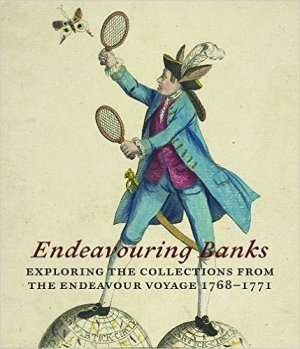 When English naturalist Joseph Banks (1743–1820) accompanied Captain James Cook (1728–1779) on his historic mission into the Pacific, the Endeavour voyage of 1768–1771, he took with him a team of collectors and illustrators. They returned with unprecedented collections of artefacts and specimens of stunning birds, fish, and other animals as well as thousands of plants, most seen for the first time in Europe. They produced, too, remarkable landscape and figure drawings of the peoples encountered on the voyage along with detailed journals and descriptions of the places visited, which, with the first detailed maps of these lands (Tahiti, New Zealand, and the East Coast of Australia), were afterwards used to create lavishly illustrated accounts of the mission. These caused a storm of interest in Europe, where plays, poems, and satirical caricatures were also produced to celebrate and examine the voyage, its personnel, and many ‘new’ discoveries.
Along with specimens and artefacts, contemporary portraits of key personalities aboard the ship, scale models and plans of Endeavour itself, scientific instruments taken on the voyage, commemorative medals and sketches, the objects (over 140) featured in this new book tell the story of the Endeavour voyage and its impact ahead of the 250th anniversary in 2018 of the launch of this seminal mission. Items separated in some cases for more than two centuries are brought together to reveal their fascinating history not only during but since that mission. Original voyage specimens will feature together with illustrations and descriptions of them, showing a rich diversity of newly discovered species and how Banks organized this material, planning but ultimately failing to publish it. Drawings of people and places visited during the mission are reproduced. And by comparing these voyage originals with the often stylized engravings later produced in London for the official account, this book investigates how knowledge gained on the mission was gathered, later revised and then printed in Europe.
The book focuses on the contribution of Banks’s often neglected artists—Sydney Parkinson, Herman Diedrich Spöring, Alexander Buchan as well as the priest Tupaia, who joined Endeavour in the Society Islands—none of whom survived the mission. These men illustrated island scenes of bays, dwellings, canoes as well as the dress, faces, possessions, and ceremonies of Pacific peoples. Of particular interest, and only recently recognised as by him, are the original artworks of Tupaia, who produced as part of this mission the first charts and illustrations on paper by any Polynesian. The surviving Endeavour voyage illustrations and maps were the most important body of images produced since Europeans entered this region, matching the truly historic value of the plant specimens and artefacts seen alongside them in this handsome book.
Exhibition | Divine Pleasures: Painting from India’s Rajput Courts
Press release (14 June 2016) from The Met:
Divine Pleasures: Painting from India’s Rajput Courts—The Kronos Collections
The Metropolitan Museum of Art, Fifth Avenue, New York, 14 June — 12 September 2016
Curated by Navina Haidar and Courtney Stewart

Detail of The Village Beauty. Probably painted by the artist Fattu (active ca. 1770–1820). Illustrated folio from the dispersed ‘Kangra Bihari’ Sat Sai (Seven Hundred Verses). Punjab Hills, kingdom of Kangra, ca. 1785. Opaque watercolor, ink, and gold on paper; narrow yellow and white borders with black inner rules; dark blue spandrels decorated with gold arabesque; painting 18.7 x 13.2 cm, page 20.6 x 14.9 cm. Promised Gift of the Kronos Collections, 2015 (SK.082).
Compelling episodes from the epic and poetic literature of the Indian subcontinent dominate the nearly 100 masterful paintings—most a 2015 promised gift by Steven M. Kossak from his family’s Kronos Collections—on display at The Metropolitan Museum of Art. Created mainly between the 16th and the early 19th century for the royal courts of Rajasthan and the Punjab Hills in northern India, the works on view in the exhibition Divine Pleasures: Painting from India’s Rajput Courts—The Kronos Collections are meant to move the soul and delight the eye. Suffused with the powerful imagery of the myths of the past, Indian painting expressed a new way of seeking the divine through bhakti, or personal devotion. The collection was assembled over nearly four decades by Mr. Kossak, formerly a curator in The Met’s Department of Asian Art.
“We are delighted to present this exhibition of Steve Kossak’s generous promised gift,” said Thomas P. Campbell, Director and CEO of The Met. “These distinguished paintings constitute one of the premier collections of this material in private hands, and their eventual addition to The Met collection will transform the Museum’s holdings of Rajput painting. It is a significant addition to Steve’s legacy at The Met after serving for two decades as a curator.”
The exhibition is organized into three major sections: Early Rajput and Rajasthan, early Pahari (Punjab Hills), and later Pahari. Within each room, the paintings will be shown in relation to the literary traditions of Indian Hinduism. Rajput court painting was mainly intended for royal delectation, to amplify through the artistic fantasy manifest in the pictures, well-known religious, quasi-religious, and secular texts and subjects. The power and magic of the images transcends the subjects they portray.
Under the patronage of their Rajput rulers, many of the principalities of north India developed and nurtured a distinctive painting style. This galaxy of stylistic expression is amply demonstrated in the exhibition through compelling examples of the Early Rajput Style; the later schools of Bikaner, Bundi, Kishangarh, Kota, and Mewar; as well as many of the small courts of the Punjab Hills: Bahu, Bahsoli, Bislalpur, Chamba, Guler, Kangra, Mandi, Mankot, and Nurpur.
Painted on paper in opaque watercolor and ink, they are often heightened with gold and silver. Whites are often raised to simulate pearls and reflective beetle-wing casings stand in for emeralds. Many of the paintings have never before been exhibited publicly.
Concurrent with the exhibition is a small, thematically related display, Poetry and Devotion in Indian Painting: Two Decades of Collecting (June 15–December 4, 2016) in the Florence and Herbert Irving Galleries for the Arts of South and Southeast Asia, Indian Painting Gallery, Gallery #251. Recognizing the contributions of Mr. Kossak to the Department of Asian Art, where he was a curator from 1986 to 2006, it features 22 of the dozens of Rajput and Pahari paintings that were acquired during his tenure, including a large intricately painted and printed cloth pichwai (temple hanging).
The exhibition was organized by Navina Haidar, Curator, and Courtney Stewart, Senior Research Assistant, of The Met’s Department of Islamic Art. Exhibition design is by Daniel Kershaw, Exhibition Design Manager; graphics are by Constance Norkin, Graphic Design Manager; and lighting is by Clint Ross Coller and Richard Lichte, Lighting Design Managers, all of the Museum’s Design Department.
◊ ◊ ◊ ◊ ◊
The catalogue is distributed by Yale UP:
Terence McInerney, with essays by Steven Kossak and Navina Najat Haidar, Divine Pleasures: Painting from India’s Rajput Courts—The Kronos Collections (New York: The Metropolitan Museum of Art, 2016), 272 pages, ISBN: 978-1588395900, $50.
 This splendidly illustrated publication features over 90 important paintings from the predominantly Hindu Rajput tradition of Indian painting, and are highlights from the Kronos Collection, one of the finest holdings of Indian art. These remarkable works—most of them published and illustrated here for the first time—were painted between the 16th and 18th centuries for the Indian royal courts in Rajastan and the Punjab Hills. Many of the paintings are characterized by their brilliant colors and vivid depictions of scenes from Hindu epics, mystical legends, and courtly life. Along with an informative entry for every work and a personal essay by expert and collector Steven M. Kossak, the book contains an extensive essay by Terence McInerney that outlines the history of Indian painting, with a special emphasis on the Rajput courts, and provides an overview of the subject with fresh insights and interpretations.
Terence McInerney is an independent scholar, dealer, and author of numerous articles on Indian painting. Steven M. Kossak is a former curator in the Department of Asian Art at The Metropolitan Museum of Art and a distinguished collector.
New Book | Condition: The Ageing of Art
From Paul Holberton:
Paul Taylor, Condition: The Ageing of Art (London: Paul Holberton Publishing, 2015), 264 pages, ISBN: 978-1907372797, £30 / $45.
 The paintings we see today in museums, galleries, churches, and temples are often much altered by the centuries. Pictures can split, rot, be eaten by woodworm, warp, blister, crack, cup, flake, darken, blanch, discolour, become too translucent, and disappear under a centuries-old varnish; and they can also suffer from the efforts of their owners to rectify these situations: they might be transferred, relined, ironed, abraded or repainted.
Anyone considering a work of art needs to establish at the outset how much it has changed since it was first made. This act of understanding is far from easy. We need to develop a knowledge of the physical and chemical processes which have brought paintings to their current state, in the hope that we can imagine their reversal. And we have to look as much as we can at a wide variety of paintings, so we can learn to distinguish those in a worse or better state of preservation; we have to try to understand what it is about a picture that differentiates good and bad condition. Theories of art history have been built on works whose appearance is made up of little more than repaint and decay, and the beginner needs to be warned about the many pitfalls dug by time for the unwary. This book is meant both for that beginner and for the qualified practitioner who might have missed a step along the way.
While there are many books on conservation and restoration, there is nothing which focuses specifically on condition. The plan here is to provide a hands-on introductory text, which can be used as a first orientation in the study of condition, and can remain as a basic reference work when the reader’s studies have progressed further. It should appeal to anyone with an interest in art.
Far too complex for their own good, European ‘Old Master’ pictures—by the likes of Cranach the Elder, Raphael, Leonardo, Poussin, Vermeer, Rembrandt, Canaletto, Gainsborough, Turner, and Van Gogh—rely for their delicate effects on layers of fragile materials, all of which are subject to change and decay. No-one can enjoy them to the full without an understanding of how and what they may have survived, suffered, or lost in the journey through the years.
Paul Taylor is curator of the photographic collection at the Warburg Institute, University of London, and editor of the Journal of the Warburg and Courtauld Institutes. He has written numerous articles and contributed to many books; he is the author of Dutch Flower Painting 1600–1720 (1995) and the editor of Pictorial Composition from Medieval to Modern Art (2000), The Iconography of Cylinder Seals (2006); Iconography without Texts (2008); and, most recently, Meditations on a Heritage: Papers on the Work and Legacy of Sir Ernst Gombrich (2014), also published by Paul Holberton publishing.
Exhibition | Geminiano Cozzi and His Porcelain
Now on view at Ca’ Rezzonico:
Geminiano Cozzi and His Porcelain / Geminiano Cozzi e le Sue Porcellane
Ca’ Rezzonico, Museo del Settecento Veneziano, Venice, 9 March – 12 July 2016
Curated by Marcella Ansaldi and Alberto Craievich
 Porcelain is perhaps the material that best embodies the spirit and aesthetic of the eighteenth century: glossy and light, it naturally lends itself to the creation of objects characterised by elegant, flowing lines. For long kept a secret by Chinese manufacturers, it was re-created in Europe in the second decade of the eighteenth century at the Saxon court of Augustus the Strong and from there gradually spread across the continent, despite desperate attempts to hide the formula. During the eighteenth century, the Venetian Republic was the only state to have no less than four porcelain factories, all of them opened by private initiative. One of these was that of Geminiano Cozzi (1728–1798), born in Modena but Venetian by choice. It is to his extraordinary activity as an entrepreneur ante litteram that the Fondazione Musei Civici di Venezia is now dedicating the first ever retrospective, 250 years after the privilege granted to him by the Republic in 1765 (and which marks the real birth of the Cozzi manufacture).
It is no coincidence that the exhibition should be presented in the pòrtego on the first floor of Ca’ Rezzonico, the Museo del Settecento Veneziano, a venue that in terms of its form and history is the best-suited to celebrating one of the most fascinating aspects of eighteenth-century art. Curated by Marcella Ansaldi and Alberto Craievich, the exhibition features over six hundred pieces from Italian and foreign museums, including the few items to have a firm date and the many still in private collections and hitherto difficult of access to the public and to scholars, a circumstance that has not helped the fortune critique of Cozzi: only today is his work as artist and manufacture being being its due recognition within the European scene. Unfolding in a development that is both chronological and thematic, the exhibition shows the evolution of Cozzi’s manufacture and of the types of decoration and various items, highlighting on the one hand one of the most fascinating art-historical events of the eighteenth century, and on the other by presenting an overview of a manufacturing activity of the period that includes items of surprising modernity.
The development of the art of porcelain in the eighteenth century in the Venetian Republic was undertaken by figures who were controversial, stubborn and fascinating. One of these was the Giovanni Vezzi, goldsmith and merchant, who in 1720 started his own production in Venice. Another was Nathaniel Friederich Hewelcke, a Saxon merchant who emigrated in 1757 from Meissen because of the closure of the factory during the Seven Years War; he requested and obtained a twenty-year privilege to manufacture “Saxon porcelain of any and all types” in Venice. And aside from the aforementioned Geminiano Cozzi, we might also mention Giovanni Battista Antonibon, who in 1762 started production in Nove (VI) thirty years after obtaining the privilege from the Serenissima’ “Savi della Mercanzia” for the production of high-quality majolica quality for twenty years without having to pay taxes (1732). Their destiny, however, despite the qualitatively extraordinary work, was not so lucky: after a few years, Vezzi and Hewelcke were obliged to abandon their businesses because of debts, and only Antonibon in Nove and Cozzi in Venice were able to establish long-lasting businesses, despite encountering difficulties on the way.
Marcella Ansaldi and Alberto Craievich, Geminiano Cozzi e le Sue Porcellane (Crocetta del Montello: Antiga Edizioni, 2016), 384 pages, ISBN: 978-8897784890, $72.
Exhibition | Emperors’ Treasures: Chinese Art from Taipei

Press release (2 May 2016) from the Asian Art Museum:
Emperors’ Treasures: Chinese Art from the National Palace Museum, Taipei
Asian Art Museum, San Francisco, 17 June — 18 September 2016
Museum of Fine Arts, Houston 23 October 2016 — 22 January 2017
Curated by Jay Xu and Li He
The centerpiece of the Asian Art Museum’s 50th anniversary year, Emperors’ Treasures: Chinese Art from the National Palace Museum, Taipei, presents nearly 150 imperial masterworks, many of which are making their North American debut. Visitors will discover a trove of exquisite paintings, ceramics, jades and more from one of the world’s greatest collections of Chinese art. The exhibition offers audiences a chance to behold the prized possessions of eight emperors and an empress, passed from dynasty to dynasty and once sheltered in Beijing’s Forbidden City. A glimpse into the artistic life inside an imperial palace, the exhibition showcases how family collections were refined over generations, showcasing rare pieces created by emperors themselves in private moments of inspiration.

Leng Mei, Illustrations of Farming and Weaving, ca. 1696; Qing dynasty (1644–1911), reign of Emperor Kangxi (1662–1722). Album leaves, colors on silk (Taipei: National Palace Museum)
“This is the absolute ‘best of the best’ of Chinese imperial art,” says Jay Xu, director of the Asian Art Museum. “By exploring how artistic taste was cultivated and evaluated—which created standards of beauty and elegance across Chinese culture—the exhibition reflects the museum’s mission of connecting audiences today with the great arts and traditions of Asia.”
The meticulously crafted public identities and carefully guarded private lives of each ruler will be told in a story narrated by the artworks of their eras, from the dignified Song to the bold yet subtle Yuan, from the celebrated brilliance of the Ming to the last days of the dazzling Qing dynasty.
While the National Palace Museum, Taipei, is renowned among Chinese art enthusiasts, historically its collection has not been widely accessible to the American public. Displays have traveled to the U.S. only a handful of times: in the 1960s and again in 1995–1996 for an exhibition presented by both The Metropolitan Museum of Art in New York and the Asian Art Museum—an exhibition that Xu also participated in organizing during his time as a junior research fellow there. “It’s exactly 20 years later,” Xu notes. “However, there are many works that haven’t been seen outside Asia before. In terms of the objects and time periods, it’s a fresh perspective for American audiences since the imperial court surrounded itself with the most important, avant-garde works of its time.”
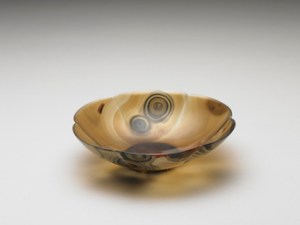
Imperial Workshop, Beijing, Hibiscus-shaped bowl; Qing dynasty, reign of Emperor Yongzheng (1723–1735). Agate (Taipei: National Palace Museum)
Organized around the lives of nine rulers—eight emperors and one empress who reigned from the early 12th through the early 20th centuries—the exhibition will explore how taste and connoisseurship as both personal virtues and statements of political power evolved over 800 years. By examining the distinct contributions of each subject, the rich styles and the variety of craftsmanship they prized, the exhibition outlines how Chinese art developed and flourished under Han Chinese, Mongol and later Manchu regimes. Through this exceptional selection of objects, Emperors’ Treasures presents a unique occasion for audiences to connect with powerful historical figures through their most cherished belongings, relating to them on an intimate, human scale that only art can express.
Emperors’ Treasures unfolds chronologically, allowing audiences to gauge how imperial tastes evolved from within China or due to external pressures, looking backward to ancient examples or blazing forward with new ideas. The exhibition flows through four galleries on the museum’s first floor.
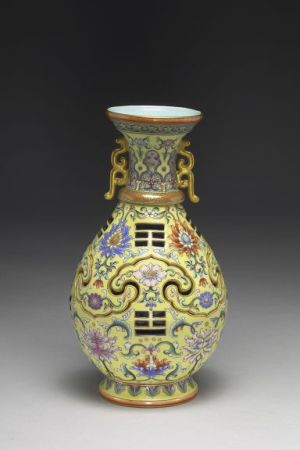
Vase with revolving core and eight-trigram design, ca. 1744. Jingdezhen, Jiangxi province, Qing dynasty, reign of Emperor Qianlong (1736–1795). Porcelain with golden glaze, multicolor decoration, and appliquéd sculpture. (Taipei: National Palace Museum)
Opening in the large Osher Gallery, audiences are introduced to the Song emperors (960–1279), celebrated for leading a renaissance in Chinese art more than 800 years ago. Here, visitors will discover the masterful landscapes and calligraphy of Emperor Huizong, recognized for his distinctive, influential ‘slender-gold’ script. Alongside these elegant works are the robust art pieces and an imposing portrait demanded by the mighty Yuan-dynasty (1271–1368) ruler Kublai Khan. Also in this gallery are legendary Ming porcelains (1368–1644), the pinnacle of ceramic art in China. Highlights include a rare cloisonné vessel; one of only two surviving blue-and-white Ming vases depicting West Asian entertainers; and the ‘holy grail’ of Chinese porcelains—a wine cup with a cock and hen design like the example recently sold at Sotheby’s for more than $36 million.
The adjacent Hambrecht Gallery features an overview of illustrious Qing-dynasty accomplishments (1644–1911). During this period, a dozen imperial workshops across the Chinese Empire were opened to fulfill the Forbidden City’s relentless appetite for lacquers, enamels and carved jade, like the paper-thin hibiscus-shaped bowl from the early 1700s, sculpted from a single piece of glowing, nut-brown agate.
Next door is the Lee Gallery, which paints an intimate portrait of the 18th-century Qianlong Emperor, known as the ‘Old Man of Ten Perfections’ and admired as the most prolific poet-monarch in Chinese history. Through a selection of paintings, carvings and other treasures, audiences will see how a single ruler caused a seismic shift in the creative output of China. While many of the masterworks remain quietly breathtaking in their elegance, others certainly call out to the interests of today. The White Falcon hanging scroll by Italian Jesuit Giuseppe Castiglione introduces visitors to an intriguing European figure who spent decades in the Qing court, serving under Emperors Kangxi, Yongzheng, and Qianlong. Having his Chinese name as Lang Shining, Castiglione’s collaboration on court portraits and paintings underscores a tradition of East-West cultural exchange that continues in the current globalized art arena.
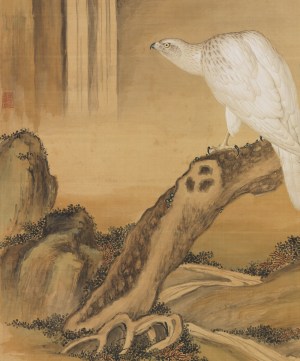
Lang Shining (Giuseppe Castiglione, Italian, 1688–1766), White Falcon; Qing dynasty, reign of the Qianlong emperor (1736–1795). Hanging scroll, colors on silk (Taipei: National Palace Museum)
The exhibition concludes in the museum’s Resource Room with a focus on the Empress Dowager Cixi, a Manchu concubine who rose to become the long-ruling power behind the final Qing emperors. Cixi recruited female artists to her ‘Studio of Great Elegance’, where, under her personal direction, the coterie combined traditional symbols and patterns with botanical study, setting a foundation for modern Chinese aesthetics.
An icon of the National Palace Museum, Taipei, the celebrated Qing-dynasty ‘Meat-shaped stone’ will also be traveling to the U.S. for the first time. The stone—a hunk of jasper carved and dyed to resemble a portion of braised pork belly fresh from the pot—exemplifies how the enduring appeal of traditional Chinese cooking has long inspired devotion. When on view in Japan in 2014, the stone was seen by an average of 6,000 people a day and generated a mini-boom in dongpo rou, the classic dish it closely resembles. In honor of the stone’s unusual appeal, a special edition of the Asian Art Museum’s popular Thursday evening programs will feature innovative new dishes inspired by the Meat-shaped stone and prepared by four local chefs. Their dishes—from street carts to haute cuisine—will be presented to the public on July 7. Additionally, from June 17 to July 18, more than a dozen San Francisco chefs, both up-and-coming and established, will feature versions of the mouthwatering, slow-simmered ‘priceless pork belly’ in their restaurants. Another take on the delicious dish developed by Melinda Quirino, chef at the museum’s own Cafe Asia, will be available for visitors to enjoy throughout the exhibition’s run.

Meat-shaped stone; Qing dynasty (1644–1911). Jasper, golden stand (Taipei: National Palace Museum)
“Emperors’ Treasures is about looking forward and starting the museum’s next 50 years on the right note,” says Xu. “We not only share and present exceptional works of art, but we help people understand their context, significance and relevance.”
Emperors’ Treasures was made possible by a generous grant from Presenting Sponsor, The Robert H. N. Ho Family Foundation. “This important support from The Robert H. N. Ho Family Foundation enables the Asian Art Museum to curate and present Emperors’ Treasures, which will expose a global audience to the beauty and depth of Chinese art and culture,” said Xu.
Ted Lipman, CEO of The Robert H. N. Ho Family Foundation, noted: “This exhibition marks the third collaboration between the Asian Art Museum and The Robert H. N. Ho Family Foundation. A key mission of the Foundation is to promote Chinese culture and the arts to Western audiences to increase understanding and appreciation of this ancient legacy. Nowhere does the 5,000 years of Chinese history manifest itself more beautifully and comprehensively than the exquisite imperial collection, which has been lovingly conserved and displayed at the National Palace Museum, Taipei. Through support for this significant exhibition, the Foundation seeks to provide visitors with an unprecedented opportunity to witness China’s vibrant cultural heritage first-hand.”
Emperors’ Treasures: Chinese Art from the National Palace Museum, Taipei is co-organized by the Asian Art Museum of San Francisco and the National Palace Museum, Taipei. The exhibition is curated by Asian Art Museum Director Jay Xu and Li He, associate curator of Chinese art.
◊ ◊ ◊ ◊ ◊
Jay Xu and He Li, eds., Emperors’ Treasures: Chinese Art from the National Palace Museum, Taipei (San Francisco, Asian Art Museum, 2016), 272 pages, ISBN: 978-0939117734, $50.
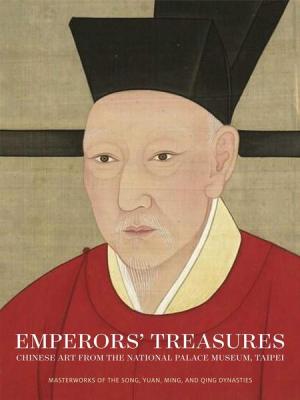 Emperors’ Treasures features artworks from the renowned National Palace Museum, Taipei. It encompasses paintings, calligraphy, bronzes, ceramics, lacquer ware, jades, and textiles exemplifying the finest craftsmanship and imperial taste. The exhibition catalog explores the identities of eight Chinese rulers—seven emperors and one empress—who reigned from the early 12th through early 20th centuries. They are portrayed in a story line that highlights artworks of their eras, from the dignified Song to the coarse yet subtle Yuan, and from the brilliant Ming until the final, dazzling Qing period. Emperors’ Treasures examines each ruler’s distinct contribution to the arts and how each developed his or her aesthetic and connoisseurship.
With contributions by Fung Ming-chu, Jay Xu, Ho Chuan-hsin, Alfreda Murck, Tianlong Jiao, Li He, and curators from the National Palace Museum and the Asian Art Museum.
Jay Xu is Executive Director of the Asian Art Museum of San Francisco. He is the first Chinese American director at a major US art museum and the first Asian American museum director elected to the American Academy of Arts and Sciences.
Li He is associate curator of Chinese Art at the Asian Art Museum of San Francisco and a visiting research fellow at the Palace Museum, Beijing. She is the author of Chinese Ceramics: A New Comprehensive History from the Asian Art Museum of San Francisco.
Exhibition | Emma Hamilton: Seduction and Celebrity

◊ ◊ ◊ ◊ ◊
Looking ahead to the fall . . . press release from the National Maritime Museum:
Emma Hamilton: Seduction and Celebrity
National Maritime Museum, Greenwich, 3 November 2016 — 17 April 2016
From humble origins, Emma Hamilton rose to national and international fame as a model, performer, and interpreter of neo-classical fashion. Within the public mind, however, she typically continues to occupy a passive and supporting role and is often remembered simply as the mistress of Britain’s greatest naval hero, Admiral Lord Nelson. This landmark exhibition recovers Emma from myth and misrepresentation and reveals her to be an active and influential historical actor in her own right: one of the greatest female lives of her era.
Born into poverty in 1765, Emma’s talent and beauty brought her fame while still in her teens as muse to the great portrait artist George Romney. In her twenties she achieved still greater artistic prominence in Naples, the epicentre of the fashionable Grand Tour. Here, as the confidante of Queen Maria Carolina, she also came to wield considerable political power. Emma embarked on a passionate affair with Admiral Lord Nelson but risked her security and social status in the process. Her fortunes never recovered from the tragedy of his death at Trafalgar, and—following a period in debtor’s prison—she died in self-imposed exile in Calais in 1815.
The exhibition carries visitors through the arc of this remarkable story, revealing Emma’s driving ambition and her brilliance as a performer and placing in sharp relief the social conventions ranged against her. In an age when people tended to remain fixed in the social categories in which they began their lives, she crossed boundaries of all kinds, broke through barriers, and ultimately paid a heavy price.
Emma’s story will be told through over 200 objects from public and private lenders around a core from the Museum’s own collections. Emma’s compelling story will be explored through exceptional fine art, antiquities that inspired Emma’s famous ‘attitudes’, costumes that show her impact on contemporary fashions, prints and caricatures that carried her image to a mass audience, her personal letters and those of Nelson and William Hamilton, and finally the uniform coat that Nelson wore at Trafalgar, retained by Emma until destitution forced her to part with it.
◊ ◊ ◊ ◊ ◊
From Thames & Hudson:
Quintin Colville and Kate Williams, with contributions by Vic Gatrell, Hannah Greig, Jason Kelly, Margarette Lincoln, Christine Riding, and Gillian Russell, Emma Hamilton: Seduction and Celebrity (London: Thames & Hudson, 2016), 280 pages, ISBN: 978-0500252208, £30 / $50.
 Emma Hamilton (1765–1815) is widely known as a temptress who ensnared the naval hero Horatio Nelson and paid the price by dying in poverty in Calais. But this epic love affair, and the judgments surrounding it, have obscured a spectacular life story. This book, published to coincide with a major exhibition on Hamilton at the National Maritime Museum, Greenwich, explores her remarkable life and recovers Emma from myth and misrepresentation. Distinguished contributors provide a fresh evaluation of her artistic undertakings, cultural achievements, and legacy, as well as of the momentous years of her association with Nelson and the unravelling of her fortunes after his death at the Battle of Trafalgar in 1805. Illustrated with paintings, prints, and drawings capturing the beauty that propelled her to celebrity status, Emma Hamilton tells the story of an extraordinary woman who broke through barriers of class and privilege to win her own unique place in British history.
Quintin Colville is Curator of Naval History at the National Maritime Museum. He edited Nelson, Navy & Nation and is the author of The British Sailor of the First World War.
Kate Williams is Professor of History at the University of Reading. Her biography England’s Mistress: The Infamous Life of Emma Hamilton was published in 2006.
◊ ◊ ◊ ◊ ◊
Note (added 28 October 2016) — The original version of this posting used an earlier working title, Seduction and Celebrity: The Spectacular Life of Emma Hamilton. Other changes have been made to reflect updated information.
New Book | Batteux, The Fine Arts Reduced to a Single Principle
Published last fall by Oxford University Press:
Charles Batteux, The Fine Arts Reduced to a Single Principle, translated by James O. Young (Oxford: Oxford University Press, 2015), 208 pages, ISBN: 978-0198747116, $70.
 The Fine Arts Reduced to a Single Principle (1746) by Charles Batteux was arguably the most influential work on aesthetics published in the eighteenth century. It influenced every major aesthetician in the second half of the century: Diderot, Herder, Hume, Kant, Lessing, Mendelssohn, and others either adopted his views or reacted against them. It is the work generally credited with establishing the modern system of the arts: poetry, painting, music, sculpture and dance. Batteux’s book is also an invaluable aid to the interpretation of the arts of eighteenth century. And yet there has never been a complete or reliable translation of The Fine Arts into English. Now James Young, a leading contemporary philosopher of art, has provided an eminently readable and accurate translation. It is fully annotated and comes with a comprehensive introduction that identifies the figures who influenced Batteux and the writers who were, in turn, influenced by him. The introduction also discusses the ways in which The Fine Arts has continuing philosophical interest. In particular, Young demonstrates that Batteux’s work is an important contribution to aesthetic cognitivism (the view that works of art contribute importantly to knowledge) and that Batteux made a significant contribution to understanding the expressiveness of music. This book will be of interest to everyone interested in the arts of the eighteenth century, French studies, the history of European ideas, and philosophy of art.
James O. Young is Professor of Philosophy at the University of Victoria. He is the author of four books: Global Anti-realism (1995), Art and Knowledge (2001), Cultural Appropriation and the Arts (2008), Critique of Pure Music (2014), and over 50 articles in refereed journals. He has edited the four volume collection, Aesthetics: The Critical Concepts (2005) and (with Conrad Brunk) The Ethics of Cultural Appropriation (2009). Another collection of essays, The Semantics of Aesthetic Judgements, is forthcoming from Oxford. He is Artistic Director of the Early Music Society of the Islands.
C O N T E N T S
Acknowledgements
Translator’s Introduction
Epistle Dedicatory
Preface
Part One: Where we establish the nature of the arts by reference to the genius that produced them
1 Division and origin of the arts
2 Genius is only able to produce the arts by imitation; what imitation is
3 Genius must not imitate reality just as it is
4 The state genius must be in to imitate belle nature
5 On the manner in which the arts imitate
6 Why eloquence and architecture differ from the other arts
Part Two: Where we establish the principle of imitation by reference to nature and the laws of taste
1 What taste is
2 The subject of taste can only be nature
3: Evidence drawn from the history of taste
4 The purpose of the laws of taste is to imitate belle nature
5 Second general law of taste: belle nature must be imitated well
6 There are particular rules for each artwork and taste finds them only in nature
7 Conclusion I. There is only one general type of good taste, but several particular types
8 Conclusion II: Since the arts are imitators of nature, they must be judged by comparison to it
9 Conclusion III: Taste for nature and a taste for the arts being the same, there is only one taste that applies to everything, even to manners
10 Conclusion IV: How it is important to form taste in a timely manner and how we should go about forming it
Part Three: In which the principle of imitation is verified by its application to various arts
Section One: Poetical art consists in the imitation of belle nature
1 Alternatives to the principle of imitation are refuted
2 The divisions of poetry are found in [types of] imitation
3 The general rules of poetical content are contained in the principle of imitation
4 The rules of poetical style are contained in the imitation of belle nature
5 All rules of epic poetry come from the principle of imitation
6 On tragedy
7 On comedy
8 On pastoral poetry
9 On fables
10 On lyric poetry
Section Two: On Painting
Section Three: On Music and Dance
1 Gestures and tones of voice are the keys to understanding music and dance
2 The emotions are the principal subject of music and dance
3 All of music and dance must have a referent and a meaning
4 The expressive qualities that music and dance must have
5 On the union of the fine arts
Exhibition | Marseille in the Eighteenth Century, 1753–1793
Now on view at the Musée des Beaux-Arts in Marseille:
Marseille au XVIIIe siècle: Les années de l’Académie, 1753–1793
Le Musée des Beaux-Arts, Marseille, 17 June — 16 October 2016
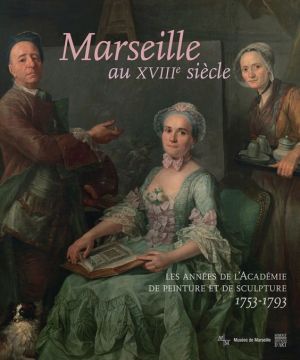 Pour la première fois le panorama artistique d’une période majeure de l’histoire de Marseille, le XVIIIe siècle, va être présenté au musée des Beaux-arts. Cent cinquante œuvres, peintures, sculptures et dessins, provenant des riches collections patrimoniales de la ville, musées, bibliothèque, archives, mais également des musées français et européens seront réunies pour retracer une histoire des arts dans une ville que le commerce a, de tout temps, ouvert aux influences extérieures.
Cette évocation débute pourtant par une tragédie, celle de l’épidémie de Peste dont les grandes toiles de Michel Serre, restaurées pour l’occasion, nous ont gardé l’exceptionnel souvenir. La ville saura se relever du désastre et au milieu du siècle, deux grands peintres, Dandré-Bardon et Joseph Vernet viendront redonner un nouveau souffle au milieu local.
En créant en 1753, l’académie de peinture et de sculpture de Marseille, Dandré-Bardon va faire de cette institution un extraordinaire vivier de jeunes artistes, y attirant également ceux qui sont en route vers l’Italie. Joseph Vernet, dont l’Europe entière s’arrache les marines, venant sur place peindre pour Louis XV le port de Marseille, va susciter de nombreux émules comme Lacroix de Marseille, Volaire ou Henry d’Arles, et faire des marines un genre particulièrement prisé des collectionneurs marseillais.
Du baroque au néo-classicisme, Marseillais ou non, installés à demeure ou simplement de passage, artistes et amateurs d’arts, ont fait de Marseille un des importants foyers artistiques de la France du XVIIIe siècle.
◊ ◊ ◊ ◊ ◊
From Somogy:
Luc Georget and Gérard Fabre, eds., Marseille au XVIIIe siècle: Les années de l’Académie, 1753–1793 (Paris: Somogy, 2016), 304 pages, ISBN: 978-2757210581, 39€.
Cet ouvrage rend compte de la vie artistique à Marseille au Siècle des lumières. L’Académie de peinture et de sculpture de Marseille, créée en 1753, est au cœur de ce récit. La naissance de cette institution concrétisait les efforts de ces hommes, artistes et amateurs d’art, qui voulaient doter leur ville d’un établissement capable de former peintres, sculpteurs et architectes. Ils rêvaient de faire de cette institution un soutien pour les jeunes artistes, un lieu d’accueil et de rencontre pour ceux qui étaient de passage et, par le réseau de relations qu’ils entretinrent avec le reste de l’Europe, un instrument du rayonnement de leur ville. Au cours de ses quarante années d’existence, l’Académie de peinture et de sculpture a formé des élèves qui connurent de grands succès, bien au-delà de Marseille, et des dessinateurs qui offrirent aux productions de ses manufactures un niveau inégalé. Fermée en 1793, comme toutes les académies en France, elle devait donner naissance, une fois la tourmente apaisée, à deux des plus importantes institutions culturelles du XIXe siècle : l’école des beaux-arts et le musée.
Sous la direction de Luc Georget, Conservateur en chef du Musée des Beaux-Arts de Marseille et Gérard Fabre, assistant de conservation au Musée des Beaux-Arts de Marseille – Avec la collaboration de Régis Bertrand, Marie-Claude Homet, Emilie Beck Saiello, Olivier Bonfait, Laëtitia Pierre, Markus Castor, Sylvain Bédard, Emilie Roffidal, Christine Germain-Donnat, Yves di Domenico, Alexandre Maral, et Claude Badet.
S O M M A I R E
• Luc Georget, Avant-propos
• Régis Bertrand, Le « glorieux » XVIIIe siècle marseillais: Marseille de la Régence à la Révolution
• Marie-Claude Homet, L’héritage baroque: Michel Serre
• Émilie Beck Saiello, De l’aristocratie du négoce aux cercles de l’Académie: Les réseaux marseillais de Joseph Vernet
• Olivier Bonfait, École de dessin, académie, académies: L’« Académie de Peinture, &c. de Marseille » dans l’espace des Lumières
• Gérard Fabre, De l’École académique de dessin à l’Académie de peinture, sculpture et architecture civile et navale de Marseille, 1753–1793
• Laëtitia Pierre et Markus Castor, Faire œuvre de pédagogie: Le directorat de Michel-François Dandré-Bardon à l’Académie de peinture et de sculpture de Marseille, 1749–1783
• Sylvain Bédard, Modèles parisiens: Un lot de figures académiques pour Marseille
• Luc Georget, Une académicienne: Françoise Duparc
• Émilie Roffidal, L’union des arts et du commerce
• Christine Germain-Donnat, La faïence de Marseille
• Yves di Domencio, Le cycle de l’Histoire de Tobie de Pierre Parrocel
• Alexandre Maral, Les sculpteurs de l’Académie de Marseille
• Luc Georget, L’architecture à l’Académie: Les morceaux de réception
• Luc Georget, Une commande singulière: Le Saint Roch intercède la Vierge pour la guérison des pestiférés de David
• Claude Badet, Marseille et la création artistique pendant la Révolution
Liste des œuvres exposées
Bibliographie
Index des noms de personnes
New Book | Fashionable Encounters
This collection of essays appeared in 2014, but I learned of it just a a few days ago—thanks to Michael Yonan’s Instagram: he’s in Denmark this week, participating in Attingham’s Study Programme. I’m hoping to start a list of Instagram feeds relevant to eighteenth-century art and architecture in the coming weeks, so please feel free to send me any of your favorites! -Craig Hanson
◊ ◊ ◊ ◊ ◊
From Oxbow Books:
Tove Engelhardt Mathiassen, Marie-Louise Nosch, Maj Ringgaard, Kirsten Toftegaard, and Mikkel Venborg Pederson, eds., Fashionable Encounters: Perspectives and Trends in Textile and Dress in the Early Modern Nordic World (Oxford: Oxbow Books, 2014), 256 pages, ISBN: 978-1782973829, £40.
 At the heart of this anthology lies the world of fashion—a concept that pervades the realm of clothes and dress, appearances and fashionable manners, interior design, ideas and attitudes. Here sixteen papers focus on the Nordic world (Denmark, Norway, Sweden Finland, Iceland, the Faroe Isles and Greenland) from 1500 to 1850. This was a period of rapid and far-reaching social, political and economic change, from feudal Europe through political revolution, industrialisation, development of international trade, religious upheaval, and technological innovation—changes impacting on every aspect of life and reflected in equally rapid and widespread changes in fashion at all levels of society. These papers present a broad image of the theme of fashion as a concept and as an empirical manifestation in the Nordic countries in early modernity, exploring a variety of ways in which that world encountered fashionable impressions in clothing and related aspects of material culture from Europe, the Russian Empire, and far beyond. The chapters range from object-based studies to theory-driven analysis. Elite and sophisticated fashions, the importation of luxuries and fashion garments, christening and bridal wear, silk knitted waistcoats, woollen sweaters and the influence of the whaling trade on women’s clothing are some of the diverse topics considered, as well as religious influences on perceptions of luxury and aspects of the garment trade and merchant inventories.
◊ ◊ ◊ ◊ ◊
C O N T E N T S
Prologue (Mikkel Venborg Pedersen)
1 The World of Foreign Goods and Imported Luxuries: Merchant and Shop Inventories in Late 17th-Century Denmark-Norway (Camilla Luise Dahl and Piia Lempiäinen)
2 Foreign Seductions: Sumptuary Laws, Consumption and National Identity in Early Modern Sweden (Eva I. Andersson)
3 Fashion from the Ship: Life, Fashion and Fashion Dissemination in and around Kokkola, Finland in the 18th Century (Seija Johnson)
4 Creating fashion: Tailors’ and Seamstresses’ Work with Cutting and Construction Techniques in Women’s Dress, ca. 1750–1830 (Pernilla Rasmussen)
5 Silk Knitted Waistcoats: A 17th-Century Fashion Item (Maj Ringgaard)
6 Fashioning the Early Modern Swedish Nobility, Mirrored in Preserved 17th-Century Liturgical Textiles (Lena Dahrén)
7 Reflections on Dress Practices and How to Get to Know the Past (Bjørn Sverre Hol Haugen)
8 The Queen of Denmark: An English Fashion Doll and Its Connections to the Nordic Countries (Cecilie Stöger Nachman)
9 At the Nordic Fringe of Global Consumption: A Copenhagen Bourgeois’ Home and the Use of New Goods in the Mid-18th Century (Mikkel Venborg Pedersen)
10 The Theft of Fashion: Circulation of Fashionable Textiles and Garments in 18th-Century Copenhagen (Vibe Maria Martens)
11 Bolette-Marie Harboe’s Bridal Dress: Fashionable Encounters Told in an 18th-Century Dress (Kirsten Toftegaard)
12 Luxurious Textiles in Danish Christening Garments: Fashionable Encounters across Social and Geographical Borders (Tove Engelhardt Mathiassen)
13 Fish-bones and Fashion: The Influence of Whaling on Women’s Clothes in Early Modern Europe (Christina Folke Ax)
14 From Doll Cups to Woollen Sweaters: Trends, Consumption, and Influentials in early 19th-Century Southern Disko Bay, Greenland (Peter Andreas Toft and Maria Mackinney-Valentin)
15 Abundance to Asceticism: Religious Influences on Perceptions of Luxury in Denmark and Great Britain in the 18th Century (Juliane Engelhardt)
16 Circulating Images of Unmanliness and Foreignness: Collector Niclas Holterman and European Caricatures in Sweden around 1800 (Patrik Steorn)
Acknowledgements
Illustrations
Contributors
New Book | The Royal Garden: Identity, Power and Pleasure
From the Ax:son Johnson Foundation:
Kurt Almqvist and Susanna Hakelius Popova, eds., The Royal Garden: Identity, Power and Pleasure (Stockholm: Axel and Margaret Ax:son Johnson Foundation, 2016), 193 pages, 250SEK.
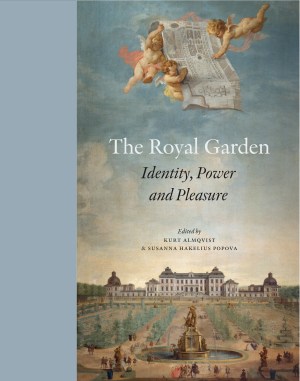 Throughout history, royals have strongly influenced the form and content of gardens and parks. Our strong connection to these cultivated places is not only due to our fascination with nature itself, but reveals our relationship to royal houses, monarchy and the nation. Through the conservation of these places we do not only see and view nature, but our own cultural heritage.
In this book, eight garden experts from five countries provide important examples of how kings and regents—through their extraordinary creations—have shaped history, communicated with the world, and mirrored themselves in their respective eras. The essays stem from a seminar, The Royal Garden, arranged by The Axel and Margaret Ax:son Johnson Foundation for Public Benefit and held at Drottningholm Palace near Stockholm in 2015.
The conference included these presentations:
• John Dixon Hunt — The Royal Garden as an Historic Concept
• Göran Alm — The Paradise: A Swedish Royal Garden Recreation
• Magnus Olausson — Travels, Tournaments, and Freemasonry: National and International
• Åsa Ahrland — The Royal Park: From Regal Pursuit to Public Recreation
• Renske Ek — The Royal Baroque Garden at Het Loo as a Work of Art
• Patricia Bouchenot-Déchin — Louis XVI, André Le Nôtre, and the Royal Garden of Versailles
• Todd Longstaffe-Gowan — Sweet Prospects and Stately Avenues: The Role and Importance of the Lime Tree Avenues at Hampton Court
• Peter Wirtz — Case Study Domaine de Wideville: Revamping a Louis XIII Garden
• George Plumptre — Overview of, and Differences in, Ten Interesting Royal European Gardens










 Enfilade
leave a comment