Berlin Conference on Plaster Casts
Gipsabgüsse und antike Skulpturen / Plaster Casts of Ancient Sculpture
Pergamon Museum, Berlin, 7-9 April 2011
Much of this conference addresses the nineteenth century, with a keynote address on Thursday evening by Dr. Marjorie Trusted, of the V&A on “Reproduction as Spectacle and Inspiration: The Cast Courts at the Victoria and Albert Museum, London.” There are, however, several sessions on Friday morning for the eighteenth century:
- Simone M. Kaiser (Johann-Wolfgang-von-Goethe-Universität, Frankfurt am Main), “Die Verbindung von Antikenforschung und fürstlicher Repräsentation im Villengarten der frühen Neuzeit”
- Hélène J. Bremer (University of Leiden), “How to Display a Collection of Classical Sculpture at the End of the 18th Century?”
- Francesca Valli (Accademia di Belle Arti di Brera, Milano), “The Galleria delle Statue of Brera Academy in Milan, 1806”
The full program is available here»
Paris Conference on Collectors’ Marks
Last year on the occasion of a new supplement to Frits Lugt’s Marques de Collections de dessins et d’estampes (link to a useful description at CODART), the Rencontres Internationales du Salon du Dessin 2010 focused on this crucial work, looking both at its significance and a few specific examples of collectors’ marks. The upcoming 2011 meeting continues the theme. From the Salon du Dessin website:
Rencontres Internationales du Salon du Dessin 2011: Les Marques de collections
Palais de la Bourse, Paris, 30-31 March 2011
A l’occasion de l’inauguration en 2010 d’un supplément de l’ouvrage de Frits Lugt (1884-1970) Marques de Collections de dessins et d’estampes, les Rencontres internationales du Salon du Dessin 2010 se sont consacrées à l’histoire des Marques de Collections. Le premier après-midi a été dédié à la présentation de la base, à un hommage à Frits Lugt, ainsi qu’aux apports des marques dans la connaissance des fonds institutionnels. La seconde partie du colloque s’est penchée plus précisément sur quelques exemples de collectionneurs et de leurs marques. Cette double approche a permis de définir le monde de la collection et des collectionneurs selon Frits Lugt, lui-même membre éminent de cette famille et doté d’une personnalité réellement hors du commun.
Pour cette nouvelle édition 2011, les Rencontres se dérouleront à nouveau au Palais de la Bourse les 30 et 31 mars prochain, toujours sous la direction éditoriale de Peter Fuhring, responsable de la mise en oeuvre de ce projet, dans la continuité des conférences de l’an dernier.
Wednesday, 30 March 2011
- Pierre Rosenberg (de l’Académie française), Présentation des VIèmes Rencontres
- Novella Barbolani di Montauto (Università « La Sapienza » di Roma), “Les inscriptions sur les dessins de la collection F.M.N Gaburri”
- Diana Dethloff (University College of London), “La collection de dessins de Peter Lely”
- Donato Esposito (Historien de l’art, Londres), “Les vraies et fausses marques de Sir Joshua Reynolds”
Thursday, 31 March 2011
- Peter Fuhring (Fondation Custodia, Paris), “Soleil ou Séchan? Identification de la marque L.2342”
- Rhea Sylvia Blok (Fondation Custodia, Paris), “Francis Seymour Haden (1818-1890), collectionneur et artiste sur les pas de Rembrandt”
- Pierre Juhel (Historien d’art, Paris), “Georges Pochet (1843-1901), collectionneur de dessins et estampes modernes”
- Francesco Grisolia, (Doctorant, Université « Tor vegata » di Roma), “Rodolfo Lanciani (1845-1929), archéologue et collectionneur de dessins et d’estampes”
University of Warwick: Spanish America in the Eighteenth Century
Spanish America in the Early 18th Century: New Perspectives on a Forgotten Era
University of Warwick, Coventry, 15-16 April 2011
A day and a half workshop, to take place at the University of Warwick on 15 and 16 April 2011, will bring together a group of scholars working on Spanish America during the first half of the eighteenth century from different disciplines and perspectives. Until recently, the years between the accession of the house of Bourbon to the Spanish throne in 1700 and the coronation of Charles III in 1759 had failed to attract the interest of scholars of the Spanish world in the way that the latter part of the century had. Over the past few years, however, a growing number of scholars have begun to explore the early Bourbon period from innovative perspectives challenging the traditional view of the period as a largely inconsequential sequel to the later years of Habsburg rule. The workshop is an opportunity for a new generation of scholars, and for those well established academics that spearheaded these new developments, to talk about the directions in which research is moving and to discuss what the period looks like from our different perspectives. Particular emphasis will be placed on discussing the different ways in which the Bourbon succession, international competition over access to Spanish American resources, and war affected the region in the short and medium term. Participants include Rebecca Earle (Warwick), Allan Kuethe (Texas Tech), Anthony McFarlane (Warwick), Adrian Pearce (KCL), Christoph Rosenmuller (MTSU), Nuria Sala (Girona), Christopher Storrs (Dundee). Conference fee £20 (£12 for graduate students/unwaged). For further details please visit the conference website.
In Munich: Conserving Boulle Furniture, Exhibition and Symposium
From the museum’s website:
Prunkmöbel am Münchner Hof: Barocker Dekor unter der Lupe
Bayerisches Nationalmuseum Munich, 8 April — 31 July 2011
Symposium — Baroque Furniture in the Boulle Technique: Conservation, Science and History
Bayerisches Nationalmuseum Munich, 5-7 May 2011
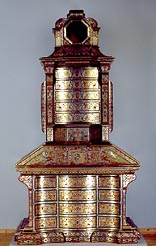 In spring 2011 the Bayerisches Nationalmuseum will have completed an interdisciplinary research project dedicated to the conservation /restoration of four writing cabinets decorated with fine marquetry in the Boulle technique. These cabinets were made by Johann Puchwiser (1680-1744), ebenist to the Munich court. The project has been supported by the Getty Foundation, the Ernst von Siemens Kunststiftung und the Eleonora-Schamberger-Stiftung and joined by an international group of furniture experts, scientists and conservators/restorers.
To showcase this project, we are planning the exhibition Prunkmöbel am Münchner Hof: Barocker Dekor unter der Lupe from 8th April to 31st July 2011. The show will present magnificent furniture in the Boulle technique and focuses especially on the conservation of the Puchwiser cabinets, stylistic developments, manufacturing
techniques, and Boulle marquetry in general.
 The announced symposium on the conservation project Baroque Furniture in Boulle Technique: Conservation, Science, and History is addressed to art historians, conservators/restorers and scientists. Internationally recognized experts will present their results in conservation/ restoration and scientific analysis of objects in Boulle technique. Lectures and guided tours will be held in English. Post-prints will be published shortly after the conference and can be ordered in advance. Conference fee including coffee break and lunch: 120€ / Reduced fee for students: 60€. Deadline for registration: 15th April 2011.
On Thursday 5th May we will meet for an evening dinner in the restaurant of the Bayerisches Nationalmuseum. If you would like to join, please add 40€ to the conference fee. For registration and information, please contact:
restaurierung.sekretariat@bnm.mwn.de
A preliminary program is available here»
ASECS in Vancouver, 2011
2011 American Society for Eighteenth-Century Studies Conference
Vancouver, British Columbia, 17-20 March 2011
The 2011 ASECS conference takes place in Vancouver, British Columbia, March 17-20, at the Sheraton Vancouver Wall Centre. Along with our annual luncheon and business meeting on Friday, HECAA will be represented by two panels (also on Friday) chaired by Douglas Fordham and David Ehrenpreis and Kevin Justus. In addition to these, a wide selection of sessions are also included below (admittedly there are lots of others that will interest HECAA members). For the full program, see the ASECS website.
◊ ◊ ◊ ◊ ◊
T H U R S D A Y , 1 7 M A R C H , 2 0 1 1
8:00-9:30
The Material Culture of Authorship, Pavilion Ballroom C
Chair: Robert MILES, University of Victoria
1. David A. BREWER, The Ohio State University, “Authorial Heads: Painted, Printed, Carved and Cast”
2. Brian COWAN, McGill University, “Henry Sacheverell and Material Celebrity in Eighteenth-Century Britain”
3. Sören C. HAMMERSCHMIDT, Ghent University, “‘The Best Work, or Best Character’: Intermedial Authorship in Alexander Pope’s Letters”
4. Tom MOLE, McGill University, “The Material Culture of Commemoration: The Scott Monument and the Reformed Nation”
◊ ◊ ◊ ◊ ◊
9:45-11:15
Clothing/Costume/Fashion – I, Pavilion Ballroom C
Chairs: Vivian P. CAMERON, Independent Scholar AND William W. CLARK, Queens College and Graduate Center, City University of New York
1. Emily PFIEFER, University of California, Riverside, “Fashioning Absolute Control: Defining the French Autocratic Ideal through Indian Textile Regulation, 1700–1706”
2. Jeffrey COLLINS, Bard Graduate Center, “Cornelis Troost: Fashioning Satire in Eighteenth-Century Holland”
3. Meredith MARTIN, Wellesley College, “Fashion and Globalization in Pre-Revolutionary France”
◊ ◊ ◊ ◊ ◊
11:30-1:00
Clothing/Costume/Fashion – II, Pavilion Ballroom C
Chairs: William W. CLARK, Queens College and Graduate Center, City University of New York AND Vivian P. CAMERON, Independent Scholar
1. Denise Amy BAXTER, University of North Texas, “Fashion and the Maternal Body in France, 1792–1814”
2. Laura ENGEL, Duquesne University, “Much Ado about Muffs: Actresses, Accessories, and Austen”
3. Alicia KERFOOT, McMaster University, “‘Let firm, well-hammer’d Soles protect thy Feet’: Footwear and the Permeability of the Street in Gay’s Trivia”
◊ ◊ ◊ ◊ ◊
2:30-4:00
Prints: Past and Present in the Eighteenth Century, Pavilion Ballroom C
Chair: Craig HANSON, Calvin College
1. Robert FOLKENFLIK, University of California, Irvine, “Illustrating English Novels in the Eighteenth Century”
2. Catharine INGERSOLL, University of Texas at Austin, “Medieval Margaret, Enlightenment Edinburgh: Alexander Runciman’s Etchings of St. Margaret of Scotland in their Historical Contexts”
3. Michael YONAN, University of Missouri, “‘The Uniqueness of English Humours’: Hogarth’s Prints and the German Critique of National Character”
4. Liza OLIVER, Northwestern University, “Sites of Exclusion and Slippages of Time: Murphy’s Arabian Antiquities of Spain, 1815”
◊ ◊ ◊ ◊ ◊
4:15-5:45
Aesthetics, Ethics, and Economics in Late Eighteenth-Century Art and Literature, Port McNeill
Chair: Catherine LABIO, University of Colorado, Boulder
1. Sophie RAUX, Université Lille 3, “Amateurs vs. Dealers: Defining the Value of Art in Enlightenment France”
2. Bradford MUDGE, University of Colorado, Denver, “Eating Money: Kitty Fisher, Joshua Reynolds, and the Ethics of Consumption”
3. Konstanze BARON, University of Halle-Wittenberg, “Diderot’s Les Deux amis de Bourbonne: The Passions and the Interests (of Reading)”
4. Yota BATSAKI, Center for Hellenic Studies, Washington, DC, “‘Interesting in Every Sense: Economics, Ethics, and Aesthetics in Olaudah Equiano’s The Interesting Narrative (1789)”
◊ ◊ ◊ ◊ ◊
6:00-7:30
A Round Table In Memory of Angela Rosenthal, Grand Ballroom A
Organized by Laura AURICCHIO, Bernadete FORT, and Melissa HYDE
Eight speakers will pay tribute to Angela Rosenthal’s life and the influence of her scholarship on the study of Eighteenth-Century visual culture.
◊ ◊ ◊ ◊ ◊
F R I D A Y , 1 8 M A R C H 2 0 1 1
8:00-9:30
The Dutch Connection in European Visual Arts, Pavilion Ballroom C
Chair: JoLynn EDWARDS, University of Washington, Bothell
1. Georgina COLE, University of Sydney, “Eavesdropping: Rethinking Space and Subjectivity in the Eighteenth Century”
2. Christina K. LINDEMAN, Pima Community College, “Illustrating a Painter’s Profession: Convergence of Dutch Genre Conventions in Anna Dorothea Therbusch’s Self Portraits”
3. Craig HANSON, Calvin College, “From Scientific Illustration to the Painted Landscape: The Importance of Dutch Artists for British Visual Culture”
4. Julie CADOTTE, University of Montreal, “A French Play Seen by a Dutch Artist: Cornelis Troost and the Scene from Tartuffe”
◊ ◊ ◊ ◊ ◊
9:45-11:15
Art Before Nationalism, Pavilion Ballroom C — (Historians of Eighteenth-Century Art and Architecture)
Chairs: David EHRENPREIS, James Madison University AND Douglas FORDHAM, University of Virginia
1. Claude WILLAN, Stanford University, “Performance Anxiety: Sociality, Theatre, and Watteau’s political fêtes galantes”
2. Andrew SCHULZ, University of Oregon, “Excavating Spain’s Islamic Past”
3. Daniel O’QUINN, University of Guelph, “The Countenance of Patriotism: Sir Joshua Reynolds’ Portraits of Augustus Keppel”
◊ ◊ ◊ ◊ ◊
11:30-1:00
Looking Forward, Looking Back: HECAA’s New Scholars Session, Pavilion Ballroom C — (Historians of Eighteenth-Century Art and Architecture)
Chair: Kevin L. JUSTUS, Independent Scholar
1. Leah SINGSANK, University of Arizona, “Ambiguity, Legibility, and the Erotic in Eighteenth-Century France”
2. Heidi E. KRAUS, The University of Iowa, “New Sources: David’s Sabine Women Reconsidered”
3. Molly MEDAKOVICH, University of North Carolina, Chapel Hill, “A Portrait of Female Friendship: Juliette Récamier at the Abbaye-aux-Bois”
◊ ◊ ◊ ◊ ◊
1:00-2:30
HECAA Luncheon
◊ ◊ ◊ ◊ ◊
2:30-4:00
Presidential Address, Awards Presentation, and ASECS Business Meeting
Heather MCPHERSON, University of Alabama at Birmingham, “‘Thinking Heads’: Deciphering Enlightenment Portraits”
◊ ◊ ◊ ◊ ◊
4:15-5:45
Confluences and Continguties in Eighteenth-Century French Literary, Visual Arts and Musical Arts: A Seminar in Memory of Walter E. Rex, Grand Ballroom BC
Chairs: Dorothy JOHNSON, University of Iowa AND Mary SHERIFF, University of North Carolina, Chapel Hill
1. Paula RADISICH, Whittier College, ‘A bust, a globe,’ Chardin and the Quarrel of the Ancients and Moderns”
2. Tili Boon CUILLÉ, Washington University, “Staging the Supersensory”
3. Christopher M. S. JOHNS, Vanderbilt University, “Canova’s Penitent Magdalene: Art, Literature, and Roman Catholicism in Napoleonic Paris.”
◊ ◊ ◊ ◊ ◊
S A T U R D A Y , 1 9 M A R C H 2 0 1 1
9:45-11:15
Transfers and Transformations: The Visual Arts in the Iberian Peninsula and the New World – I, Grand Ballroom BC
Chair: Anne-Louise G. FONSECA, Université de Montréal
1. Giuseppina RAGGI, Centro Histórico de Além Mar / Universidade Nova de Lisboa, Portugal, “A pintura de quadratura nas terras portuguesas d’aquém e além mar”
2. Rodrigo Almeida BASTOS, Universidade Federal de Minas Gerais/ UNIVILLE, Brazil, “Adaptação de modelos e elementos portugueses na arquitetura religiosa do século XVIII em Minas Gerais, Brasil”
3. Rafael MOREIRA, Universidade Nova de Lisboa / Sociedade Portuguesa de Estudos do Século XVIII, Portugal, “A Portuguese “Temple of Solomon” in the Tropics: the Sanctuary of São Bento de Olinda in late Eighteenth-Century Brazil”
◊ ◊ ◊ ◊ ◊
2:00-3:30
Dogs and Cats, Monkeys and Birds: Pets and Pet Keeping in the Eighteenth Century, Finback
Chair: Julie-Anne PLAX, University of Arizona
1. Erin PARKER, University of Toronto, “Be our Guest: Pets, Hospitality, and Sarah Trimmer’s Fabulous Histories”
2. Ingrid TAGUE, University of Denver, “Fops and Dancing-Masters, Apes and Lapdogs: Masculinity and Pets in England”
3. Sandra BARR , Independent Scholar, “Alone in a Crowd—the People’s Pet Rhino, Clara”
4. Kevin L. JUSTUS, Independent Scholar, “Pussy Cat, Pussy Cat, Where Have You Been? I’ve been to Versailles to Visit the King: Louis XV’s
Pets, or How the King Loves and Indulges his Animals.”
◊ ◊ ◊ ◊ ◊
2:00-3:30
Transfers and Transformations: The Visual Arts in the Iberian Peninsula and the New World – II, Port McNeill
Chair: Gloria EIVE, Emerita, Saint Mary’s College of California
1. Sebastian FERRERO, Université de Montréal, “Un motivo andino en la Apoteosis de San Ignacio de Andrea Pozzo. La red jesuita y los alcances del conocimiento pseudo-etnográfico”
2. Leticia SQUEFF, Universidade Federal de São Paulo, Brazil, “History Painting or Allegory? Manuel Dias de Oliveira’s Nossa Senhora da Conceição”
3. Anne-Louise G. FONSECA, Université de Montréal, “Eighteenth-Century Colonial Painting in Brazil: Enlightenment and Cultural Transfers”
◊ ◊ ◊ ◊ ◊
3:45-5:15
Everyday Objects, Grand Ballroom BC
Chair: Paula RADISICH, Whittier College
1. Amy FREUND, Texas Christian University, “Things in Portraits: Everyday Objects and Personal Identity in Revolutionary France”
2. David EHRENPREIS, James Madison University, “Ordering Things: The Beauregard Primer of 1814”
3. Chi-ming YANG, University of Pennsylvania, “Race, Chinoiserie, and the Technology of the Umbrella”
4. Christine A. JONES, University of Utah, “The Eloquence of Porcelain Objects in French Eighteenth-Century Painting”
◊ ◊ ◊ ◊ ◊
3:45-5:15
Naples Reconsidered, Grand Ballroom A
Chairs: Heidi A. STROBEL, University of Evansville AND Amber LUDWIG, Boston University
1. Clorinda DONATO, California State University, Long Beach, “Of Synthetic Marble and Anatomical Machines: Displaying Occult Science in Early Modern Naples”
2. Tom ALLSUP, Independent Scholar and Appraiser, “Eighteenth-Century Naples Porcelain”
3. Christoph WEBER, University of North Texas, “Witnesses to Disaster: Naples’ Response to the Calabrian Earthquake of 1783 in the Crossfire of German Travel Accounts”
4. Jack D’AMICO, Canisius College, “Naples, Byron, and the Early Risorgimento”
Colloquium on the Ties between Painting and Gardening
From Le blog de APAHAU:
De la peinture au jardin: transferts artistiques de l’Antiquité à nos jours
Villa Medici, Rome, 17-19 March 2011
 Si les ouvrages d’ensemble sur l’iconographie des jardins dans la peinture se sont multipliés depuis peu, à l’inverse les répercussions de la peinture sur les jardins n’ont fait l’objet pour l’instant que de travaux dispersés. C’est sur les modalités des transferts de la peinture au jardin et leur évolution, depuis l’Antiquité jusqu’aux créations les plus contemporaines, que le colloque souhaite apporter une réflexion renouvelée. Trois thématiques principales orienteront les réflexions des chercheurs : d’une part, la présence de la peinture dans les jardins qui enrichit symboliquement la sémantique de leur espace à travers une « iconographie ». D’autre part, la question de la peinture comme modèle du jardin, qui atteindra son apogée dans l’Angleterre du XVIIIe siècle à travers les diverses esthétiques rassemblées sous la bannière du « picturesque ». Enfin, la conception du jardin en tant que représentation et la place paradoxale de cette forme de création au sein des différents « systèmes des beaux-arts ». Cette approche des transferts complexes de la peinture au jardin – selon un rapport d’imitation, d’émulation, de traduction ou parfois d’émancipation – sera enfin susceptible de déboucher sur une interrogation plus large quant aux fonctions – et aux limites – du paradigme pictural dans le rapport culturel au paysage, en Occident comme dans d’autres cultures.
Conference: Ancient Vases in Eighteenth- & Nineteenth-Century Europe
A conference at the INHA in Paris later this spring will bring together twenty-five participants, specializing in ancient ceramics, art history, and the scientific study of conservation and restoration. Sessions will address leading individuals for collecting and restoration networks of the eighteenth and nineteenth centuries, along with the diversity of approaches deployed in the face of the materiality of these objects. From the INHA website:
L’Europe du vase antique: collectionneurs, savants, restaurateurs aux XVIIIe et XIXe siècles
Institut national d’histoire de l’art, Paris, 31 May — 1 June 2011
Collectionner, étudier, restaurer : trop souvent dissociées dans les travaux consacrés au devenir moderne de l’antique, ces trois pratiques étroitement liées au cours du temps n’ont cessé de s’influencer et de se féconder mutuellement, dans le cadre de réseaux européens particulièrement actifs autour de l’objet de fascination qu’a représenté le vase peint – qu’il soit d’origine grecque ou étrusque – durant les XVIIIe et XIXe siècles.
Promouvant une approche globale et interdisciplinaire de la problématique, l’INHA propose de faire le point sur les recherches menées depuis plusieurs années au sein de l’institution, comme sur celles développées par des chercheurs étrangers. Le colloque international qui se tiendra à l’INHA les 31 mai et 1er juin 2011 rassemblera ainsi vingt cinq participants, spécialistes de la céramologie antique, de l’histoire de l’art moderne, de l’étude scientifique des œuvres d’art et de la conservation-restauration du patrimoine. Parmi les thèmes abordés figureront l’étude de personnalités marquantes qui ont animé les réseaux du collectionnisme et de la restauration en Europe, aux XVIIIe et XIXe siècles ; on s’attachera aussi à éclairer la diversité des approches déployées face à la matérialité des objets. En analysant les stratégies et les contextes dans lesquels ces différents acteurs ont opéré – avec un intérêt particulier porté aux collections de vases formées en Italie et parvenues en Europe centrale et en Russie- on espère aussi bien contribuer à définir les nécessités méthodologiques de ce champ d’études qu’à projeter de nouveaux éclairages sur l’histoire des œuvres.
Conference at Tate Britain: ‘British Art 1660-1735, Close Readings’
From the University of York:
British Art 1660-1735: Close Readings
Tate Britain, 20 May 2011
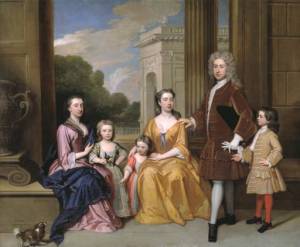
Sir Godfrey Kneller, "The Harvey Family," 1721 (Tate Britain)
This conference will showcase some of the latest scholarship on art and artists in this dynamic period. Focusing on the detailed study of works of art, the event is designed to open up new perspectives on their place within British culture. This is the second of a series of major scholarly events hosted by the AHRC-supported research project Court, Country, City: British Art 1660-1735. This three-year project runs from October 2009 to September 2012, and is led by Professor Mark Hallett of the University of York and Professor Nigel Llewellyn and Dr Martin Myrone of Tate Britain.
- Anthony Geraghty (University of York), Robert Streeter at the Sheldonian
- Helen Pierce (University of Aberdeen), Francis Barlow: The political animal
- Christine Stevenson (Courtauld Institute), Court, city, cosmos: meditations of London’s second Royal Exchange
- Sarah Monks (University of East Anglia), Drawing fire: the van de Veldes, and the imagery and implications of late Stuart naval conflict
- Jacqueline Riding (University of York), Joseph Highmore’s ‘David Le Marchand’ and the search for Kneller’s heir
- Mark Hallett (University of York), Genres and Transformations: Reflections on the first ‘Court, Country, City’ display
The conference is free, but you must register to attend. Please email Clare Bond, at cecs1@york.ac.uk, or write to the Centre for Eighteenth Century Studies, University of York, The King’s Manor, Exhibition Square, York Y01 7EP, with your name, address, and affiliation, if any.
There will be an opportunity at lunch time to see the Court, Country, City Display in Room 3 (see below).
◊ ◊ ◊ ◊ ◊
Court, Country, City: British Art 1660-1735
Tate Britain, November 2010 — November 2011

Edward Collier, "Still Life," 1699 (Tate Britain)
This display introduces a major new research project, Court, Country, City: British Art 1660-1735, which will explore how the visual arts developed in these years. The period 1660-1735 was a dramatic time. Many people’s lives were transformed by the restoration of the monarchy, the establishment of a modern economy and government, and the expansion of global trade and empire. In art historical terms, the period covers the time between the appointment of Peter Lely as court painter to Charles II, and the emergence of a new form of modern British art with Hogarth and the St Martin’s Lane Academy in the 1730s.
The ways in which art was commissioned, practiced, viewed and experienced changed dramatically over these decades, as the balance of power between the Court (centred on the monarch), the Country (the land-owning elite) and the City (the urban middle class) shifted. The display divides paintings into groups according to genre – history, portraiture, landscape and still life. These groups may suggest how the
styles and forms of art changed between 1660 and 1735.
The research team would welcome your comments about the works of art you see here, and what you think they tell us about this key period of British history. Please send comments to cccresearch@tate.org.uk. The display can be seen in Room 3, Tate Britain, London, from November 2010 to November 2011.
Additional information and links to the images included in each genre are available here»
Conference: The Material Countours of Knowledge
from the ISECS site:
• Inscriptions: The Material Contours of Knowledge, March 10-11 2011, University of California, Riverside. This conference will explore the material dimensions of inscribed knowledge across modern disciplinary lines, featuring talks by scholars in History, Literature, Digital Humanities, Geography, Music and Art History. The speakers will collectively address the role of material inscription in the formation, or deformation, of knowledge from roughly 1660-1850. Kinds of inscription that we will consider include manuscripts, drawings, maps, graffiti, archives, books and other objects. We will also consider the physical circuits and practices (i.e., manual, technological, social, institutional) through which such inscriptions traveled. Free registration is now open on the conference website. “Inscriptions” is part of the international series of six events, “The Disorder of Things: Predisciplinarity and the Divisions of Knowledge,” a collaborative network jointly organized by faculty in the University of California, Riverside and Birkbeck, University of London. Faculty Organizer: Professor Adriana Craciun (adrianac@ucr.edu). [Conference website]
Conference at Versailles: The Sciences at Court
The following conference at Versailles has been organized in conjunction with the current exhibition, Sciences and Curiosities at the the Court of Versailles. From the Château de Versailles website:
La cour et les sciences : naissance des politiques scientifiques dans les cours européennes aux XVIIe et XVIIIe siècles
Galerie basse du château de Versailles, 3-5 February 2011

Henri Testelin, "Colbert présente à Louis XIV les membres de l’Académie royale des sciences crée en 1667," Versailles (MV2074). © RMN (Château de Versailles) / Gérard Blot
La cour, siège du pouvoir et lieu de concentration des capitaux, a toujours soutenu la recherche scientifique tandis que cette dernière devait servir les intérêts généraux du pays et la gloire de son souverain. Dans ce colloque, il s’agira essentiellement d’étudier les politiques scientifiques volontaristes ou non des États européens sous l’Ancien Régime en s’attachant particulièrement à la recherche « fondamentale » et à la recherche « utile » (amélioration de la santé, lutte contre la famine, progrès des techniques, des constructions et des bâtiments, etc.). Volontairement comparatistes, les études engloberont l’ère géographique européenne à travers trois axes : le financement des sciences et des scientifiques, la communauté scientifique
face à la cour et, enfin, la diffusion et la culture scientifique à la
cour.
PROGRAMME (more…)










leave a comment