Exhibition | Mark Catesby: Watercolours from the Royal Collection
From the Royal Collection:
Mark Catesby: Watercolours from the Royal Collection
Gainsborough’s House, Sudbury, Suffolk, 6 July — 12 October 2013

Mark Catesby, The Bald Eagle, watercolour and bodycolour heightened with gum arabic over pen and ink, ca.1722-26
(Royal Collection 924814)
Watercolours of birds, fish and exotic flora painted by British naturalist Mark Catesby (1682–1749) go on display at Gainsborough’s House in Sudbury, Suffolk, from 6 July. The 27 works lent by Her Majesty The Queen from the Royal Collection were acquired by George III in 1768, when the King purchased Catesby’s original illustrations for Natural History of Florida, Carolina and the Bahama Islands.
Catesby, who was raised and educated in Sudbury, showed a passion for natural history from a young age. After his father died, leaving him a sufficient income, Catesby made extended trips to the east coast of North America from 1712, travelling to Virginia, Carolina, Florida and also to the West Indies.
At the time, there was a burgeoning garden culture in Britain, fuelled by the introduction of plant species from the Near East. This ignited Catesby’s desire to produce a comprehensive study of the flora and fauna native to the eastern seaboard of North America. He collected seeds, animals and botanical specimens during his travels and made detailed drawings along the way. Catesby returned to England in 1726 and began work preparing the plates and text for his Natural History of Florida, Carolina and the Bahama Islands, the first major publication on the subject. The Natural History was issued in parts between 1729 and 1747.
In 1768, George III purchased Catesby’s original watercolours for the Natural History and had them bound into a three-volume set of the publication (rather than the usual two), in the place of the printed illustrations. In more recent times, the watercolours were removed from the volumes for conservation reasons and individually mounted.
Among the studies on display at Gainsborough’s House is The Bald Eagle, which Catesby placed at the beginning of the first volume of Natural History. It was rare for the artist to introduce drama into his compositions, but in this work the eagle is shown swooping to catch a fish which has been dropped by an osprey above.
Exhibition | Threads of Feeling in Williamsburg
This exhibition, organized by The Foundling Museum, was on view in London from October 2010 to March 2011. Through next May, it can be seen in Williamsburg (perfect timing for next year’s ASECS meeting). From the press release (17 May 2013) . . .
Threads of Feeling: The London Foundling Hospital’s Textile Tokens, 1740–1770
DeWitt Wallace Decorative Arts Museum, Colonial Williamsburg, 25 May 2013 — 26 May 2014
Curated by John Styles
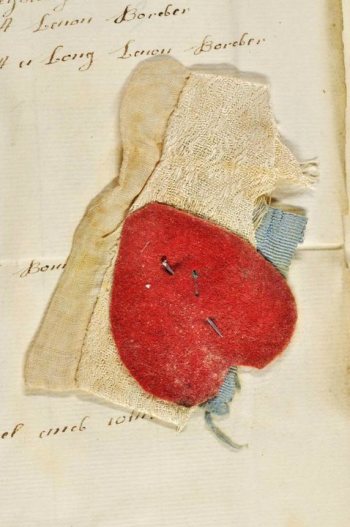 Each piece of fabric or token tells a poignant, emotional story from more than 200 years ago. Many of those stories are on view at the Art Museums of Colonial Williamsburg in a traveling exhibition organized by the Foundling Museum of London. Threads of Feeling consists of 59 books of textile tokens on loan from the Thomas Coram Foundation, a British children’s charity.
“These stories pack powerful, emotional punches, sure to resonate with parents,” said Ronald Hurst, Colonial Williamsburg’s chief curator and vice president for collections, conservation and museums. “We are pleased to have the only mounting of the exhibition in the United States since it closed in London two years ago.”
In the cases of more than 4,000 babies left at London’s Foundling Hospital between 1741 and 1760, a small object or token, usually a piece of fabric, was kept as an identifying record. The fabric was either provided by the mother or cut from the child’s clothing by the Foundling Hospital’s nurses. Attached to registration forms and bound up into ledgers, these pieces of fabric form the largest collection of everyday textiles surviving in Britain from the 18th century. A selection of the textiles and the stories they tell us about individual babies, their mothers and their lives form the focus of the Threads of Feeling exhibition. The exhibition also examines artist William Hogarth’s depictions of the clothes, ribbons, embroidery, and fabrics worn in the 18th century as represented by the textile tokens.
“The process of giving over a baby to the Foundling Hospital was anonymous,” said exhibition curator John Styles, research professor in history at the University of Hertfordshire. “It was a form of adoption. The Foundling Hospital became the infant’s parent and its previous identity was erased.”
The mother’s name was not recorded, but many left personal notes or letters exhorting the hospital to care for their child. Occasionally children were reclaimed, and the pieces of fabric in the ledgers were kept with the expectation that they could be used to identify the child if it was returned to its mother. The textiles are beautiful and poignant, embedded in a rich social history. Each swatch reflects the life of a single infant child. The textiles also indicate the types of clothing their mothers wore. Many clothes for babies were usually made up from worn-out adult clothing and the fabrics reveal how working women struggled to be fashionable in the 18th century.
Museum guests also are invited to participate in several programs related to the exhibition:
• Textiles and accessories can be much more than just material objects. Guests create their own memory token during Tokens of Affection. Like those in the Threads of Feeling exhibition, their creations tell their own unique stories. Presented 11 am – noon, Tuesdays and Fridays, June 18 – August 30.
• Open Drawers: Treasured Textiles from Colonial Williamsburg. Guests drop in to get a closer look at the new exhibition, Threads of Feeling and then peer into the textile study drawers and examine related clothing and needlework from Colonial Williamsburg’s collections. Presented 2–3 pm, Mondays, June 3 – August 26.
• Lives Lost and Found. Guests go behind the scenes of Threads of Feeling on a guided tour, examine the textiles on view and discuss the historical and emotional stories behind these textile tokens from the Foundling Hospital in London and the Colonial Williamsburg collection. Space is limited and a $10 ticket is required in addition to museum admission. Presented 9 – 10:30 am, Tuesdays and Fridays, June 18 – August 30.
The conference symposium, Threads of Feeling Unraveled, takes place 20–22 October 2013.
Exhibition | Charakterköpfe: Portrait Busts in the Enlightenment
From the museum’s 2013-14 exhibition schedule:
Charakterköpfe: Die Bildnisbüste in der Epoche der Aufklärung
Germanisches Nationalmuseum, Nuremberg, 6 June — 6 October 2013
Curated by Frank Matthias Kammel and Anna Pawlik
 The portrait bust is one of the most fascinating genres of sculpture. It was particularly adaptable to the varieties of concurrent artistic styles prevalent at the end of the 18th century. Portraits of rulers, burghers, artists and intellectuals were oriented towards idealized images, towards the antique, or presented the subject in unidealized, haunting realism. Often they show consideration of the interconnectedness between physiognomy and personality. Through the presentation of sculptural masterpieces, this exhibition illuminates a major facet of a politically and spiritually fascinating era, and not least will convey a lively image of the Enlightenment’s novel interest in the individual.
◊ ◊ ◊ ◊ ◊
From the Germanisches Nationalmuseumm:
Die Porträtbüste ist eine der faszinierendsten Gattungen der Bildhauerkunst. Ende des 18. Jahrhunderts war sie von der Gleichzeitigkeit gegensätzlicher Stile bestimmt wie in kaum einer anderen Epoche zuvor. Bildnisse von Regenten, Bürgern, Künstlern und Gelehrten orientieren sich an Idealbildern, an der Antike oder stellen den Porträtierten ungeschönt, in einem packendem Realismus dar. Nicht selten spiegeln sie Überlegungen zur Abhängigkeit von Gesichtzügen und Charakter wider. Die Ausstellung präsentiert dieses breite Spektrum anhand plastischer Meisterwerke zahlreicher bedeutender Künstler wie Johann Heinrich Dannecker, Franz Xaver Messerschmidt, Johann Valentin Sonnenschein oder Johann Gottfried Schadow. Namhafte Geistesgrößen der Zeit, wie Goethe, Herder, Pestalozzi oder Winckelmann, erscheinen in Glanzleistungen früher realistischer und klassizistischer Strömungen der Bildhauerei. Flankiert von zeitgenössischer Graphik und Malerei vermittelt die Ausstellung eine lebhafte Vorstellung von einem damals neuartigen Interesse am Bild des Menschen.
Frank Matthias Kammel, Charakterköpfe: Die Bildnisbüste in der Epoche der Aufklärung (Nürnberg: Germanisches Nationalmuseum, 2013), 244 pages, ISBN: 978-3936688757, €33.
Exhibition | Prized and Played: The Jon Crumiller Chess Collection
From the World Chess Hall of Fame:
Prized and Played: Highlights from the Jon Crumiller Collection
World Chess Hall of Fame, St Louis, 3 May 2013 — 15 September 2013
Prized and Played showcases over 80 beautiful, antique chess sets from across the centuries and around the world, as well as many interesting artifacts related to the history of chess.

East India ‘John’ Company Chess Set, ca. 1800–1850,
Berhampore, India, ivory. King is 5 1/2 inches high.
(Jon Crumiller Collection). Photo © Bruce M. White, 2013
◊ ◊ ◊ ◊ ◊
Prized
Intended to be shown as objets d’art rather than used in play, ornamental chess sets are testaments to the artistic skill of their creators, as well as the refinement of the wealthy patrons who commissioned them. Freed from the confines of practicality, artists created chess sets of great beauty and originality. Master carvers flaunted their expertise in manipulating luxury materials such as ivory, gold, silver, pearls and precious stones in these ornamental chess sets. Many feature elaborate gilded decoration, delicate carving, and tall forms that made them less than ideal for playing, but perfect as demonstrations of wealth, or as a generous gift for a friend.

Dieppe Europeans vs. Africans Ivory Chess Set, ca. 1800, Dieppe, France, Ivory. King is 3 1/4 inches (Jon Crumiller Collection)
Photo © Bruce M. White, 2013
Ornamental sets were also symbols of the erudition and sophistication of their owners. Several of the ornamental sets in this show have themes drawn from history, mythology, or religion. The Good Versus Evil set contains bishops holding copies of Dante Alighieri’s The Inferno, while another set pits Venus and Bacchus, two figures from Roman mythology, against each other. Other artists turned to contemporary military conflicts for inspiration. The army of the British East India Company combats Indian military forces in John Company sets, while other sets celebrated the exploits of Emperor Napoleon. Ornamental sets could also show that a person was well-traveled. A set from Dieppe, France, where master carvers produced lovely ivory products could indicate the owners had traveled to the popular resort town. Swiss Charlemagne sets, produced in Brieze, Switzerland, were also marketed to tourists in catalogues. These sets were so prized by their owners that, despite their delicate nature and rich materials, they have survived centuries later as examples of the excellent craftsmanship of their makers. They continue to be valued, not only for their aesthetic qualities, but also for the fascinating stories they tell.
Played

François-André Danican Philidor, L’Analyze des échecs (London: 1749)
Photo © Bruce M. White, 2013
In Prized and Played, superb examples of antique playing sets from across Europe and Asia illuminate the fascinating history of stylistic evolution of chess pieces. Though some of the sets in this half of the exhibition feature elaborate decoration, they were all intended for use in play. Their widely varied appearances testify to the imagination and stylistic preferences of the artisans who created them, as well as the artistic tastes of the players who used them over the centuries. They were made of durable materials like wood, ivory, bone, and metal so that players could regularly use them for play over many years. While the style of the simple, brightly colored, and dome-topped Islamic sets in the show stands in contrast to that of the European sets, diverse styles of playing sets were often manufactured within the same country. Some examples include the Directoire, Régence, and Lyon style sets produced in France, or the Barleycorn and Northern Upright style sets manufactured in England.
The nineteenth century brought the rise of modern organized chess tournaments and clubs, which highlighted the need for standardized chess pieces. The regional styles that had proliferated in previous centuries led to confusion and contention when the great players of numerous nations gathered to compete. Prominent chess manufacturers in early-to-mid-nineteenth century England began to stabilize the designs of playing sets into recognizable precursors of the sets we use today. John Calvert set up shop in 1791 at 189 Fleet Street, London, and mass-produced several designs that grew in popularity. These designs, as well as fancier playing sets imported and sold by James Leuchars and other retailers in the initial years of the nineteenth century, influenced subsequent well-known London chess manufacturers such as George Merrifield, Thomas Lund and his son William, and Charles Hastilow.
Finally, the iconic Staunton chess set, designed by architect Nathaniel Cooke and endorsed by the famous English player Howard Staunton, emerged during this period. The sets were first manufactured and sold in 1849 by John Jaques and Son, Ltd, of London, and later became the standard for tournament play. (more…)
Exhibition | Paintings by Hubert Robert from the Musée de Valence
Now on view at the Petit Palais:
Tableaux d’Hubert Robert du Musée de Valence
Le Petit Palais, Paris, May — October 2013
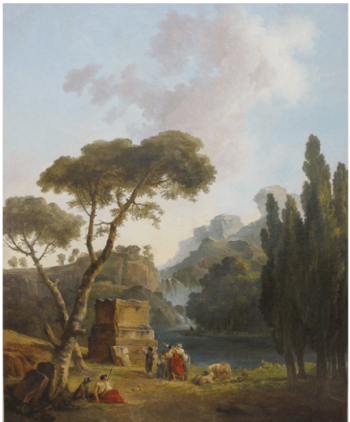
Hubert Robert, Paysage de cascade avec les bergers d’Arcadie
© Musée de Valence, photo Eric Caillet
En avant-première de la réouverture en décembre prochain du musée de Valence (Drôme), quatre des plus beaux tableaux d’Hubert Robert (1733–1808) sont présentés au Petit Palais, aux côtés des dix tableaux de l’artiste des collections permanentes.
Peintre par excellence des ruines de la Rome antique, Hubert Robert séjourna onze ans dans la ville des papes, à partir de 1754. Il en cultiva le souvenir jusqu’à la fin de sa carrière bien qu’il ait été également un chroniqueur inlassable du Paris du XVIIIe siècle. Hubert Robert a enchanté ses contemporains par sa verve, sa poésie et son inventivité – qualités qui ne pouvaient qu’enthousiasmer un critique comme Diderot. Le succès de ses paysages lui valut même la commande de plusieurs jardins qu’il peupla de « fabriques » et de grottes à la manière des tableaux qui avaient fait sa célébrité.
Connu pour sa collection incomparable de dessins d’Hubert Robert offerte par l’amateur Julien-Victor Veyrenc en 1836, le musée de Valence s’est attaché depuis plus d’une vingtaine d’années à étoffer ce fonds par l’acquisition de toiles significatives de l’artiste. L’ensemble formera un des centres de gravité du musée de Valence dont la rénovation, confiée à l’atelier d’architecture Jean-Paul Philippon, est en voie d’achèvement. Le prêt exceptionnel de quelques-uns de ses fleurons à Paris est l’occasion de les faire dialoguer avec les toiles conservées au Petit Palais. Ainsi la vue de la basilique Saint-Pierre du musée de Valence, cadrée de façon audacieuse à travers une baie, rejoint la toile vivement esquissée du Petit Palais montrant un Sculpteur sur un échafaudage dans la nef de Saint-Pierre. Le vaste Paysage de cascade avec les Bergers d’Arcadie, de Valence, est présenté dans la rotonde avec deux grandes toiles tirées des réserves du Petit Palais provenant du décor de l’hôtel Beaumarchais exécutés l’année suivante. A cette occasion, l’ensemble des salles du XVIIIe siècle du musée ont d’ailleurs été réaccrochées et des oeuvres d’autres artistes remises en valeur.
En attendant de parcourir les nouveaux espaces de l’ancien évêché de Valence, ce prêt de quelques mois est aussi une invitation à redécouvrir les galeries du XVIIIe siècle du Petit Palais – musée des Beaux-Arts de la Ville de Paris qui, rappelons-le, sont ouvertes gratuitement au public.
Le Petit Palais est heureux de soutenir la rénovation et l’extension du Musée de Valence. Pour plus d’information, téléchargez le communiqué de presse.
Exhibition | Quilts 1700–1945
From the QAG press release (14 June 2013) . . .
Quilts 1700–1945
Queensland Art Gallery, Brisbane, 15 June — 22 September 2013
Curated by Sue Prichard

Coverlet with sundial, cotton, 1797
(London: Victoria and Albert Museum)
An exhibition of historic British quilts from London’s Victoria and Albert Museum (V&A) is now on view at the Queensland Art Gallery, presenting enthralling social histories and personal stories of more than 200 years of quiltmaking and patchwork. The exhibition includes more than 35 hand-crafted textiles created to provide comfort and commemorate historical events and family occasions between 1690 and 1945, plus a host of associated material such as pin cushions, needlework tools and sewing baskets.
The works come primarily from the esteemed collection of the V&A, the world’s leading decorative arts and design museum. Select pieces have travelled from British regional museums and private collections, and there is the special addition of the much-admired Rajah quilt of 1841, sewn by convict women during transportation to Van Diemen’s Land, on loan from the National Gallery of Australia.
Divided into four thematic sections, the exhibition explores the domestic landscape of the wealthy bedrooms of 18th-century Britain; the private thoughts and political debates that emerged as patchwork spread to aspirational middle class homes in the early 19th century; the movement of quilts to the public sphere for exhibition and display in Victorian England; and the survival of quiltmaking in economically deprived areas in the face of the emergence of mass production in the early 20th century.
“The exhibition has been curated for QAG by Sue Prichard, Curator of Contemporary Textiles at the V&A, based on the popular exhibition Quilts 1700–2010: Hidden Histories, Untold Stories, presented in 2010 at the V&A,” explained Director Chris Saines.
The exhibition is accompanied by the 196-page publication Quilts 1700–1945, a co-edition from QAGOMA and the V&A.
Exhibition | Witches and Wicked Bodies
Press release (10 December 2012) from the Scottish National Gallery of Modern Art:
Witches and Wicked Bodies
Scottish National Gallery of Modern Art, Edinburgh, 27 July — 3 November 2013
 The fascination for witches, which has gripped many Western artists from the sixteenth century to the present, will be the subject of a major new exhibition at the Scottish National Gallery of Modern Art this summer. Witches and Wicked Bodies, will delve into the dark and cruel origins of the classic image of the witch, and demonstrate how the now familiar old woman on a broomstick is just one part of a rich and very diverse visual tradition.
Witches and Wicked Bodies will highlight the inventive approaches to the depiction of witches and witchcraft employed by a broad range of artists over the past 500 years, with striking examples by famous names such as Albrecht Dürer, Lucas Cranach, Salvator Rosa, Francisco de Goya, Henry Fuseli, John William Waterhouse and William Blake. The selection will also include more recent interpretations of the subject, by twentieth-century and contemporary artists including Paula Rego, Kiki Smith and Edward Burra. The exhibition has been curated by the National Galleries of Scotland with artist and writer Deanna Petherbridge and will contain major works on loan from the British Museum; the National Gallery (London); the Ashmolean Museum, Oxford; Tate; and the Victoria & Albert Museum, to be shown alongside key images from the Royal Scottish Academy and the Galleries’ own collections.
John Leighton, Director General of the National Galleries of Scotland, said: “We look to offer our public a world-class yet very distinctive programme of exhibitions. I believe that this is the first time that witchcraft across the ages has been the subject of a major art exhibition in the UK and we are delighted to be partners with the British Museum on this truly fascinating and compelling show.”
Europe has a long history of witchcraft and the persecution of witches was particularly widespread in the sixteenth and seventeenth centuries, accounting for thousands of deaths of women and even children. Prints and drawings dating from this period will form a key part of the exhibition, showing how the advent of the printing press gave artists as well as writers the means to share ideas, myths and fears about witches from country to country. Engravings by Albrecht Dürer will be shown alongside woodcuts by Hans Baldung Grien and many other printmakers including Bruegel and de Gheyn.

Paul Sandby, The Flying Machine from Edinburgh in One Day Performed by Moggy Mackenzie at the Thistle and Crown, etching, 1762. The print satirizes Scottish emigration to England.
Photograph: National Galleries of Scotland
The exhibition will focus on six key themes. The centrepiece of Witches’ Sabbaths and Devilish Rituals is one of the most famous images of witches of all time – Salvator Rosa’s Witches at their Incantations on loan from the National Gallery (London). Unnatural Acts of Flying will include the origins of the image of the witch as an old woman riding a broomstick against a night sky, but rather than the cloaked figure wearing a pointy hat that has become so widely known to adults and children alike, this section features more sinister images of flying witches attending black masses.
In Magic Circles, Incantations and Raising the Dead, visitors will encounter glamorous witches cooking up spells as in Frans Francken’s 1606 painting Witches’ Sabbath. This powerful section also includes the luscious 1886 painting by John William Waterhouse, The Magic Circle. Hideous Hags and Beautiful Witches will include the medusa-like witch with snakes for hair in John Hamilton Mortimer’s drawing Envy and Distraction. This introductory section will also feature unsettling works depicting old crones by Francisco de Goya – the exhibition contains a significant group of works by this major Spanish artist. Some of the images are genuinely frightening and disturbing, whereas others will reveal the negative attitudes towards women in periods when they were very much seen as the second sex. Due to the particular association of women with witchcraft, these works will highlight the ways in which a largely male-dominated European society has viewed female imperfections, highlighting the concerns created by women laying claim to special powers, or simply behaving in the ‘wrong’ way.

Daniel Gardner, The Three Witches from Macbeth (Elizabeth Lamb, Viscountess Melbourne; Georgiana, Duchess of Devonshire; Anne Seymour Damer), pastel on paper, 1775 (London: NPG)
Works depicting the various appearances of the witches in Shakespeare’s Macbeth, in Unholy Trinities and The Weird Sisters from Macbeth, will range from John Martin’s theatrical large-scale painting of Banquo and Macbeth lost on the blasted heath, with the turbulent skies swirling over exaggerated mountains, through to John Runciman’s striking drawing which here is interpreted as the Three Witches conspiring over Macbeth’s fate.
This fascinating thematic survey will culminate with The Persistence of Witches. Works by Kiki Smith and Paula Rego mark a sea-change with these high-profile contemporary artists’ own take on a subject that had previously been almost exclusively male-dominated. In Smith’s study Out of the Woods, the artist herself explores the expressions and attitudes of the ‘witch’, whereas Rego’s 1996 work Straw Burning relates to the famous Pendle Witch trials which took place in 1612 in Lancaster, 400 years ago.
The exhibition has been organised in partnership with the British Museum, whose loans will include William Blake’s magnificent drawing The Whore of Babylon which will be shown alongside the National Galleries’ own Blake drawing, once thought to depict Hecate, the classical witch of the crossroads. Witches and Wicked Bodies will be an investigation of extremes, exploring the highly exaggerated ways in which witches have been represented, from hideous hags to beautiful seductresses who ‘bewitch’ unwary men.
Writing for The Guardian (22 March 2013), Charlotte Higgins provides a useful introduction»
◊ ◊ ◊ ◊ ◊
From ACC Distribution:
Deanna Petherbridge, Witches & Wicked Bodies (Edinburgh: National Galleries of Scotland, 2013), 112 pages, ISBN: 978-1906270551, £15.
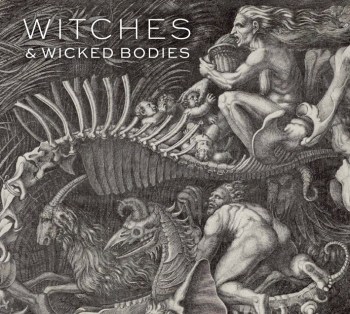 Witches & Wicked Bodies provides an innovative, rich survey of images of European witchcraft from the sixteenth century to the present day. It focuses on the representation of female witches and the enduring stereotypes they embody, ranging from hideous old crones to beautiful young seductresses. Such imagery has ancient precedents and has been repeatedly re-invented by artists over the centuries, to include scenes with corpses and cauldrons, caverns and kitchens, and the dead being raised through demonic or satanic rites – all inversions of an ordered and religious social world.
Petherbridge introduces this fascinating subject and includes catalogue entries on each of the exhibited works. The illustrations primarily feature drawings and prints as well as a group of important paintings. A wide range of artists is represented including Dürer, Goya, Fuseli, Blake, Burra and Rego.
Deanna Petherbridge CBE is an artist, curator and writer. Her book The Primacy of Drawing: Histories and Theories of Practice (Yale University Pres)s, was published June 2010. She was Visiting Professor of Drawing at the University of the Arts London from 2009 to 2012 and was Professor of Drawing at the Royal College of Art from 1995 to 2001 where she launched the Centre for Drawing Research. Between 2002 and 2006 Petherbridge held a post as Arnolfini Professor of Drawing at the University of the West of England, Bristol and a two year Research Professorship at the University of Lincoln from 2007 to 2009.
Exhibition | Northern Vision: Master Drawings
From the Soane’s Museum:
Northern Vision: Master Drawings from the Tchoban Foundation
Sir John Soane’s Museum, London, 21 June – 28 September 2013
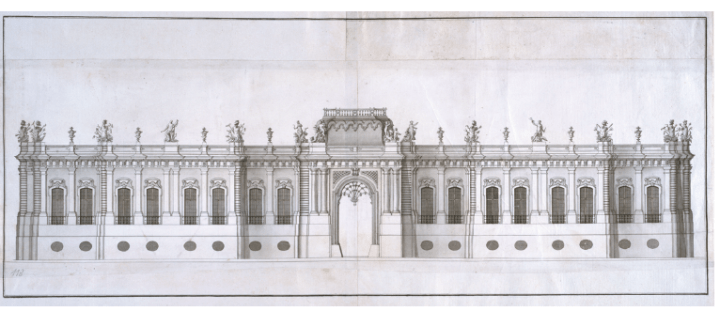
Matthäus Daniel Pöppelmann (1662–1736), Project for the Orangerie
of the Peterswalsky von Peterswald Palace, Silesia, undated
(Berlin: Tchoban Foundation)
◊ ◊ ◊ ◊ ◊
From Schinkel’s earliest attributed drawing to designs for the Palace of the Soviets, Moscow, this exhibition draws on the highlights of the Tchoban Foundation collection, Museum für Architekturziechnunung, Berlin. Amongst the architects represented will be seldom seen works by Matthias Daniel Pöppelmann (1662–1736), Leo von Klenze (1784–1864), Herman Giesler (1898–1987) and Boris Iofan (1891–1976). The Tchoban Foundation has been set up by the Russian Berlin-based architect Sergei Tchoban and the collections reflect his personal, architectural interests.
The exhibition includes drawings by Sergei Tchoban illustrating his practice’s interest in the continued use of architectural draughtsmanship. Many of these drawings also reflect the distinctive and historical cityscapes of Berlin and Sergei Tchoban’s native St Petersburg.
The 41-page guide (with wall text and images) is available as a PDF file here»
The catalogue is available from the museum shop»
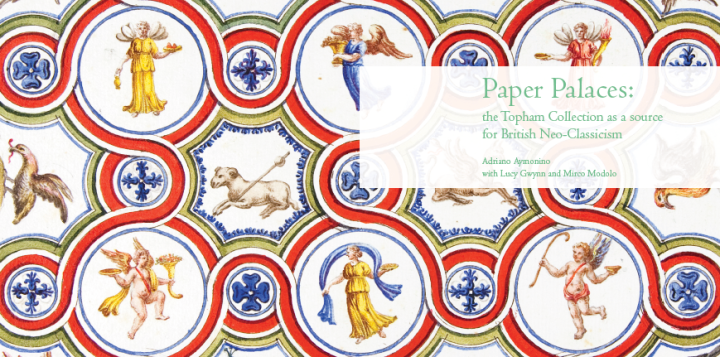
Exhibition Catalogue | Paper Palaces: The Topham Collection
◊ ◊ ◊ ◊ ◊
Adriano Aymonino with Lucy Gwynn and Mirco Modolo, Paper Palaces: The Topham Collection as a Source for British Neo-Classicism (Windsor: Eton College, 2013).
Exhibition on view from May until November 1, 2013 at The Verey Gallery, Eton College Library.
I’m delighted to announce that the 56-page catalogue for Paper Palaces is available free of charge for download as a PDF file here. Warm thanks to the exhibition organizers for their generous cooperation. -CH
Recent TLS Reviews (5 July 2013)
The eighteenth century in The Times Literary Supplement (5 July 2013). . .
Angus Trumble, “Six Half-Lengths: Review of James Stourton and Charles Sebag-Montefiore, The British as Art Collectors, From the Tudors to the Present (Scala, 2012),” TLS (5 July 2013), pp. 3-4.
 . . . The British as Art Collectors, liberally and beautifully illustrated, sets out the history of the art-collecting impulse in Britain from the beginning of the sixteenth century to the present. Shaping it into four densely packed, chronological sections, James Stourton and Charles Sebag-Montefiore deal, first, with “Royalty” (in other words, collecting at Court, above all the assembly and dispersal of the superb collection of King Charles I at Whitehall); “Aristocracy” (the principally eighteenth-century Whig Grand Tour and country-house phenomena which Quatremère de Quincy had in mind); “Plutocracy” (the transitional period brought about by the displacement effects of the French Revolution and the Napoleonic Wars); and, finally, “Democracy” (which concerns the arrival of the public art museum in the early nineteenth century, its proliferation, and the gradual institutionalization, professionalization and broadening of the collecting impulse into our time).
But this is an over-simplification, for the history of collecting is really the history of individual shoppers, and, occasionally, partnerships or syndicates such as that of the coal and canal magnate the third Duke of Bridgewater, with budgets ranging from the merely large to the positively obscene, and not necessarily husbanded with corresponding degrees of wisdom. It is also the history of sweatypalmed acquisitiveness, of rapacious greed, and also of processes of dissolution and loss – an invariably human story in which mostly anonymous crate-makers, removalists and shipping agents must figure prominently, while debt, disease, dispossession and death often interrupted grand schemes. . .
Perhaps the principal pleasure of The British as Art Collectors . . is the intelligence and effectiveness with which a mass of contemporary illustrative material is marshalled to open a window onto cultural worlds. If at times the text is weighed down by lengthy descriptions of who owned what when, there is also a wealth of information, current and historical, in purely visual form. . .
The full review is available here (subscription required)
◊ ◊ ◊ ◊ ◊
Albert Rivero, “Truths to Life: Review of John Bender, Ends of Enlightenment (Stanford University Press, 2012),” TLS (5 July 2013), p. 12.
 The publication of Imagining the Penitentiary in 1987 established John Bender as a compelling critic of eighteenth-century British literature and culture. That book, written in imitation of Michel Foucault, connected novels by Daniel Defoe and Henry Fielding to the panoptic model of incarceration that was then emerging. Since then, Bender has published a number of important and groundbreaking essays, ranging widely and often brilliantly over various topics and disciplines. Ends of Enlightenment gathers ten of those essays, grouped under three headings (Enlightenment Knowledge, Enlightenment Novels and Enlightenment Frameworks), with a framing introduction elucidating their common themes and concepts. . .
Novelistic realism has a dark ideological side, but not all essays here cast a suspicious eye on Enlightenment. In its ideal quest for universal and objective knowledge, available in conversation and in print to men and women from every walk of life (Jürgen Habermas’s “public sphere,” a construct Bender invokes frequently), the Enlightenment had many salutary effects. Some of these, in fragmentary and surprising ways – Bender regards the democratically composed Wikipedia as today’s version of Diderot and d’Alembert’s Encyclopédie – are still very much with us.
It is in fact the sceptical David Hume who has displaced Foucault as Bender’s principal point of reference, and who inspires the modes of inquiry and ordering knowledge in Ends of Enlightenment. . .
The full review is available here (subscription required)
◊ ◊ ◊ ◊ ◊
James Hall, “Fade to Grey: Review of the exhibition Paper Palaces: The Topham Collection as a Source for British Neo-Classicism, Eton College Library,” TLS (5 July 2013), pp. 17-18.
 . . . Expertly curated by Lucy Gwynn and Adriano Aymonino, Paper Palaces explores the influence exerted on architect-designers by illustrations of antique decorative painting commissioned by Richard Topham (1671-1730), Old Etonian antiquary and MP for Windsor. . .
The exhibition suggests Topham was rather more single-minded and original than Pope would have us believe, even if he did use agents in Italy to amass his roughly 2500 documentary drawings of Roman antiquities. Topham’s was the largest and most systematic collection of its kind in England, unique in being organized by location like a tourist guidebook, with every drawing clearly indexed in his own
hand. . .










leave a comment