Call for Papers | Understanding British Portraits 2014 Seminar
From the Understanding British Portraits website:
Understanding British Portraits Annual Seminar 2014
National Portrait Gallery, London, 26 November 2014
Proposals due by 13 June 2014
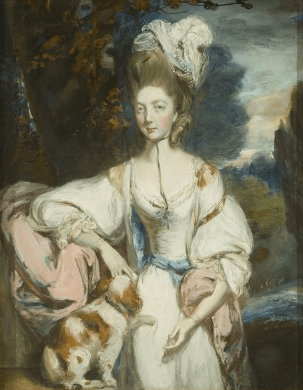
Mrs Henchman by Daniel Gardner (?1750-1805), drawing and watercolour © Bristol Musuem & Art Gallery
The ‘Understanding British Portraits’ Annual Seminar aims to highlight current scholarly research, museum-based learning programmes, conservation discoveries and curatorial practice relating to British portraits of all media and time periods. This year’s Annual Seminar will be held at the National Portrait Gallery, London, on Wednesday 26 November.
We invite proposals for 20/25 minute-papers from professionals who would like to share case studies and ideas which relate to the aims of the seminar as given above. Please send an outline of approximately 200 words, along with a brief biographical note, to mail@britishportraits.org.uk before Friday 13 June. Those who have submitted papers for consideration in the past are very welcome to do so again this year.
Understanding British Portraits is an active network with free membership for professionals working with British portraits including curators, museum learning professionals, researchers, academics and conservators. They aim to enhance the knowledge and understanding of portraits in all
media in British collections, for the benefit of future research,
exhibitions, interpretation, display and learning programmes.
Display | The Flowering of American Tinware

Tray, made in Pontypool, Wales or Birmingham, England, 1740–60
(Winterthur: Bequest of H.F. du Pont, 1958.2282)
From Winterthur:
The Flowering of American Tinware
Winterthur Museum, Delaware, 18 May 2013 — 4 May 2014
Tinware objects with lively, bright colors and hand painted with fruit, flowers, birds, and borders were once ubiquitous in the young United States. The base material, sheet iron coated with tin, provided an appealing surface for painted or punched ornament to be applied. At first glance, it may look like amateur artwork, but this exhibition examines the professional and practical roots of a material that is still produced by artists today.
The story of antique tinware may be surprising. Useful household objects were created by tinsmiths for myriad home and work purposes, such as to keep paperwork or tobacco dry and safe, to hold dry or liquid cooking ingredients, or to support a candle for light. Tinware objects that survived were often decorated ones, although, unpainted, shiny white tinware once was even more prevalent. American painted tinware has origins in an industry that emerged in the late 1690s in Britain with artistic influences coming from lands as far away as China and Japan.
During that time of developing sea-born trade, imported lacquerwork and other goods from Asia became very desirable to Europeans consumers who could afford them. Experiments in Wales and England led to ‘japanned’ varnishes and colorants that could be baked directly on to the surface of tinware, creating opaque, dark coatings that resembled more expensive imported lacquerwork. Soon after, the colors and designs prevalent in local decorative arts were added with oil paints to ‘flower’ or enhance tinware’s appeal to new markets in Europe and America. This Western process was generically called ‘japanning’, and Americans used the term to describe all manner of painted and varnished items.
This pocket-size exhibition highlights the collection of decorated tinware that Henry Francis du Pont acquired from antiques dealers in New England and Pennsylvania, particularly from Ephrata, Lancaster, Carlisle, and York. These beautiful, hand-painted objects feature decorative techniques that have been in use from the early 1700s to today.
The exhibition website is available here»
Call for Papers | L’architecture des ingénieurs, 1650–1850
From the Call for Papers:
L’architecture des ingénieurs, 1650–1850
Galerie Colbert, Paris, 8 November 2014
Proposals due by 15 May 2014

Jacques-Pierre-Jean Rousseau, ingénieur des ponts et chaussées, puis architecte de la ville d’Amiens, reliefs de la façade du théâtre de la ville, 1778, Archives départementales de la Somme
Organisée par les universités Bordeaux III, Paris-Sorbonne, Paris-Ouest, avec le concours du GHAMU
Les années 1980 furent propices à l’étude du travail des ingénieurs : en 1981, Anne Blanchard publiait un Dictionnaire des ingénieurs militaires actifs en France entre 1691 et 1791, témoignant par son volume de l’importance de leur activité, tandis qu’en 1988, Antoine Picon, dans son ouvrage Architectes et ingénieurs au siècle des Lumières, accordait enfin aux ingénieurs des Ponts l’attention qu’ils méritaient et examinait leur formation et leurs méthodes de travail au regard de celles des architectes de l’Académie royale d’architecture.
Au-delà des programmes attendus, fortifications, ouvrages hydrauliques, ponts et routes, les ingénieurs, militaires et des Ponts et Chaussées, honorèrent des commandes dans le domaine de l’architecture publique monumentale, de l’architecture religieuse et hospitalière, mais aussi dans celui de l’architecture domestique et de l’art des jardins.
L’historiographie fait la part belle aux architectes dans les embellissements de la capitale, tandis que les études récentes sur la province accordent aux ingénieurs une place de plus en plus importante : le tableau est en réalité bien plus nuancé. Cette journée sera l’occasion de présenter les limites de cette opposition et d’initier un travail systématique sur l’activité des ingénieurs du règne de Louis XIV à la monarchie de Juillet.
Pour cette première rencontre sont attendues plus spécialement les communications portant sur l’architecture privée et son décor, la distribution et le projet urbain.
Une deuxième rencontre se déroulera en 2015.
Direction scientifique : Basile Baudez, maître de conférences, Paris IV, Alexia Lebeurre, maître de conférences, Bordeaux III, et Dominique Massounie, maître de conférences, Paris Ouest-Nanterre.
Propositions à transmettre avant le 15 mai 2014 : alexialebeurre@aliceadsl.fr, basile.baudez@gmail.com, dommassounie@aol.com
New Book | Jodice: Canova

◊ ◊ ◊ ◊ ◊
Accompanying an exhibition of photographs by Mimmo Jodice of works by Canova (Museo Civico di Bassano del Grappa, 15 September 2013 to 23 March 2014), the catalogue will appear in English this September. As reported at the Robb Rebort, in 2009 Silvio Berlusconi presented members of the G8 with copies of the book Antonio Canova: L’invenzione della bellezza, each handmade with a marble cover weighing 21 pounds and 77 photographs by Jodice; only 39 copies were published by Marilena Ferrari House of Fine Art and Foundation (FMR) of Bologna, with 4 copies being donated to museums and 25 copies offered for sale at a whopping $200,000 each (itself interesting for the reception history of Canova). -CH
From ArtBooks.com:
Giuliana Ericani, Jodice: Canova (Venice: Marsilio, 2014), 116 pages, ISBN: 978-8831717571, $47.
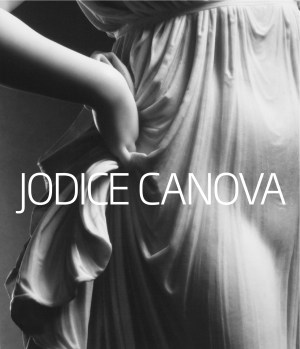 A disquiet expressed with a timeless vision. The decision to pay homage to Antonio Canova could not but start out of the encounter with the man who, back in 1992, had already understood his sculptures and captured their essence in images that have themselves become works of art. This man, this contemporary artist, could only be Mimmo Jodice. He is not only a photographer of art but a person with a keen gaze and vision who has decided to tackle perhaps the most complex sculptor of all time. Jodice chose to approach Canova with love and intellectual nobility and now, through a fascinating series of unprecedented details, is offering us a new, contemporary, conceptually lucid, authoritative, and captivating view of one of the greatest artists in history.
Giuliana Ericani was born in Trieste and graduated in Art History with Rodolfo Pallucchini at the University of Padua. She
is the director of the museums at Bassano del Grappa.
Book Discussion | Basile Baudez on Architecture et tradition académique
From the École Nationale des Chartes:
Basile Baudez on Architecture et tradition académique, with Katie Scott
École Nationale des Chartes, Paris, 29 March 2014
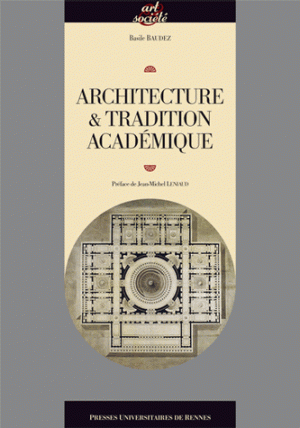 Basile Baudez, Architecture & tradition académique au temps des Lumières (Presses Universitaires de Rennes, 2013), 390 pages, ISBN: 978-2753521223, 24€.
Issu d’une thèse de doctorat soutenue à l’Éphé sous la direction de Jean-Michel Leniaud, cet ouvrage, constitue la première synthèse jamais publiée traitant des rapports entre l’architecture, les architectes et l’institution académique au XVIIIe siècle en Europe.
Adoptant une méthode comparatiste, ce livre permet d’interroger la pertinence d’un modèle élaboré dans l’Italie humaniste et transformé au XVIIe siècle pour servir la politique culturelle de Louis XIV. Le succès considérable de cette forme institutionnelle dans l’Europe des Lumières s’explique en grande partie par sa souplesse, à l’opposé de son évolution au XIXe siècle et sa capacité à organiser de manière efficace les rapports entre certains artistes, le pouvoir et le public.
Étudier l’histoire de l’architecture sous l’angle de la tradition académique, c’est mettre au jour la naissance de la profession architecturale telle qu’on la connait aujourd’hui. L’appartenance à une académie sanctionnée par le pouvoir politique permet en effet de définir les critères au nom desquels l’exercice de la profession était possible, d’une part, et la relation du milieu de l’architecture au pouvoir, d’autre part, la soif de reconnaissance et de protection à la fois.
L’auteur
Archiviste paléographe (prom. 2000), Basile Baudez est agrégé d’histoire, maître de conférences en histoire du patrimoine moderne et contemporain à l’Université Paris-Sorbonne et travaille sur l’histoire de l’architecture européenne au XVIIIe siècle ainsi que sur l’histoire des institutions artistiques.
Le discutant
Katie Scott travaille au Courtauld Institute of Art with et s’est spécialisée dans les représentations du quotidien en particulier à travers les arts éphémères. Sa récente étude est dédiée à ce sujet, plus particulièrement dans le Paris du XVIIIe siècle : Trade and the Ephemeral Everyday in Eighteenth-century Paris.
La conférence se déroulera à 17 h, en grande salle de cours de l’École nationale des chartes, au 19, rue de la Sorbonne (Paris Ve).

Call for Papers | CAA in New York 2015, Donald Posner Session
Here’s the description for the HECAA-sponsored, 90-minute session—chaired by Andria Derstine and Rena Hoisington—on the legacy of Donald Posner:
103rd Annual Conference of the College Art Association
New York, 11–14 February 2015
Proposals due by 9 May 2014
The 2015 Call for Participation for the 103rd Annual Conference, taking place February 11–14 in New York, describes many of next year’s sessions. CAA and the session chairs invite your participation: please follow the instructions in the booklet to submit a proposal for a paper or presentation. This publication also includes a call for Poster Session proposals.
◊ ◊ ◊ ◊ ◊
Donald Posner and the Study of Seventeenth- and Eighteenth-Century French and Italian Art
Andria Derstine, Allen Memorial Art Museum, Oberlin College; Rena M. Hoisington, Baltimore Museum of Art, Andria.Derstine@oberlin.edu and RHoisington@artbma.org
Donald Posner (1931–2005), the Ailsa Mellon Bruce Professor of Fine Arts at the Institute of Fine Arts, New York University, was one of a select group of art historians who, beginning in the 1950s and 1960s, significantly advanced scholarly inquiry into the Italian and French Baroque. From his first published article, on Le Brun’s Triumphs of Alexander series (1959), to his work on Annibale Carracci, Caravaggio, Domenichino, Lanfranco, Callot, and Poussin, his work helped to initiate and direct future research in the field. In the late 1960s and early 1970s, he began to turn his attention toward the eighteenth century—then a notably understudied area. His publications on Watteau, Fragonard, Boucher, Tiepolo, Rigaud, and Nattier set standards for art historical scholarship and greatly contributed to the burgeoning interest in this ‘new’ century. As wide-ranging as the topics he took up was his critical method, encompassing connoisseurship, patronage and collecting, iconography, stylistic issues, taste, and aesthetics, among others. Posner promoted and encouraged research and publication over the course of his long career, and served CAA as Editor-in-Chief of The Art Bulletin from 1968 to 1971 and as Chairman of The Art Bulletin Editorial Board from 1991 to 1994. Ten years after his death, this panel celebrates Posner’s rich legacy by inviting papers that take up particular areas of his field of inquiry and present new information, or that are stimulated by his scholarship and relate to his broad interests.
Descriptions for additional sessions are available here»
Huguenot Heritage Centre Scheduled to Open in 2015
The recipient of a £1.2m grant from the Heritage Lottery Fund, the French Hospital in Rochester, Kent is on schedule to open in 2015 the first museum dedicated to the history and legacy of the Huguenots in Great Britain.
From the project description:
The story so far
95 High Street, Rochester, Kent
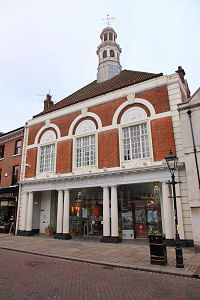 In 2010 the Directors (Trustees) of the 295-year-old Huguenot-founded French Hospital in Rochester High Street, were presented with a once-in-a-lifetime opportunity. This was afforded by Medway Council which gave them the opportunity to purchase the two storey building which would allow, not only an increase in the number of flats for people of Huguenot descent from 59 to 63, but also the establishment of the first Huguenot Heritage Centre in the UK.
The building stretches from the High Street to the line of the Roman Wall, from its fine, art deco-style rooms at the front through to more functional facilities. It also lies opposite and very close to the proposed, new railway station and within a very short walk of the Cathedral and Castle. This offer fulfilled the wish of the Directors to increase the number of almshouse flats, creating secure state-of-the-art facilities for the storage of Huguenot family archives, books and historical material of great significance, in an air-conditioned and temperature controlled environment. Importantly it also provides new spaces and an existing 96-seat theatre for creating the first ever museum and education centre covering the extraordinary role played by French Protestant immigrants to this country.
To take full advantage of the large number of visitors to Rochester, the French Hospital has leased back the ground floor to Medway Council for the next 20 years, so that it can continue to provide the existing Visitor Information Centre and café for its 320,000 visitors per annum.
The past and the future
Successful integration of immigrants into a community is a skill. There is much that can be learnt today to the country’s benefit from the practices and initiatives of both the Huguenot immigrants and their welcoming nation. The Huguenot Heritage Centre will be the first and only visitor centre in Britain focussed specifically on this sizeable immigrant population, demonstrating the positive benefits well-managed immigration can bring to Britain and providing a useful comparator with later influxes of immigrants. To achieve these aims a dedicated Huguenot Heritage Centre Committee is working on the plans for conversion of the building and the raising of the money to complete this exciting project.
The Huguenot Heritage Centre will provide
• A major focus and source of pride for those of Huguenot descent, with an important opportunity to learn about their heritage and, if desired, to have the opportunity to safeguard their artefacts and papers in the long-term.
• Greater accessibility to the collections and archives for the public, researchers and heritage professionals.
• An expansion of public knowledge about an important part of the history of modern Britain as well as the history of Huguenots and their descendants.
• An improved physical access and condition of display of precious heritage artefacts which will also be better conserved, as well as being digitised.
• Educational courses and research facilities, which will be available with the collections and archives for teachers, students, community groups and individuals. Subjects covered will include important elements of British history, genealogy, family history, immigration, persecution, tolerance and the skills and trades brought to Britain by the Huguenots; and the lessons which can be learnt from these.
• A new opportunity for personal development and growth through volunteering.
Four new flats for the French Hospital Almshouses
To satisfy the increasing need for additional sheltered accommodation for those of Huguenot descent and to reduce its waiting list of some 100 applicants for the French Hospital, four new flats will also be included in the conversion. These well insulated, lift accessible flats with good views across the River Medway and surrounding countryside, will be compliant with the Almshouse Association guidelines and contain a living room, two bedrooms, kitchen and a bathroom.
 A background profile of the French Hospital
The French Hospital, known by generations of residents as La Providence, was founded in London in 1718 as a charity, offering sanctuary to poor French Protestants or Huguenots as they are known. It has had several subsequent locations and currently maintains 59 self-contained, sheltered flats in the ancient Roman City of Rochester in Kent. On the same site, it owns a highly regarded collection of paintings, engravings, furniture, silverware, clocks, books, archival records and other items illustrating the culture and history of the Huguenots. However, the collection is neither readily accessible by the public, nor is it professionally displayed in a museum gallery setting.
Fundraising campaign
The total target for the campaign is approximately £5 million. . . The French Hospital is governed by a board of nearly 40 Directors (Trustees) including a Governor, Deputy Governor, Treasurer and Secretary. The Board has begun a fundraising campaign for the recent purchase of 95 High Street, the development of a Huguenot Heritage Centre and additional almshouse sheltered accommodation. For more information and how to fulfil these aims, please visit the French Hospital’s website or write to us:
The French Hospital
Charity number 219318
41 La Providence, Rochester
Kent ME1 1NB
Living the History of George Washington’s Tent
There were, for me, many stimulating offerings available at this year’s ASECS conference in Williamsburg, including a fine session on “Historical Reenactment,” sponsored by the Society of Early Americanists and chaired by Joy Howard. While I found all seven of the brief contributions thought-provoking (none more so than Michael Twitty’s presentation of his extraordinary work, including the Southern Discomfort Tour), Tyler Rudd Putman’s account of working as an intern on The First Oval Office Project during the summer of 2013 seemed perfectly suited to a posting here at Enfilade. I was thrilled he agreed. -CH

Living the History of George Washington’s Tent
T Y L E R R U D D P U T M AN
I spent the summer of 2013 dressed for work in the 1770s. As a historic trades intern working in costume in a workshop at Colonial Williamsburg, I was part of the First Oval Office Project, an initiative to recreate the sleeping tent, or marquee, used by George Washington during the American Revolution. Amazingly, this 22-foot-long oval tent still exists in the collection of the Museum of the American Revolution. Of thousands of tents made and used during the Revolution, only two survived to 2014; both belonged to Washington, saved for posterity.
Why would people spend years of research and months of sewing to make a big piece of canvas, especially when we already have the original? You can imagine what the old marquee is like after two centuries. It’s fragile. When the new Museum in Philadelphia installs it in Philadelphia in a new building about to begin construction, it will rest on a custom support system, so it doesn’t tear itself apart. But we wanted a tent that could travel, a tent that people could touch, a tent that people could walk into, look up at the ceiling inside, and wonder what it was like to be Washington during the Revolutionary War. Moreover, for all the hours experts have spent scrutinizing Washington’s marquee, there were still all sorts of mysteries we hoped to solve by making an exact copy. There were strange stitches, hints of repairs and adjustments, and other oddities we hoped to explain in the process of sewing a new tent, stitch by stitch, by hand (there were no sewing machines in the 1770s).
We also know almost nothing about the men and women who sewed Washington’s tent in 1777. They left few documentary traces, but recreating labor can help historians recapture lives. What was it like to sit ‘tailor fashion’, cross-legged atop a worktable, for a long day? Documents indicate that some women worked sewing tents during the Revolution as well. How was sewing work different for them? What does regular hand-sewing do to your hands?

The author at work sewing tent canvas.
◊ ◊ ◊ ◊ ◊
Experimental archaeology, or recreating an object or activity from the past to better understand the culture from which it emerged, is not time travel. I don’t know what it’s like to work a fourteen-hour day on a bread and small beer diet, in a body weathered from years of such labor, with an eighteenth-century mind. But I know how it hurts when you break a needle against your thumb, and I’ve felt the jubilation of finishing a hopelessly long seam. If you had been there this summer, you would have felt your back muscles tire and your posture change after only a day of sewing. You would have started to notice things. Linen lint floating in the air. The peculiar, miniscule catching when a steel needle has a small barb growing at its tip. How it’s possible to daydream and almost fall asleep amid the rhythmic motions of sewing a long seam. It’s in these microscopic moments that we connect with people long gone. No matter how much cultural baggage and time separates us, there’s something here we share with our long-ago predecessors.
We could have figured all this out in a warehouse somewhere. That certainly would have made our big experiment more efficient. But we wanted to make the tent in front of the public, so that the process of creation would both answer our questions and educate everyday people. To this end, the Museum of the American Revolution teamed with the Colonial Williamsburg Foundation and, in the summer and fall of 2013, operated a tentmaking shop in Williamsburg.
Washington’s tent was made in Reading, Pennsylvania, in 1777, but we know that artificers and other tradesmen who worked for the army sewed plenty of tents in Williamsburg during the Revolution, so operating such a shop in the city fit well with the Foundation’s interpretive goals. A crew of costumed tradesmen, including myself, spent five days a week sewing common tents used by ordinary soldiers, uniforms, knapsacks, and George Washington’s marquee. We didn’t pretend to be historical characters but instead spoke with visitors as ourselves. The costumes were just another one of our tools, allowing us to understand and discuss things like posture, cleanliness, and fashion from a contemporary viewpoint.
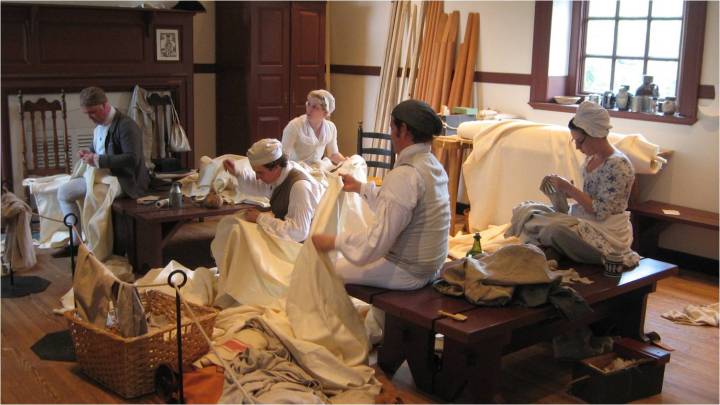
Tailor Mark Hutter and interns Aaron Walker, Nicole Rudolph, Michael Ramsey, and Gwendolyn Basala at work in the tentmaking shop.
◊ ◊ ◊ ◊ ◊
Over eight months, we answered a lot of our questions and came up with all sorts of new ones. We had an exceptional, interdisciplinary crew of sewers, including experts in historic trades, artists, students, and historians. Behind the scenes, we relied on curators, conservators, weavers, woodworkers, and social media workers to keep our project on track. These diverse viewpoints generated valuable insights. In the process, we had to answer persistent visitor questions. “Were these tents waterproof?” many people asked. We wondered that, too, and we were lucky enough to have a rainy summer in Williamsburg, giving everyone the opportunity to see how linen canvas resists even torrential rain, how tightly sewn seams hold up well, and how everything depends on good tent poles, tight ropes, and firmly planted stakes.
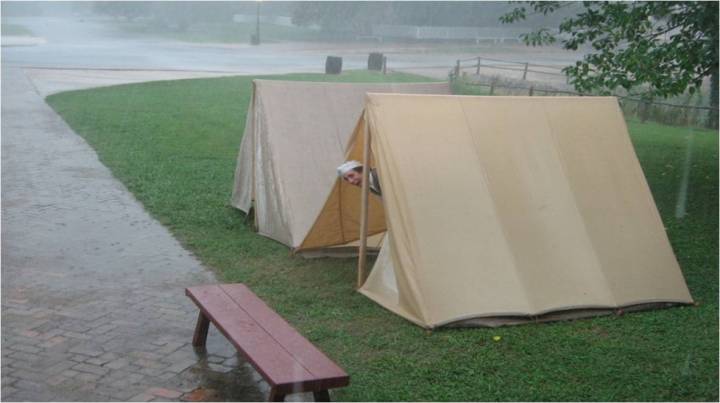
Intern Aaron Walker tests a common tent, home to six Revolutionary soldiers, in a Williamsburg rain.
◊ ◊ ◊ ◊ ◊
I would also argue that we gained at least as much from the public as they did from visiting our workshop. Public interpretation, after all, is just interdisciplinarity in another form. What better way to test explanations of Revolutionary War society and politics than to present them to a banker, an IT specialist, or a med student visiting Colonial Williamsburg? Do the arguments of historians such as Gordon Wood, David Waldstreicher, or Rosemarie Zagarri fly with the average American? This isn’t about dumbing-down information, it’s about translating it. That’s why it’s called interpretation. One of the best conversations I had all summer came after I had been explaining colonial labor and social hierarchy to a middle-aged man. “So,” he asked, pausing in thought, “When did America become a good country for poor people?” As we talked about changing standards of freedom, individual rights, and American ideologies, you could see his eyes light up as he thought about his world, America today, in new ways. Who would have thought you could get all the way there, starting with a tent?
A month ago, a user of the online reddit forum “Ask Historians,” posed this question:
Are there any merits to these ‘doing history’ acts? I’m not a fan of battle reenactments… I see them as telling us more about ourselves now than they do about the past and I think it’s a mistake (detrimental?) to use them as ways in which history/the past is taught to the public and to students.
Perhaps this is a fair criticism of living history. I’ve certainly seen my share of bad costumed interpretation at museums, like the sort of tours led by guides in vaguely historic costumes demonstrating ‘traditional’ activities and repeating tired clichés. But there are also places and people that get it right. Michael Twitty, a historian and interpreter of early African-American foodways, argues that his interpretation is the result of a conversation between historical sources and current practices. Likewise, George Washington’s marquee means different things to retirees, boy scouts, or Midwestern families. But good living history interpretation makes it relevant to each of them in a personalized way. I think the reddit question offers the justification for this sort of quality living history. When it’s well done, when it engages with academic questions as well as public audiences, living history does tell us at least as much about ourselves as about the past. When that works, it’s beautiful—as beautiful as a clean white tent, the work of many hands, sitting on a grassy patch at Colonial Williamsburg.

◊ ◊ ◊ ◊ ◊
Tyler Rudd Putman is a PhD student in the History of American Civilization Program in the Department of History at the University of Delaware. He thanks Scott Stephenson, Mark Hutter, Neal Hurst, Gwendolyn Basala, Jay Howlett, Michael McCarty, Samantha McCarty, Brendan Menz, Joseph Privott, Michael Ramsey, Nicole Rudolph, Aaron Walker, the Museum of the American Revolution, the Colonial Williamsburg Foundation, Nicole Belolan, Joy Howard, and the other members of the “Historical Reenactment, Living History, and Public History” panel at ASECS 2014.
Call for Papers | ‘Capability’ Brown: Perception and Response
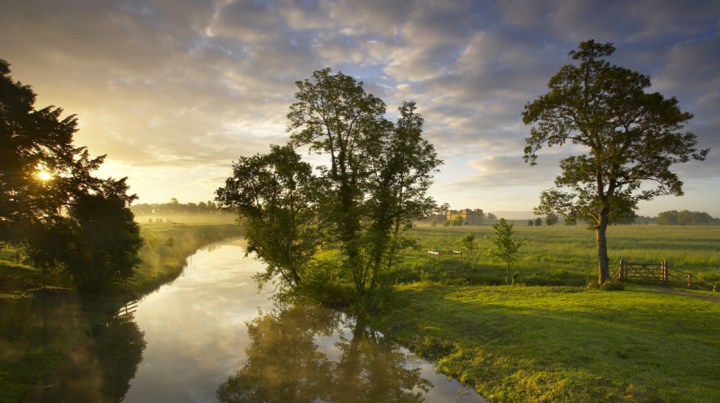
© National Trust Images / David Noton / Croome Park / Worcestershire
From the Capability Brown Tercentenary website
◊ ◊ ◊ ◊ ◊
From The Garden History Society:
‘Capability’ Brown: Perception and Response in a Global Context
University of Bath, 9–11 September 2016
Proposals due by 31 August 2014
An ICOMOS-UK International Conference in collaboration with the University of Bath, in association with the Garden History Society and the National Trust, and supported by the ICOMOS International Scientific Committee on Cultural Landscapes.
The landscape designer Lancelot ‘Capability’ Brown (1716–1783) changed the face of 18th-century England. Yet Brown left no written explanation of his work. Much must be inferred from his surviving landscapes and by seeing his work in the wider context of the naturalistic style that developed in Europe and in countries influenced by Europe. In 2016 the tercentenary of his birth is being celebrated as an opportunity to reflect on his life, work, style and significance.
This international conference, organised by the ICOMOS-UK Cultural Landscapes and Historic Gardens Committee in collaboration with the University of Bath, will be one of the major events in the Capability Brown Tercentenary year. Internationally renowned researchers and practitioners will present Brown’s work in a global context and explore the ways in which it has been interpreted over the last 250 years. The papers will be published in Garden History. With partners including the Garden History Society and the National Trust, this conference will be one of the highlights of the first-ever ‘Capability’ Brown Birthday and Festival, bringing together in a national campaign a huge range of events, openings, exhibitions and publications.
More information is available on the full Call for Papers»
Exhibition | Augustus the Strong’s Festival of the Planets

Johann Friedrich Wentzel, Elector Friedrich Augustus (II) of Saxony
and Archduchess Maria Josepha of Habsburg, 1719.
◊ ◊ ◊ ◊ ◊
From the Staatliche Kunstsammlungen Dresden:
Constellation Felix: Augustus the Strong’s Festival of the Planets and
Thomas Ruff’s Stellar Constellations
Neues Grünes Gewölbe and Residenzschloss, Dresden, 13 March — 9 June 2014
‘Constellation Felix’—a fortunate stellar constellation—is the motto of one of the most significant celebrations of the Baroque era: the 1719 Festivals of the Planets held by Augustus the Strong in Dresden. The king staged the event to mark the marriage of his son Frederick Augustus (II) to Archduchess Maria Josepha of Habsburg, a link on which he pinned the lofty hope of securing the Imperial crown for his royal house. For a whole month in the late summer, every day brought new attractions at various sites in the royal capital and its surroundings. One set of increasingly extravagant highlights were the festivals dedicated to the planets: fireworks for Apollo / Sol; jousting and foot tourneys for Mars, the god of war; Four Elements tilting games for Jupiter; a waterfowl hunt for Luna / Diana, the goddess of hunting; a Banquet of the Nations and fair for Mercury; jousting for ladies’ favours to honour Venus, the goddess of love; and finally a mine festival for Saturn.

Johann August Corvinus after Matthäus Daniel Pöppelmann (?), Fireworks on the Elbe at the Dutch Palace, 1719.
Since ancient times, all life on Earth had been seen as an integral part of a higher cosmic order, leading artists and creative minds to explore the topic of the planets. Our fascination with the stars and yearning for the endless depths of space has not left us today, as Thomas Ruff’s commanding large-format photographic works make tangibly clear. Like no other artist, he explores the limits of visual conceivability, or—to put it another way—the invisibility of the celestial bodies, a topic probed in his series Sterne, Cassini, and m.a.r.s.
In comparing the universal Baroque imagery and contemporary photography of celestial bodies, the exhibition reveals an anthropological constant: our
lingering excitement and awe at the secrets of space,
despite the Enlightenment and modern sciences










 Enfilade
leave a comment