Symposium | Freemasonry and the Visual Arts
From the symposium programme:
Freemasonry and the Visual Arts
Bibliothèque nationale de France, Paris, 26 May 2017
Co-chaired by Reva Wolf and Alisa Luxenberg
 The Freemasonry and the Visual Arts symposium is a program of the second World Conference on Fraternalism, Freemasonry, and History.
It brings together a series of original case studies to reveal the wide variety, international scope, social complexity, and fundamental historical significance of the intersections of Masonry and the arts from the eighteenth century forward.
Registration is free through this link.
14:00 Part 1: Freemasonry and the Exploration of Architecture
• David Martín López (University of Granada), Freemasonry in Eighteenth-Century Portugal and the Architectural Projects of the Marquis de Pombal
• Alisa Luxenberg (University of Georgia, Athens), Building Codes: New Light on f … baron Taylor and Les Voyages pittoresques et romantiques dans l’ancienne France
• Talinn Grigor (University of California, Davis), Reveil de l’Iran: Freemasonry and Artistic Revivalism from Parsi Bombay to Qajar Tehran
15:15 Coffee break
15:30 Part 2: Art, Freemasonry, and Social and Political Upheaval
• Cordula Bischoff (independent scholar), Meissen Porcelain and the Order of the Pug
• Reva Wolf (State University of New York at New Paltz), Goya’s Art and Freemasonry in Spain
• Katherine Marie Smith (New York University), Masonic Imagery in Haitian Vodou
16:45 Part 3: Transformations in the Art of Freemasonry in the United States
• Nan Wolverton (American Antiquarian Society), ‘Within the Compass of Good Citizens’: The Visual Arts of Freemasonry as Practiced by Paul Revere
• William D. Moore (Boston University), ‘To Consummate the Plan’: Solomon’s Temple in Masonic Art, Architecture, and Popular Culture, 1865–1930
• Cheryl Finley (Cornell University) and Deborah Willis (New York University), ‘A Change Is Gonna Come’: Imaging Black Freemasons from Emancipation to the 1960s
Conference | Heritage and Revolution: First as Tragedy, Then as Farce
From H-ArtHist, with more information available at the conference website:
Heritage and Revolution: First as Tragedy, Then as Farce
McDonald Institute for Archaeological Research, Cambridge, 6 May 2017
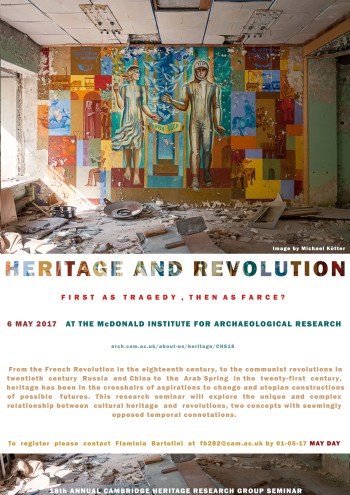 From the French Revolution in the eighteenth century, to the communist revolutions in twentieth-century Russia and China, to the Arab Spring in the twenty-first century, heritage has been in the cross-hairs of aspirations to change and utopian constructions of possible futures. This research seminar will explore the unique and complex relationship between cultural heritage and revolutions, two concepts with seemingly opposed temporal connotations.
9:00 Introduction
Chair: Mathilde LeLoup
Dominique Poulot – The French Revolution and the Democratization of Heritage: Or the Parallel Inventions of Vandalism and Heritage
9:30 Session 1: Revolutionary Vanguards in Retrospect
Chair: Tom Crowley
• Astrid Swenson – Out with the Old? The Role of Revolution in the Rise of Heritage
• Julie Deschepper – Between Past and Future: The ‘Heritage Revolution’ in Russia
• Heonik Kwon – Shrine for Displaced Spirits: A Heritage of the Vietnamese Revolution
• Tom Stammers – The Homeless Heritage of the French Revolution
11:00 Coffee break
11:20 Session 2: Building and Destroying Socialist Pasts
Chair: Margaret Comer
• Francesco Iacono – Counter-Revolution or Why It Is Impossible to Have a Heritage of Communism and What Can We Do about It
• Myroslava Hartmond – Where The Bodies Are Buried: A Comparative Study of Lenin Disposal in Post-Communist States
• Laura Demeter – Regime Change and Cultural Heritage Protection, a Matter of State Security
12:30 Artist Talk
• Martha McGuinn – authentic.obj
1:00 Lunch
2:00 Session 3: Materiality and Immateriality of Revolution
Chair: Marie Louise Stig Sørensen
• Lila Janik – Materiality of Praxis and Substance: A Tangible Witnesses to the Russian Revolution and the Subsequent Oppression
• John Carman – Anarchist Ambiguity: The Past and Creating a Free Society
• Michael Falser – From Maoist Revolution to the Mimicking of UNESCO’s Cold War Diplomacy: The Khmer Rouge and the (Un)Making of Angkor/Cambodia as Cultural Heritage, 1975–90
3:00 Session 4: Exhibition Revolution
Chair: Johanna Zetterstrom-Sharp
• Jennifer E. Altehenger – Industrial Chinoiserie: China’s Pavilion at the Leipzig Trade Fairs in the 1950s
• Flaminia Bartolini – Entertaining Italy with Propaganda: The Exhibition of the Fascist Revolution in Rome
4:15 Session 5: The Arab Spring: Reconciling Competing Visions
Chair: Dacia Viejo Rose
• Shadia Mahmoud – Museums and Cultural Heritage in Post-Revolution Egypt: Transformation and Transmission
• Dena Qaddumi – Confronting the Past for the sake of the Future: Cultural Heritage in Tunis
5:00 Discussion
5:30 Wine reception
7:00 Dinner
Call for Papers | The Histories of Loans
From H-ArtHist:
The Histories of Loans: Memories and Challenges of Museum Loans
Histoires de prêts, mémoire et enjeux des prêts dans les musées
École du Louvre, Paris, 28-29 September 2017
Proposals due by 5 June 2017
Since the end of the 19th century, the expansion of temporary exhibitions has determined the emergence of an international system for museums, based on the circulation of artworks and objects. For museums, sharing pieces from their collection has become crucial to ensure that they in turn get the loans they need to organise their own exhibitions. Lending artworks to prestigious institutions, particularly foreign ones, also enables curators to guarantee a heightened visibility to their own collections. Where to exhibit, how often, and which pieces can be obtained from which partners: nowadays, these are the fundamental criteria of a museum’s positioning within the international hierarchy of cultural heritage prestige. But loan policy does simply affect an institution’s image: it acts directly on the definition of the objects. The acceptation or refusal of a loan is the result of complex transactions, formulated or not, during which the value of an artwork is negotiated and reviewed. It also reflects the importance and rank of institutions, sometimes even of towns and nations. This international symposium intends to question the policy for loaning works of art, both from the angle of the mobility of museum artworks and objects, and that of the reconfigurations of their status. The aim of this colloquium will be to explore the ways in which, historically, loan procedure has defined itself to the point of becoming a crucial challenge for museums.
The economic, political and legal dimensions are also at the heart of this discussion. The suggested themes, which are not meant as limitations but as possible avenues for reflection, include the following:
• The History of loans
• The memory of loans
• The museographical constraints of loans
• Loans and restorations
• Loans as tools for art history
• The geopolitics of loans
• The temporality of loans
• The economy of loans
• The principle of free admission in museums and its exceptions
• Loans and their legal framework
• Notions of public and private in museum loans
The field of study for this symposium also covers the pre-history of loans (such as the translation of relics in the Middle Ages). Alongside artworks and objects, all artefacts are liable to be retained, as long as they shed more light on the theme. The very contemporary period acts as the opposite time limit for the symposium, and can be addressed from a historical viewpoint or as an anthropology of scholarly practices. While it is often difficult to distinguish both notions, the symposium will focus on the question of loans, excluding the question of long-term deposits, which has been studied specifically in the past few years.
Researchers who wish to take part in the symposium must send their paper proposals as well as a CV (one page) to the organisers (colloques@ecoledulouvre.fr) before Monday 5 June 2017. Proposals must be no longer than 2000 characters or 300 words and can be written in French, English, German, or Italian. The organisers will establish the definitive programme along with the members of the scientific committee. The final selection of participants will be announced on 15 June 2017.
Scientific Direction
François-René Martin, ENSBA et Ecole du Louvre
Michela Passini, CNRS (IHMC-ENS) et Ecole du Louvre
Neville Rowley, Staatliche Museen zu Berlin
Scientific Committee
Claire Barbillon, Université de Poitiers, Ecole du Louvre
Françoise Blanc, Ecole du Louvre
Cécilia Griener-Hurley, Ecole du Louvre et Université de Neuchâtel
Violaine Jeammet, Musée du Louvre et Ecole du Louvre
François-René Martin, ENSBA et Ecole du Louvre
Sophie Mouquin, Université Charles-de-Gaulle, Lille
Michela Passini, CNRS (IHMC-ENS) et Ecole du Louvre
Natacha Pernac, Ecole du Louvre et Université Paris-Nanterre
Neville Rowley, Staatliche Museen zu Berlin
Conference | Rococo in Scandinavia
From H-ArtHist (with an updated schedule available here). . .
Rococo in Scandinavia
Palais Thott, Copenhagen, 30 May 2017
Registration due by 29 May 2017
Organized by Corinne Thépaut-Cabasset
 Rococo in Scandinavia will explore the many ways in which the history of style affected the arts and the culture of Scandinavia over the course of the long eighteenth century by exploring the Rococo stream.
The past years in Copenhagen have shown an interest for rococo culture: the fashion exhibition Rokoko Mania was on view at the Designmuseum Denmark in 2012; Danish art historian Charlotte Christensen published the first monograph on Carl Gustaf Pilo, the most eminent eighteenth-century painter in Scandinavia, in 2016; and the Statens Museum for Kunst presented the exhibition William Hogarth: A Harlot’s Progress and Other Stories, also in 2016. These events demonstrate the potential for developing the topic in Denmark.
The study of the dissemination of Rococo in Scandinavia has never been addressed in a public forum. This is why and how the idea of having a conference in Copenhagen emerged and was developed and ought to happen in Scandinavia under the auspices of the French Embassy in Denmark. This conference will convene for the first time eighteenth-century experts from Denmark, Germany, Finland, France, Sweden, and America in a public forum about the Rococo in Scandinavia.
Participation is free, based on the number of available places, but registration is compulsory; please email Corinne Thépaut-Cabasset, ctc16@hum.ku.dk.
T U E S D A Y , 3 0 M A Y 2 0 1 7
13:30 Welcome by H. E. François Zimeray (French Ambassador in Denmark)
13:40 Charlotte Christensen (Former Curator at the Designmuseum, Denmark), Fatal Fires: How Copenhagen Lost Its Rococo
14:00 Jørgen Hein (Senior Curator at Rosenborg Palace, Denmark), Saved from the Fire and Sent to the Garden: Rococo from the First Christiansborg at Rosenborg
14:20 Merit Laine (Associate Professor, Department of Art History, Uppsala University, Sweden), Coexistence or Transition? Rococo and Classicism in Queen Louisa Ulrika’s Museum at Drottningholm
14:40 Pascal Bertrand (Professor of the History of Art, University of Bordeaux-Montaigne, France), The Color of the Rococo: French Tapestries after Oudry and Boucher in Scandinavia
15:00 Corinne Thepaut-Cabasset (Marie Sklodowska-Curie Research Fellow, SAXO Institute, University of Copenhagen), Fashioning the Rococo: Looking for a Rococo Wardrobe
15:20 Viveka Hansen (Independent Textile Historian, The IK Foundation, UK), Rococo and East India Influences at a Swedish Manor House in 1758
15:40 Michael Yonan (Associate Professor of Art History, University of Missouri, USA), Print Culture and the Dissemination of French Rococo Design in Eighteenth-Century Europe
16:00 Barbara Lasic (Professor of Art History, University of Buckingham, UK), ‘Une exquise expression artistique’: Spectacularising the Rococo at the 1935 Exhibition or Eighteenth-Century French Art in Copenhagen
16:20 Discussion
16:45 Piano Concert
17:00 Tour of the Palais Thott
W E D N E S D A Y , 3 1 M A Y 2 0 1 7
The conference will be followed by a tour on Wednesday of additional rococo spaces in Copenhagen (museums and palaces), concluding with a reception at Christian’s VIII palace in Amalienborg, at 4:00pm.
◊ ◊ ◊ ◊ ◊
Note (added 17 May 2017) — The original posting included Krista Vajanto (Researcher, Archaeologist, Aalto University, Finland) on the schedule, presenting a paper entiled, “Shipwrecks Findings: a Rococo Petticoat and Luxury Textiles from Sankt Mikael Shipwreck (1747).” Vivika Hansen’s paper has been added in its place.
New Book | ‘Het Pryeel van Zeeland’
From Uitgeverij Verloren:
Martin van den Broeke, ‘Het Pryeel van Zeeland’: Buitenplaatsen op Walcheren 1600–1820 (Hilversum: Uitgeverij Verloren, 2016), 516 pages, ISBN: 978 90870 45920, 49€.
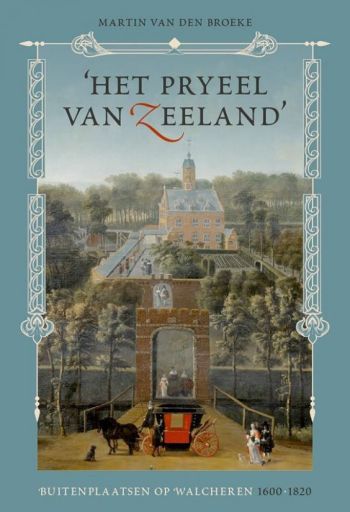 Buitenplaatsen bepaalden vroeger in sterke mate het landschap van Walcheren. Wat bewoog stedelingen in de zeventiende en achttiende eeuw om een deel van het jaar buiten de stad te gaan wonen? Een belangrijke reden was vermaak, maar welke rol speelde het economische aspect? En hoe toonden eigenaren van buitenplaatsen hun aanzien, macht en smaak? Martin van den Broeke laat zien dat al deze factoren in wisselende mate een rol speelden in het buitenleven en hoe dit door de eeuwen heen veranderde. Van den Broeke onderscheidt drie zones rond de steden waar verschillende typen buitenhuizen voorkomen. Nooit eerder zijn buitenplaatsen zo uitgebreid in hun landschappelijke en sociale omgeving beschreven. Dit boek geeft een rijk geschakeerd beeld van twee eeuwen buitenplaatscultuur in het ‘Het pryeel van Zeeland’, waarvan we de sporen nog zien in het landschap, in de archieven en op talrijke fraaie illustraties.
Met dit boek heeft Martin van den Broeke de Cultuurfondsprijs van de Historische Kring Walcheren gewonnen en de Ithakaprijs 2016 gewonnen. De Ithakaprijs is bedoeld ter stimulering van interdisciplinair (wetenschappelijk) onderzoek over Nederlandse kastelen, historische buitenplaatsen en landgoederen. Ook was zijn boek genomineerd voor de Zeeuwse Boekenprijs 2016.
C O N T E N T S
Woord vooraf
1 Inleiding
Buitenplaatsen als cultuurverschijnsel
Stand van het onderzoek
Begrippenkader
Afbakening van het onderzoek
Probleemstelling en onderzoeksvragen
Methoden en bronnen
2 Ontstaan, 1600–1670
Inleiding
Landschap
Functies
Macht
Aanzien
Architectuur
Conclusie
3 Expansie, 1670–1720
Inleiding
Landschap
Functies
Macht
Aanzien
Architectuur
Conclusie
4 Verfraaiing, 1720–1770
Inleiding
Landschap
Functies
Macht
Aanzien
Architectuur
Conclusie
5 Neergang, 1770–1820
Inleiding
Landschap
Functies
Macht
Aanzien
Architectuur
Conclusie
6 Slotbeschouwing
Het buitenplaatsenlandschap van Walcheren: langetermijn-ontwikkeling
Profijt en vermaak in drie zones
Macht
Aanzien
Vormgeving
Buitenplaatscultuur
Bijlagen
Afkortingen
Gebruikte bronnen en literatuur
Summary
Herkomst afbeeldingen
Register van buitenplaatsen
Register van namen en plaatsen
Curriculum vitae
Royal Museums Greenwich Rebrands

As Sarah Dawood writes for Design Week (18 April 2017) . . .
The Royal Museums Greenwich has new branding which aims to better represent all of its London museums, rather than focusing on those dedicated to the sea. The parent group encompasses sea and space exploration attractions, including the National Maritime Museum, historical ship the Cutty Sark, and planetarium the Royal Observatory, alongside 400-year-old art gallery the Queen’s House.
The previous brand was introduced in 2011.
The branding has been created by consultancies Jane Wentworth Associates (JWA) and Intro, with the first leading on strategy and the second on design. . . .
The new visual identity will be used by the museum parent group’s four attractions, with each one adopting the redesigned logo and replacing ‘Royal Museums Greenwich’ with its name. It features a sans-serif, all-caps logotype set in Talbot Type Karben typeface alongside a two-dimensional, line-drawn ‘G’ symbol, which aims to depict Greenwich and also symbolise different icons associated with the museums, says JWA.
The full article is available here»
Additional coverage by Patrick Burgoyne for Creative Review is available here»
Information on the previous brand is available here»
Conference | Imitation and Geographies of Art after Winckelmann
From H-ArtHist:
Under the Greek Sky: Imitation and Geographies of Art after Winckelmann
King’s College London, The Warburg Institute, The British Museum, London, 15–16 June 2017
2017 marks the 300th anniversary of the birth of the German classicist and art historian Johann Joachim Winckelmann, commonly regarded as the founding father of both archaeology and art history. Winckelmann’s writings heralded a revolution in approaches to the history of ancient art and culture, as well as contributing to the spread of neoclassical taste throughout Enlightenment Europe. This conference will re-evaluate Winckelmann’s legacy and his influence on art theory since the eighteenth century. The concept of imitation, central to Winckelmann’s theories and writings, proves to be a linchpin for modern ideas about the diffusion, appropriation, and musealization of art.
The first day of the conference will focus on the ‘culture’ of imitation. Winckelmann famously claimed, paradoxically, that one has to imitate Greece in order to become inimitable. From a range of historical and artistic perspectives, papers map the consequences this claim had for art’s theory, practice, and body politics since the eighteenth century.
The second day will discuss the ‘nature’ of imitation, and the consequences of the ecological boundaries set for it by Winckelmann. It will explore the implications of Winckelmann’s climate theory for neoclassical geographies of art and contemporary debates on aesthetic relativism in the age of nationalism.
The conference is free of charge. Pre-registration is required. Places are limited, in particular for The British Museum ‘Walking seminar’, and therefore admission can only be granted to those with booking confirmation.
The conference is organised by Katherine Harloe (Reading University), Hans Christian Hönes (The Warburg Institute / Bilderfahrzeuge Research Group), Daniel Orrells (King’s College London) and Sadie Pickup (Christie’s). Additional support has been provided by The British Museum, the Institute of Classical Studies, and Christie’s Education.
◊ ◊ ◊ ◊ ◊
T H U R S D A Y , 1 5 J U N E 2 0 1 7
King’s College London
13:00 Daniel Orrells (KCL) and Katherine Harloe (Reading), Introduction
13:15 William Fitzgerald (KCL), The Contour of Antiquity: Flaxman’s Iliad
14:00 Daniel Orrells (KCL), Visualising Antiquity in the Eighteenth Century
14:45 Coffee break
15:00 Kate Nichols (Birmingham), A Jewish Ajax in an Australian Gold Mining Town: Reforming the Classical Body in Late Victorian Visual Culture
16:00 Verity Platt (Cornell), Winckelmann’s Pharmacy: Description and the Phantasia of Restoration
16:45 Break
17:00 Whitney Davis (Berkeley), Imitation and Narcissism: Winckelmann under Psychoanalysis
18:00 Reception
F R I D A Y , 1 6 J U N E 20 1 7
The Warburg Institute / The British Museum
10:00 Hans Christian Hönes (BFZ), Introduction
10:15 Aris Sarafianos (Ioannina/Birkbeck), Convenient Misunderstandings: Meteocultural Models in Britain, 1755–1830
11:00 Coffee break
11:30 Natasha Eaton (UCL), The Sublimity of Decline: Winckelmann in India
12:15 Athena Leoussi (Reading), Beauty and the Sun: Aesthetics and Climate in the Making of the Modern European Nations
13:00 Lunch break
14:00 Mechthild Fend (UCL), Beauty in an ‘Unusual Guise’: On Colour and Adaptation
14:45 Richard Wrigley (Nottingham), Winckelmann and Rome: An Aerial Perspective
15:30 Coffee break
16:00 Pascal Griener (Neuchatel), Winckelmann and Jacob Burckhardt: The Life of Antique Statues in the Modern Museum
16:45 Closing remarks / Roundtable
17:45 Ian Jenkins (Senior Curator of Greek and Roman Antiquities), ‘Walking Seminar’ at The British Museum
20:00 Reception










 Enfilade
leave a comment